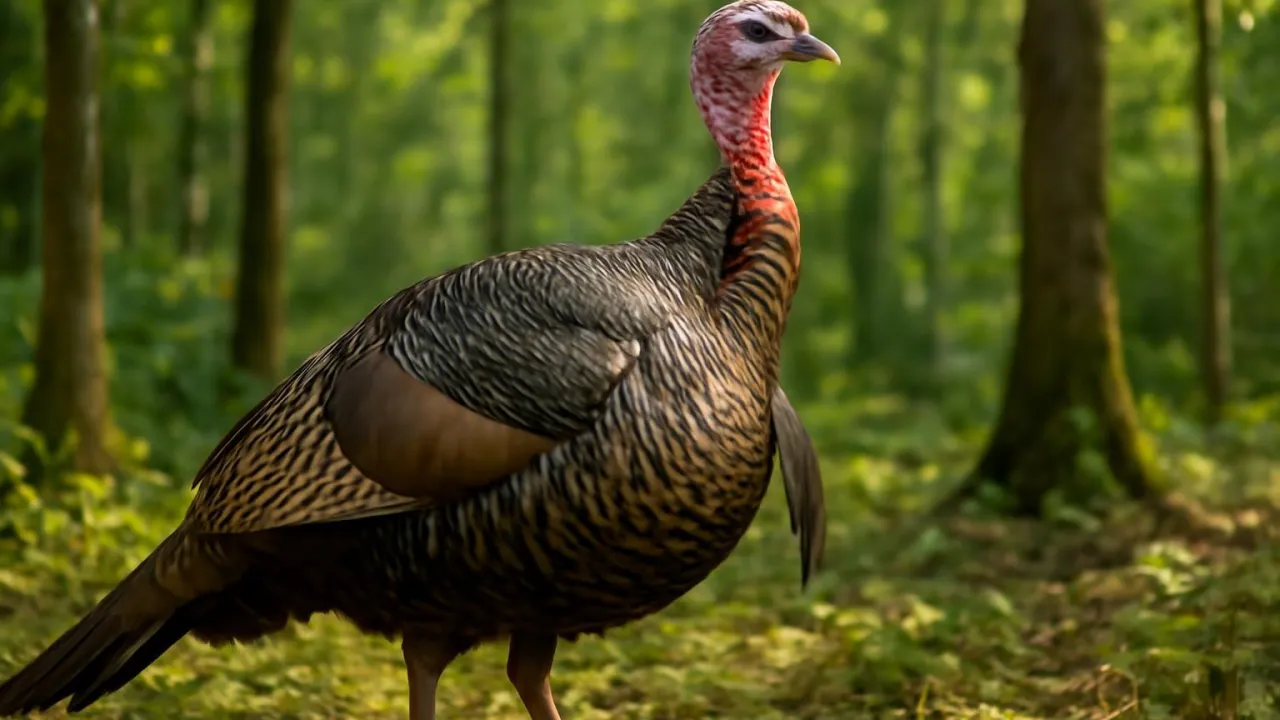
Wild turkeys can see nearly 360 degrees around their heads without moving!
✨ Word Sparks (Grade 2 Glossary)
Tap 🔊 to hear
poult
A baby turkey just after it hatches
gobble
A loud noise male turkeys make to talk
habitat
The place where animals live and grow
🪝
Have you ever heard a wild turkey gobble loudly in the forest?
1
Bright Feathers and Colors
Wild turkeys have shiny brown feathers that reflect sunlight. Their heads are red and blue. They use their feathers to show friends and scare enemies.
2
Where They Live and Grow
Wild turkeys live in forests and open fields in North America. Baby turkeys, called , grow quickly after hatching. They stay with their mother to learn how to find food.
3
Gobbling and Walking
Male turkeys loudly to attract females and warn others. They walk on the ground to find seeds, insects, and berries. Turkeys can fly short distances to escape danger.
Wild turkeys have nearly 360-degree vision, letting them watch for danger all around.
✨ Word Sparks (Grade 3 Glossary)
Tap 🔊 to hear
camouflage
Colors that help animals hide in nature
poult
A baby turkey that just hatched
predator
An animal that hunts other animals for food
🪝
Did you know wild turkeys use their feathers for camouflage and communication?
1
Feathers Help Wild Turkeys Survive
Wild turkeys have feathers that blend with forest colors to hide from . Their feathers also shine with colors to attract mates during breeding season. This helps them stay safe in the wild.
2
Life Cycle and Growth Stages
Wild turkeys start as eggs laid in hidden nests on the ground. After hatching, baby turkeys called grow quickly and learn to find food. They eat seeds, insects, and small reptiles to gain nutrients needed for survival.
3
Gobbling and Communication
Male turkeys use gobbling sounds to communicate with others and warn of danger. Their loud calls can be heard far away in forests. This helps them protect their territory and find mates during mating season.
4
Adaptations for Movement and Safety
Wild turkeys have strong legs for running fast to escape . They can also fly short distances to reach tree branches for safety. Their sharp eyesight helps spot danger early, improving their chances of survival.
Wild turkeys can run up to 20 miles per hour and fly short distances at speeds near 55 miles per hour.
✨ Word Sparks (Grade 4 Glossary)
Tap 🔊 to hear
ecosystem
A community of plants and animals living together
territory
An area an animal protects from others
conservation
Protecting animals and nature from harm
🪝
How do wild turkeys’ feathers and calls affect their role in forest ecosystems?
1
Feathers and Ecosystem Survival
Wild turkeys’ feathers provide excellent camouflage that helps them avoid predators in dense forest . Their colorful displays during mating season influence reproductive success and population growth. This balance affects the food web by controlling insect and seed populations, which helps maintain forest health.
2
Communication and Territory
Male turkeys use loud gobbling calls to establish and attract mates, which affects social structures within their groups. These calls also warn others of nearby predators, promoting group safety and cooperation. Their communication plays a key role in maintaining healthy turkey populations and balance.
3
Geographic Range and Habitat
Wild turkeys are native to North America and thrive in mixed forests, grasslands, and swamps across many states and provinces. Human activities like farming and efforts have expanded their habitats and population numbers. They adapt well to various environments, showing flexibility in their survival strategies.
4
Impact on Humans and Agriculture
Wild turkeys influence agriculture by eating insects that can harm crops, benefiting farmers and reducing pesticide use. However, they sometimes feed on seeds and young plants, which can cause minor crop damage in some areas. programs balance turkey populations to protect both wildlife and farming interests effectively.
Wild turkeys can fly at speeds up to 55 miles per hour, faster than many small airplanes take off.
✨ Word Sparks (Grade 5 Glossary)
Tap 🔊 to hear
taxonomy
The science of naming and grouping living things
physiology
How an animal’s body works and moves
conservation
Efforts to protect animals and their homes
🪝
What fascinating adaptations make the wild turkey a successful species across North America?
1
Taxonomy and Scientific Classification
The wild turkey, scientifically named Meleagris gallopavo, belongs to the family Phasianidae, which includes pheasants and grouse. It is one of the largest native birds in North America and has several subspecies adapted to different regions. Its evolutionary history traces back millions of years, showing complex relationships with other ground-dwelling birds.
2
Physiological Adaptations and Mechanics
Wild turkeys possess powerful legs enabling running speeds up to 20 miles per hour and short bursts of flight reaching 55 miles per hour. Their feathers provide both camouflage and display functions, with iridescent colors created by microscopic structures. Their eyes are positioned to allow nearly 360-degree vision, critical for predator detection in complex habitats.
3
Conservation History and Human Impact
Once severely hunted and habitat-restricted, wild turkey populations declined dramatically by the early 20th century. efforts including habitat restoration and regulated hunting have successfully increased their numbers. Today, wild turkeys are a conservation success story, illustrating the importance of human stewardship in wildlife management.
4
Ecological Role and Food Web Dynamics
Wild turkeys play a vital role in controlling insect populations and dispersing seeds, influencing forest regeneration and health. Their foraging behavior affects soil nutrient cycling, and they serve as prey for predators such as coyotes and bobcats. This interconnectedness highlights their integral position within North American ecosystems.
5
Quantitative Comparisons and Interesting Metrics
Adult wild turkeys typically weigh between 11 and 24 pounds (5 to 11 kilograms), with males generally larger than females. Their wingspan can reach up to 4.9 feet (1.5 meters). They can detect predators from over 100 meters away and use their loud gobbles to communicate across distances exceeding 1 kilometer.