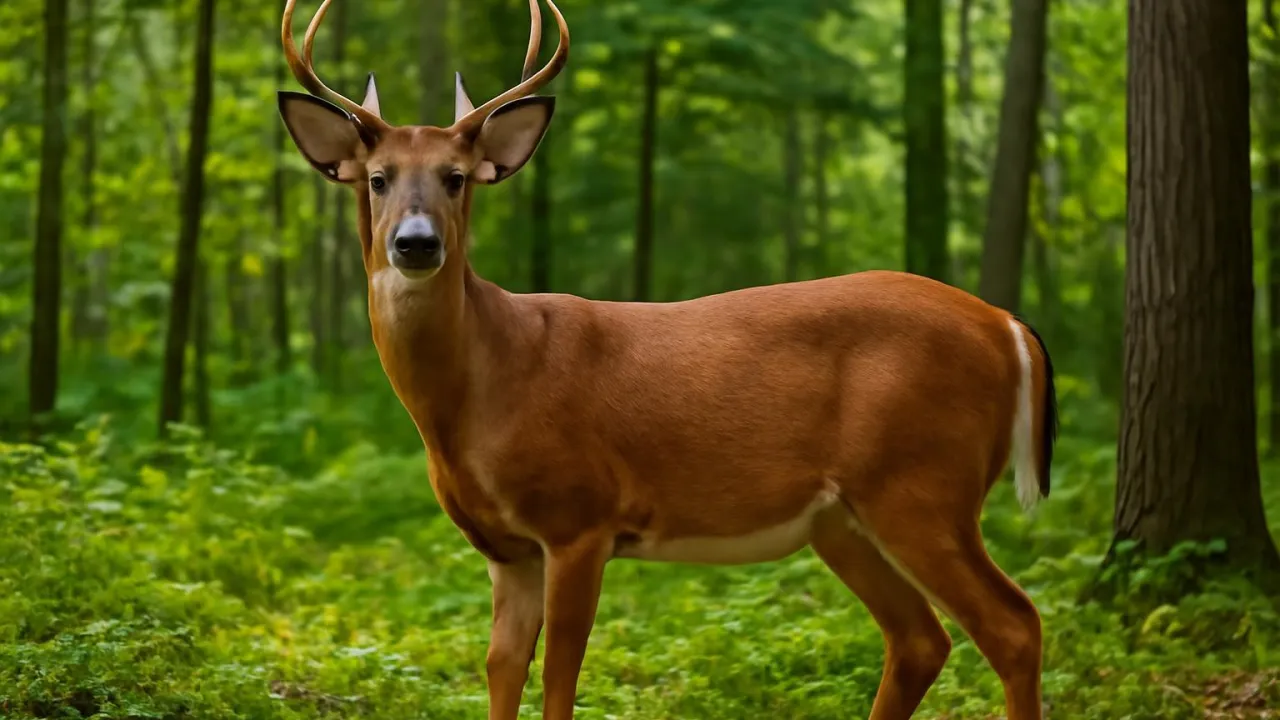
White-tailed deer can run up to 30 miles per hour to escape danger!
✨ Word Sparks (Grade 2 Glossary)
Tap 🔊 to hear
predator
An animal that hunts other animals for food
habitat
The natural home where an animal lives
twigs
Small thin branches from trees or bushes
🪝
Have you ever seen a deer flash its white tail to say, “Watch out!”?
1
Tail Signals Danger
The white-tailed deer raises its white tail high when it senses danger. This flash warns other deer nearby to run quickly. The tail’s bright color helps them stay safe in forests and fields.
2
Where They Live and Eat
White-tailed deer live in many places like forests, fields, and even near farms. They eat leaves, , fruits, and nuts from plants. They need clean water from streams or ponds to drink every day.
3
How They Move and Stay Safe
These deer can run very fast and jump over fences or logs. Their strong legs help them escape like wolves or coyotes. Their sharp ears listen carefully for sounds of danger nearby.
A white-tailed deer’s tail flash is a clever survival adaptation in the wild.
✨ Word Sparks (Grade 3 Glossary)
Tap 🔊 to hear
camouflage
Colors that help animals hide in nature
herbivore
An animal that only eats plants
adaptation
A body change that helps survival
🪝
Did you know white-tailed deer use their tail as a secret warning signal?
1
Tail as a Warning Signal
White-tailed deer flash their bright white tails to warn others of nearby predators. This form of communication helps the herd stay safe from danger. The tail’s color contrasts with their brown fur, making it easy to see. This is an important for survival in dense forests.
2
Habitat and Diet
These deer live in forests, grasslands, and even suburban areas across North and Central America. They are , feeding on leaves, twigs, fruits, and nuts. Their diet provides essential nutrients needed for growth and energy. They also play a role in seed dispersal by eating fruits.
3
Movement and Defense
White-tailed deer can run up to 30 miles per hour to escape predators like wolves and coyotes. Their strong legs allow them to jump over fences and obstacles easily. helps them blend into their environment to avoid being seen. Sharp hearing and keen eyesight alert them to danger early.
4
Life Cycle and Adaptations
Fawns are born in spring with white spots for from predators. As they grow, they lose their spots and develop adult brown coats. Bucks grow antlers each year to compete for mates during breeding season. These antlers fall off and regrow annually as part of their life cycle.
White-tailed deer help shape forests by eating plants and spreading seeds far and wide.
✨ Word Sparks (Grade 4 Glossary)
Tap 🔊 to hear
ecosystem
A community of plants and animals living together
predator
An animal that hunts other animals for food
conservation
Protecting animals and their homes
🪝
How does the white-tailed deer’s tail help it survive in many habitats?
1
Tail Signals and Survival
The white-tailed deer’s tail flashes bright white to warn others of nearby , triggering a quick escape response. This cause-and-effect communication helps protect the herd from wolves, coyotes, and humans alike. The tail’s visibility in dense forests increases the chance of survival for the group and alerts them to danger early.
2
Ecosystem Role and Food Web
White-tailed deer play an important role in their by eating plants and dispersing seeds through their droppings, which helps new plants grow. They serve as prey for many , making them a key part of the food web. Their browsing affects plant growth and forest regeneration, showing their influence on habitat health and biodiversity.
3
Geographic Range and Habitat
These deer are found throughout much of North and Central America, from Canada to Central America. They adapt to various habitats including forests, grasslands, and suburban areas near humans. Human development sometimes reduces their habitat, but deer often thrive near farms and parks where food is plentiful and shelter is available.
4
Human Impact and Conservation
Hunting and habitat loss affect white-tailed deer populations, but efforts help maintain healthy numbers. Wildlife management includes regulated hunting and habitat restoration to balance deer numbers with health. Educating people about deer helps reduce vehicle collisions and protects both humans and deer in shared environments.
1. What happens when a white-tailed deer flashes its tail?
2. How do humans help conserve white-tailed deer?
🤯 Mind-Blowing Fact • Grade 5
White-tailed deer can run as fast as a car driving in a city, up to 30 miles per hour!
✨ Word Sparks (Grade 5 Glossary)
Tap 🔊 to hear
taxonomy
How scientists group and name living things
physiology
How an animal’s body works and moves
ecosystem
A natural community of plants and animals
🪝
What scientific secrets make the white-tailed deer a master of survival across the Americas?
1
Taxonomy and Scientific Classification
The white-tailed deer, scientifically named Odocoileus virginianus, belongs to the Cervidae family, which includes all deer species. This species is one of the most widespread mammals in North and Central America. Its genus name means 'hollow tooth,' describing its unique dental structure. Understanding its helps scientists study its evolutionary history and relationships.
2
Physiological Mechanics and Adaptations
White-tailed deer have powerful leg muscles that enable rapid acceleration up to 30 miles per hour and high jumps over obstacles. Their tail contains white hairs that reflect light, creating a flashing signal visible to other deer. Keen senses of smell, hearing, and vision allow early predator detection. Seasonal coat changes provide camouflage suited to summer and winter environments.
3
Conservation History and Human Interaction
Historically, overhunting and habitat destruction reduced white-tailed deer populations severely by the early 1900s. Conservation laws, regulated hunting, and habitat restoration have allowed populations to rebound successfully. Today, deer are common in suburban areas, sometimes causing conflicts with humans. Wildlife managers balance deer numbers to protect and reduce vehicle collisions.
4
Ecological Role and Food Web Dynamics
White-tailed deer serve as both herbivores and prey within diverse , influencing plant community composition through selective browsing. They disperse seeds from consumed fruits, aiding forest regeneration. Predators like wolves, mountain lions, and coyotes rely on deer as a food source, maintaining balanced food webs. Their population fluctuations can significantly impact ecosystem health.
5
Quantitative Comparisons and Habitat Range
Adult white-tailed deer typically weigh between 100 and 300 pounds (45 to 136 kilograms) and stand about 3 feet tall at the shoulder. They inhabit environments ranging from sea level to mountainous regions over 10,000 feet (3,048 meters). Their running speed rivals that of many predators, reaching 30 miles per hour (48 kilometers per hour). These adaptations enable survival across varied climates and terrains.