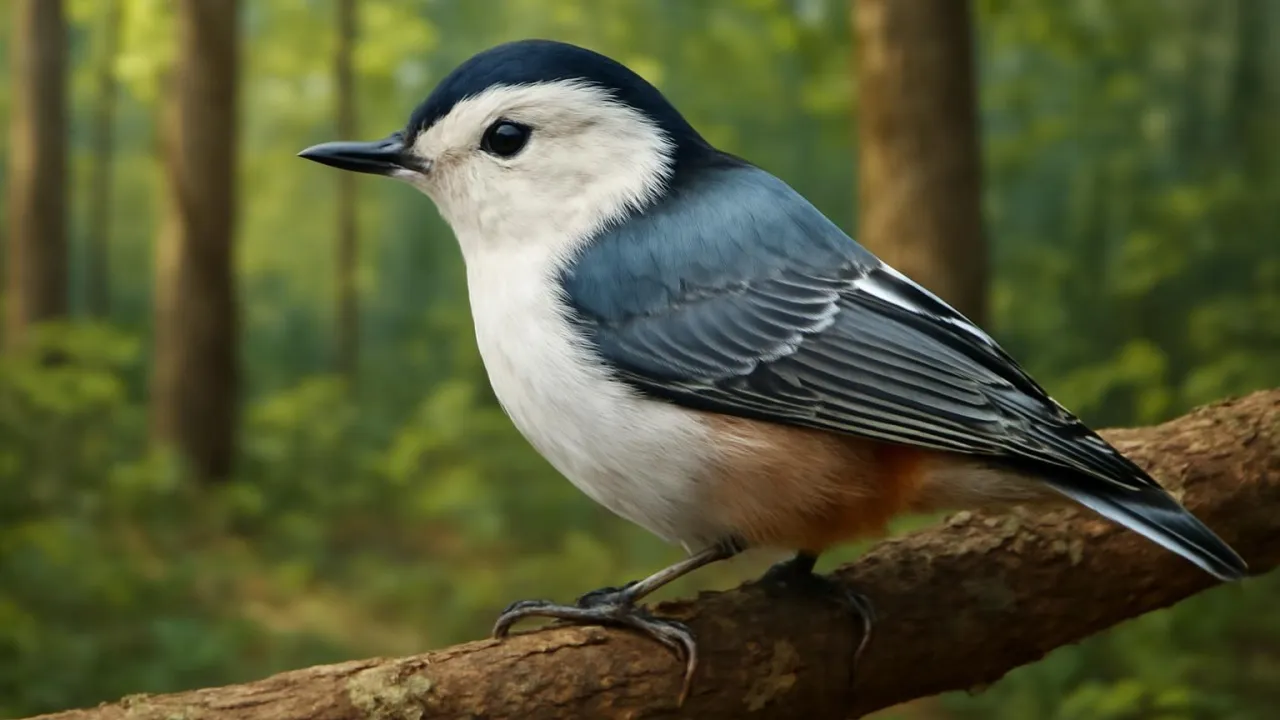
White-breasted nuthatches can climb down trees headfirst, unlike most birds!
✨ Word Sparks (Grade 2 Glossary)
Tap 🔊 to hear
nuthatch
A small bird that climbs tree trunks
insects
Tiny animals with six legs and wings
forest
A large area filled with many trees
🪝
Have you ever seen a bird climb down a tree headfirst?
1
How It Looks
The white-breasted has a white chest and a black cap on its head. It is small and strong, about five inches long. Its wings are gray-blue, and it has a short tail.
2
Where It Lives
This bird lives in with many tall trees across North America. It likes to move quickly up and down tree trunks searching for food. It often visits bird feeders in winter to eat seeds.
3
What It Eats
The eats , seeds, and nuts that it finds on tree bark. It uses its sharp beak to crack open nuts and hide them for later. It helps trees by eating insects that might harm them.
White-breasted nuthatches can climb down trees headfirst using their strong claws and short tails for balance.
✨ Word Sparks (Grade 3 Glossary)
Tap 🔊 to hear
camouflage
Colors that help animals hide in nature
nutrients
Food parts that help animals grow strong
predator
An animal that hunts other animals
🪝
Why can the white-breasted nuthatch climb down trees headfirst so easily?
1
Appearance and Adaptations
The white-breasted nuthatch has a strong body and sharp claws that help it grip tree bark tightly. Its short tail acts like a prop as it moves vertically. The bird’s black cap and white breast help it blend into tree shadows. This protects it from .
2
Habitat and Behavior
It lives mostly in deciduous and mixed forests across North America. The nuthatch is known for its unique ability to climb down trees headfirst, unlike most birds. This skill helps it find hidden insects under bark that other birds miss. It often stores seeds and nuts in tree crevices for winter food.
3
Diet and Survival
Its diet includes insects, seeds, and nuts, which provide essential . The nuthatch uses its strong beak to crack open tough seed shells. By eating insects, it helps control forest pests, playing an important role in its ecosystem. Its caching behavior ensures food availability during scarce times.
4
Communication and Nesting
White-breasted nuthatches communicate with nasal calls that sound like 'yank-yank.' They nest in tree cavities, often old woodpecker holes. Both parents help feed the young birds until they can fly. This teamwork increases the survival chances of their chicks.
1. What helps the nuthatch climb down trees easily?
2. Why does the nuthatch store seeds and nuts?
🤯 Mind-Blowing Fact • Grade 4
White-breasted nuthatches help forests grow by spreading seeds while searching for food under bark.
✨ Word Sparks (Grade 4 Glossary)
Tap 🔊 to hear
ecosystem
A community of plants and animals living together
dispersal
The spreading of seeds or animals to new places
cavity
A hollow space inside a tree used as a nest
🪝
How does the white-breasted nuthatch's unique climbing ability affect forest ecosystems?
1
Physical Adaptations and Movement
The white-breasted nuthatch has powerful claws and a short tail that work together to help it climb down trees headfirst with ease. This unusual movement allows it to find insects hidden beneath bark that other birds cannot reach. Its black and white coloring provides excellent camouflage against tree trunks, helping it avoid predators.
2
Role in the Ecosystem
By feeding on insects, seeds, and nuts, the nuthatch helps control insect populations that might damage trees. Its habit of hiding seeds in bark crevices aids in seed , which supports forest growth. This bird is a key player in forest food webs, linking insects and larger predators.
3
Habitat and Geographic Range
White-breasted nuthatches inhabit deciduous and mixed forests across much of North America, from Canada to Mexico. They prefer mature forests with plenty of old trees that provide nesting cavities. Human activity like logging can reduce their habitat, but they often adapt to suburban areas with bird feeders.
4
Nesting and Reproduction
These birds nest in tree cavities, often using abandoned woodpecker holes, which protects their eggs from many predators. Both parents share responsibilities of incubating eggs and feeding hatchlings, which increases the survival rate of their young. Their vocal calls help maintain territory and attract mates during breeding season.
1. How does the nuthatch's climbing help the forest?
2. Where do white-breasted nuthatches usually nest?
🤯 Mind-Blowing Fact • Grade 5
White-breasted nuthatches rotate their feet backward to climb down trees headfirst, a rare skill among birds.
✨ Word Sparks (Grade 5 Glossary)
Tap 🔊 to hear
taxonomy
How scientists group living things by traits
physiology
How a living thing’s body works
monogamous
Having one mate at a time
🪝
What makes the white-breasted nuthatch a fascinating subject for studying avian adaptation and forest ecology?
1
Taxonomy and Scientific Classification
The white-breasted nuthatch belongs to the family Sittidae and the genus Sitta, with the scientific name Sitta carolinensis. It is one of about twenty species of nuthatches worldwide, primarily found in temperate forests. This species is distinguished by its white breast, black crown, and blue-gray upperparts. Its classification reflects evolutionary adaptations for climbing and foraging on tree bark.
2
Physiological Mechanics of Climbing
This bird’s unique ability to climb down trees headfirst is enabled by its strong, curved claws and flexible ankle joints that can rotate backward. Its short tail provides balance without acting as a prop, unlike woodpeckers. The powerful beak is adapted to pry bark and extract insects or crack seeds. These features combine to make it an efficient bark forager and seed disperser.
3
Ecological Role and Conservation
White-breasted nuthatches play a vital role in controlling insect populations, thus protecting trees from pests. Their seed caching behavior contributes to forest regeneration by aiding seed dispersal. Although not currently endangered, habitat loss from deforestation and urbanization poses risks. Conservation efforts include preserving mature forests and promoting native plant growth to support their food sources.
4
Behavioral Ecology and Reproduction
These birds exhibit pair bonds with both parents sharing incubation and chick feeding duties. Nesting in tree cavities, often abandoned by woodpeckers, provides protection from predators. Vocal communication includes nasal calls used for territory defense and mate attraction. Their breeding success depends on habitat quality and food availability.
5
Quantitative Comparisons and Interesting Metrics
The white-breasted nuthatch measures approximately 5 inches (13 cm) in length and weighs about 20 grams. It can forage at speeds of up to 10 feet per minute while climbing tree trunks. Their calls have a frequency range of 2 to 5 kHz, audible to many forest animals. They inhabit regions with temperatures ranging from -30°F (-34°C) in winter to 90°F (32°C) in summer.