🧬 HUMAN BODY
🧬 Leukocytes • Immune & Circulatory Systems
VA Science & Health SOL 1.1, 3.1, 4.2, 5.1 (Cells, Organs & Body Systems)
White Blood Cells
Microscopic Bodyguards Patrolling Every Drop of Blood
Grade 5 • Advanced • 249 words
🩺 Body System & LocationImmune & Circulatory Systems • Born in bone marrow, patrolling blood and tissues
🔬 Size / Cell Count7–20 micrometers wide • 4,500 to 11,000 cells per microliter of blood
⚙️ Core JobHunts down invading germs, clears cellular debris, and remembers past infections
⚡ Body SuperpowerSqueezes right through solid blood vessel walls to chase germs by following chemical scent trails
🤯 Mind-Blowing Fact • Grade 1
One single drop of your blood holds thousands of white blood cell bodyguards on patrol!
✨ Word Sparks (Grade 1 Glossary)
Tap 🔊 to hear
Germ
A tiny living thing that can cause sickness
Patrol
To travel around watching carefully for any trouble
Defend
To protect someone or something from getting hurt
🪝
Who fights off sneaky germs when you catch a cold?
1
Tiny Bodyguards Inside You
Imagine tiny heroes swimming through your blood right now! We call them white blood cells. They your body day and night to keep you healthy and strong.
2
Chasing Away Germs
Sometimes sneaky slip inside a scrape or your nose. White blood cells rush to the spot fast! Some gobble the germs right up like hungry little blobs.
3
Smart Memory Helpers
Other white blood cells remember what each looks like. Next time that germ visits, your bodyguards stop it before you even feel sick!
1. What is the main job of white blood cells in your body?
2. Why is it helpful when white blood cells remember an old germ?
🤯 Mind-Blowing Fact • Grade 2
White blood cells make up only about one percent of your blood, yet that tiny fraction protects your entire body!
✨ Word Sparks (Grade 2 Glossary)
Tap 🔊 to hear
Antibody
A special protein tag that sticks onto germs
Vessel
A small tube that carries blood through you
Immune
Protected safely against catching a certain sickness
🪝
How can a blood cell crawl out of a blood tube like a shape-shifting superhero?
1
Born Inside Your Bones
Deep inside the spongy center of your bones, a busy factory works around the clock. That bone marrow builds millions of fresh white blood cells every day. Although red blood cells outnumber them, white blood cells are larger and act as brave defenders.
2
Shape-Shifting Trackers
Red blood cells stay inside blood tubes, but white blood cells can flatten out and squeeze through tiny gaps in walls! They crawl straight into skin or muscles by sniffing out invisible chemical trails left behind by germs.
3
Different Jobs on the Team
Not every defender works the same way. Big eaters wrap around germs to swallow them whole, while clever scout cells make Y-shaped tags called antibodies to lock invaders down.
1. Where are fresh white blood cells built inside your body?
2. How do white blood cells reach germs hiding outside a blood vessel?
🤯 Mind-Blowing Fact • Grade 3
Your bone marrow manufactures roughly 100 billion new white blood cells every single day just to keep your patrol squads fresh!
✨ Word Sparks (Grade 3 Glossary)
Tap 🔊 to hear
Leukocyte
The scientific name for any white blood cell
Phagocytosis
When a defender cell wraps around and eats germs
Lymphocyte
A smart white cell that remembers specific germs
🪝
Why does your doctor check your white blood cell count when you have a fever?
1
Meet the Leukocyte Squad
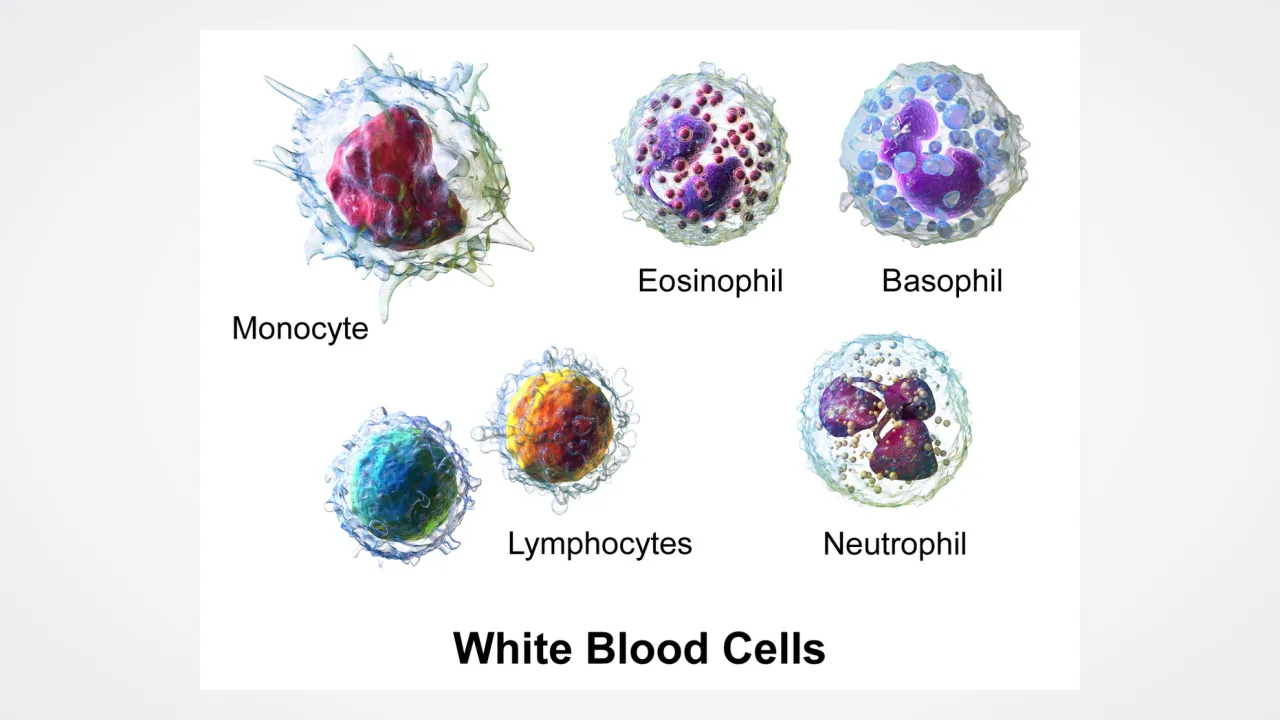
Peer through a powerful hospital microscope at a stained drop of blood, and among hundreds of small red discs you will spot larger, ruffled spheres. Scientists call them , from Greek words meaning 'white cells.' Instead of working alone, leukocytes form an organized immune squad with five specialized cell types.
2
First Responders on the Scene
Suppose a rose thorn pokes your finger and lets bacteria sneak under your skin. Injured skin cells immediately broadcast chemical alarm signals. Within minutes, fast-moving called neutrophils and macrophages squeeze out of nearby capillaries and surround the bacteria, engulfing and digesting them in a process called .
3
Sharpshooters and Memory Banks
Meanwhile, another team called studies the invader's outer coat. B-cells manufacture custom antibodies that fit that exact germ like a key in a lock, while T-cells coordinate the cleanup.
4
Clues in a Blood Test
When you battle an infection, bone marrow ramps up production, temporarily doubling your count—giving doctors a clear clue that your immune squad is hard at work!
1. What does the process called phagocytosis allow certain white blood cells to do?
2. Why might a person's white blood cell count rise higher than usual during a sickness?
🤯 Mind-Blowing Fact • Grade 4
A single activated plasma B-cell can fire off up to 2,000 custom-fitted antibody molecules every single second!
✨ Word Sparks (Grade 4 Glossary)
Tap 🔊 to hear
Antigen
An unfamiliar surface marker found on invading germs
Chemotaxis
Steering toward a trail of invisible chemical signals
Diapedesis
Squeezing cleanly through a blood vessel's tight wall
🪝
How do white blood cells tell the difference between trillions of friendly body cells and one disguised virus?
1
Reading Molecular ID Badges
Picture a bustling city of thirty trillion citizens where security guards must check identification badges in milliseconds without making mistakes. Every healthy cell in your body displays special protein badges on its outer membrane that announce, 'I belong here!' Patrolling leukocytes constantly brush against these surfaces, ignoring friendly cells while instantly flagging foreign bacteria, viruses, fungi, or damaged tissue carrying unfamiliar markers called .
2
Two Layers of Defense
Your leukocyte army operates in two coordinated waves. Innate defenders—including rapid-response neutrophils, giant scavenging macrophages, and eosinophils—charge into action within minutes of any breach. Using , they steer toward rising concentrations of distress chemicals, rolling along blood vessel linings before slipping through microscopic junctions in a feat known as .
3
Training the Adaptive Specialists
While innate cells hold the front line, dendritic cells carry fragments of captured germs to lymph nodes in your neck and armpits. There, adaptive lymphocytes take over: helper T-cells direct strategy, B-cells release thousands of precision antibodies per second, and memory lymphocytes store the blueprint for decades.
4
How Vaccines Coach Your Cells
Vaccines take advantage of this exact memory system! By introducing a harmless piece or blueprint of a germ, vaccines let lymphocytes practice building antibodies safely so real germs never stand a chance.
1. How do patrolling leukocytes avoid attacking your own healthy body cells?
2. How does a vaccine prepare your white blood cells before you ever meet a real germ?
🤯 Mind-Blowing Fact • Grade 5
Neutrophils can launch sticky microscopic nets spun from strands of their own DNA to trap fast-moving bacteria right in their tracks!
✨ Word Sparks (Grade 5 Glossary)
Tap 🔊 to hear
Hematopoietic
Capable of developing into any type of blood cell
Neutrophil
The most abundant fast-acting germ-eating white cell
Macrophage
A giant tissue cell that engulfs germs and debris
🪝
What did a scientist discover in 1882 when he poked a tiny citrus thorn into a transparent starfish larva?
1
Five Lineages from One Stem Cell
Every drop of human blood teems with a diverse ecosystem of leukocytes, all descending from multipotent stem cells inside red bone marrow. Unlike enucleated red blood cells, leukocytes retain full nuclei, mitochondria, and protein-building machinery. Hematologists classify them into five major lineages—, lymphocytes, monocytes, eosinophils, and basophils—normally numbering between 4,500 and 11,000 cells per microliter of whole blood.
2
Granulocytes and Sticky Web Traps
alone account for roughly sixty percent of circulating leukocytes and serve as fearless shock troops. Packed with enzyme-filled granules, they race to infection sites via selectin-mediated rolling and integrin locking along capillary walls. Remarkably, neutrophils can even cast microscopic 'neutrophil extracellular traps' (NETs)—sticky webs of their own unspooled DNA studded with antimicrobial proteins—to ensnare bacteria so they cannot spread.
3
Antigen Presentation and Clonal Selection
Monocytes patrol blood briefly before migrating into tissues, maturing into long-lived that engulf cellular debris and pathogens. Macrophages and dendritic cells load digested pathogen peptides onto Major Histocompatibility Complex (MHC) molecules, presenting them to naive T-lymphocytes in lymphoid organs. Through clonal selection, the rare B- or T-cell whose receptor matches that exact antigen multiplies rapidly into thousands of identical effector and memory cells.
4
Metchnikoff's Starfish Breakthrough
Cellular immunity remained mysterious until 1882, when zoologist Élie Metchnikoff inserted a tiny tangerine-tree thorn into a transparent starfish larva and watched wandering amoeboid cells surround the splinter—a discovery of phagocytosis that earned him a share of the 1908 Nobel Prize.
5
Maintaining Delicate Immune Balance
Regulatory T-cells act as peacekeepers, quieting fellow leukocytes once an infection clears so this potent arsenal protects tissues without causing allergies or autoimmune inflammation.