⚡ Body SuperpowerKeeps your heart beating and lungs breathing all night while you sleep
🤯 Mind-Blowing Fact • Grade 1
Every single message traveling between your brain and your arms or legs zooms right through this thumb-sized superhighway!
✨ Word Sparks (Grade 1 Glossary)
Tap 🔊 to hear
automatic
happening by itself without thinking
spine
backbone column protecting your spinal cord
blink
shutting and opening eyelids super fast
🪝
Who remembers to keep your lungs breathing all night long while you are fast asleep?
1
A Busy Little Stem
Thump-thump! Right at the bottom of your brain sits a short stalk no bigger than your thumb. Like a flower stem, your brainstem links your brain to your !
2
Never Takes a Nap
You never have to remind your heart to beat or your lungs to breathe. Your brainstem runs those jobs automatically day and night!
3
Quick Blinks and Sneezes
Achoo! Blinking at dust, swallowing lunch, and sneezing are fast safety tricks controlled right inside your brainstem.
1. Which body jobs does your brainstem run automatically even while you sleep?
2. What two major parts of your nervous system does the brainstem connect?
🤯 Mind-Blowing Fact • Grade 2
Animals from tiny frogs and lizards to whales and humans all rely on a remarkably similar brainstem to stay alive!
✨ Word Sparks (Grade 2 Glossary)
Tap 🔊 to hear
autopilot
control system working without conscious effort
medulla
lowest brainstem part controlling heartbeats and breath
spinal cord
thick nerve bundle inside your backbone
🪝
How can a stalk only three inches long run your heartbeat, breathing, blinking, and waking up?
1
The Ultimate Autopilot
Imagine having to whisper 'breathe in, breathe out, beat heart' every three seconds—you could never read a book or fall asleep! Thankfully, your three-inch brainstem sits at the base of your skull running life's most important systems.
2
Three Stacked Teammates
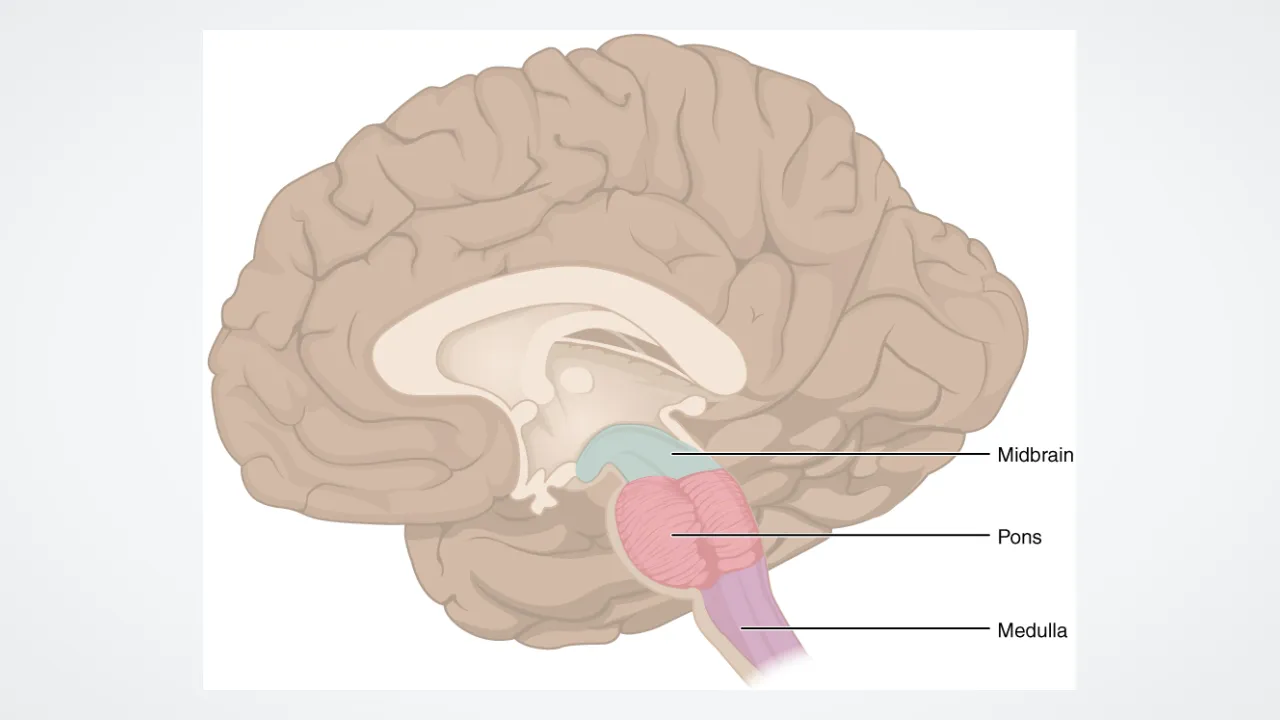
Your brainstem stacks three neat sections from top to bottom: the midbrain on top, the rounded pons in the middle, and the oblongata at the base meeting your .
3
Highway and Safety Guard
Millions of nerve wires pass through the brainstem carrying touch upward and muscle commands downward, while protective reflexes trigger instant coughs, hiccups, swallows, and blinks!
1. What are the three stacked parts that make up your brainstem?
2. Why are sneezing, coughing, and blinking controlled by your brainstem instead of slow conscious thought?
🤯 Mind-Blowing Fact • Grade 3
When you dream vividly during REM sleep, your brainstem's pons temporarily switches off signals to your arm and leg muscles so you don't leap out of bed acting out your dreams!
✨ Word Sparks (Grade 3 Glossary)
Tap 🔊 to hear
pons
middle brainstem bridge linking brain regions
cranial nerves
twelve nerve pairs serving head and organs
carbon dioxide
waste gas muscles make using energy
🪝
Why does your breathing automatically speed up when you sprint across the playground without you deciding to breathe faster?
1
Chemical Sensors in the Medulla
Race across a soccer field and your legs burn fuel fast, releasing extra into your blood! Instantly, tiny chemical sensors inside the lowest part of your brainstem—the medulla oblongata—taste that rise in carbon dioxide and command your diaphragm and rib muscles to breathe deeper and faster.
2
Pons: The Busy Bridge
Just above the medulla bulges the , whose Latin name literally means 'bridge.' True to its name, the pons relays millions of nerve messages between your thinking cerebrum and your balancing cerebellum, while also helping guide vivid dreaming sleep!
3
Midbrain Startle Reflexes
Perched at the top of the brainstem sits the midbrain. When a sudden flash of light or unexpected clap happens beside you, midbrain bumps snap your eyes and head toward the surprise before you even know what happened.
4
Head and Face Wiring
Ten out of your twelve pairs of plug directly into the brainstem—powering smiles, tongue movements, hearing, and swallowing!
1. What clue in your blood tells your brainstem's medulla oblongata to speed up your breathing when you run?
2. What clever safety trick does the pons perform while you are having vivid REM dreams at night?
🤯 Mind-Blowing Fact • Grade 4
Taking slow, deep belly breaths stimulates the brainstem's vagus nerve to release chemical signals that gently slow down your heart rate within seconds!
✨ Word Sparks (Grade 4 Glossary)
Tap 🔊 to hear
reticular
woven like a net of nerve fibers
vagus nerve
long cranial nerve calming heart and gut
decussation
X-shaped crossing of nerve fiber bundles
🪝
How does a lacy web of neurons inside your brainstem wake up your entire cerebral cortex every morning?
1
Your Brain's Power Switch: The RAS
Why do you sleep right through steady rain pattering on your window yet bolt wide awake if someone whispers your name? Running up the core of your brainstem weaves a net-like network of neurons called the Activating System, or RAS! Acting as both consciousness switch and attention filter, the RAS screens millions of incoming sensory messages every second—blocking repetitive background hums like sock seams on your toes while alerting your cerebrum to urgent news.
2
The Great Crossover in the Pyramids
Near the bottom of the medulla oblongata sit two ridges called the medullary pyramids. Right here, about ninety percent of motor nerve fibers descending from your left cerebral hemisphere cross over to the right side of your spinal cord—and vice versa! That anatomical crossover, called the pyramidal , explains why each side of your cerebrum steers the opposite hand.
3
Wandering Vagus Nerve
Emerging from the medulla is the remarkable tenth cranial nerve: the ! Wandering down through your neck and chest into your abdomen, it slows a racing heart when you take calm deep breaths and coordinates digestion.
4
Evolution's Ancient Foundation
Protected deep at the skull's foramen magnum opening, the midbrain, pons, and medulla form our nervous system's oldest, most indispensable life-support tower.
1. What job does the brainstem's Reticular Activating System (RAS) do all day long?
2. Why does the left side of your cerebrum move your right hand?
🤯 Mind-Blowing Fact • Grade 5
Inside your medulla oblongata ticks a tiny cluster of fewer than 10,000 pacemaker neurons called the pre-Bötzinger complex—firing roughly 20,000 rhythmic breaths every single day of your life without ever taking a vacation!
✨ Word Sparks (Grade 5 Glossary)
Tap 🔊 to hear
homeostasis
keeping internal body conditions steady and balanced
substantia nigra
midbrain hub making dopamine for smooth movement
baroreceptor
sensor monitoring blood pressure inside arteries
🪝
How do three compact inches of neural tissue orchestrate cardiovascular homeostasis, ten cranial nerve pairs, and human consciousness itself?
1
Tripartite Architecture Above the Foramen Magnum
Spanning roughly 7.5 centimeters from the diencephalon down to the foramen magnum at the skull's base, the brainstem (truncus encephali) unites three embryologically distinct divisions: the rostral midbrain (mesencephalon), central pons, and caudal medulla oblongata. Unlike the spinal cord's neat inner-gray, outer-white layout, ascending sensory lemnisci and descending corticospinal tracts interleave around dozens of specialized gray-matter cranial nerve nuclei, autonomic pacemakers, and neuromodulatory hubs.
2
Mesencephalon: Colliculi and Dopamine Hubs
Dorsally, the midbrain roof (tectum) bears four rounded mounds—the corpora quadrigemina: paired superior colliculi coordinate rapid saccadic eye orientation toward visual flashes, while inferior colliculi localize auditory frequencies in three-dimensional space. Deeper inside the tegmentum sit the iron-rich red nucleus and dark-pigmented , whose dopamine-producing neurons project to the basal ganglia to initiate fluid voluntary motion.
3
Pontine Relays and Medullary Pacemakers
Beneath the midbrain, massive transverse pontocerebellar fibers bulge outward as the ventral pons, funneling cortical motor blueprints into the cerebellum alongside locus coeruleus norepinephrine neurons governing alertness. Caudally, the medulla oblongata houses life's non-negotiable rhythm generators: the pre-Bötzinger complex fires rhythmic inspiratory bursts down phrenic nerves to the diaphragm, while the nucleus tractus solitarius integrates aortic pressure and blood pH/CO2 chemoreception to tune heart rate and vascular tone via sympathetic and parasympathetic vagal pathways.
4
Cranial Nerve Command and Decussations
Excepting purely sensory olfactory (CN I) and optic (CN II) nerves, cranial nerves III through XII originate or terminate directly along the brainstem—orchestrating pupillary reflexes, chewing, facial expression, vestibular balance, vocal cords, and swallowing alongside sensory medial lemniscus and motor pyramidal crossovers.
5
Ascending Arousal and Clinical Vitalism
Because the ascending reticular activating system (ARAS) continuously energizes the thalamus and cerebral cortex with acetylcholine, serotonin, and monoamines, neuroscientists recognize this ancient three-inch conduit as the indispensable physiological anchor of waking consciousness.