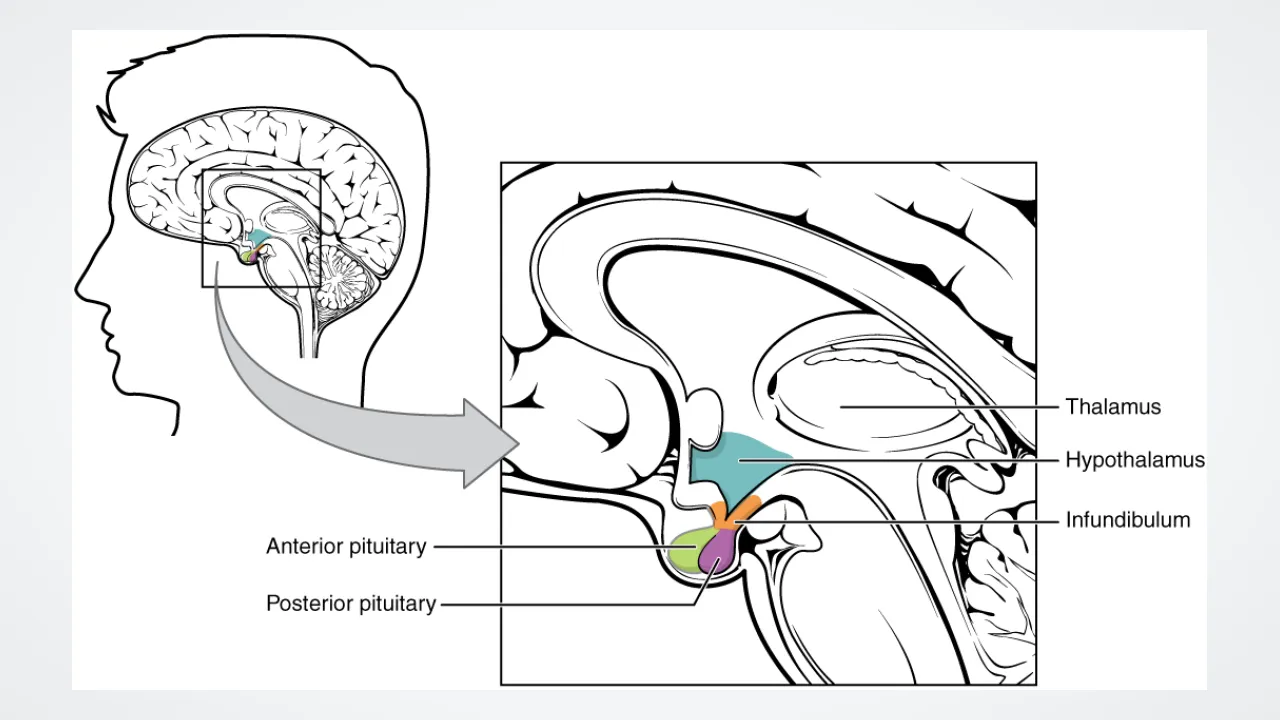
1. About how big is the hypothalamus inside your brain?
2. Which feeling is sent by your hypothalamus when you need water?
🤯 Mind-Blowing Fact • Grade 2
A tiny cluster of just twenty thousand nerve cells inside your hypothalamus acts as the master clock for your whole 24-hour day!
✨ Word Sparks (Grade 2 Glossary)
Tap 🔊 to hear
thermostat
A tool that keeps temperature just right
fuel
Food energy that powers your busy body
signal
A quick message sent inside your body
🪝
What acts like a smart thermostat tucked deep inside your head?
1
Your Built-In Thermostat
Step outside on a freezing winter morning and your teeth start to chatter right away. Run around on a sunny playground and cool sweat pops onto your skin. Deep inside your brain, a small part called the hypothalamus controls both actions like a wall .
2
Listening to Your Body
This almond-sized helper checks your blood every single second. If your body needs , it makes your stomach feel hungry. If you play hard and lose water, it reminds you to take a big drink.
3
Time for Bed
Inside the hypothalamus sits a tiny daily clock that watches daylight through from your eyes. When evening grows dark, it helps your brain get sleepy so you wake up fresh tomorrow.
1. How does the hypothalamus cool you down on a hot playground?
2. What clue helps the hypothalamus know when bedtime is near?
🤯 Mind-Blowing Fact • Grade 3
The word hypothalamus comes from Greek words meaning 'under the inner chamber' because it sits directly below your brain's thalamus!
✨ Word Sparks (Grade 3 Glossary)
Tap 🔊 to hear
homeostasis
Keeping conditions inside your body steady and safe
hormone
A chemical messenger traveling through your bloodstream
endocrine
The body system of hormone-making glands
🪝
How can one almond-sized spot link your fast nerves to your body's hormones?
1
Keeping Everything in Balance
Imagine piloting a spaceship where oxygen, heat, and fuel must stay perfectly balanced every minute. Inside your skull, the hypothalamus runs that exact mission for your body! Scientists call this steady inner balance , and you could not survive without it.
2
Bridge Between Two Systems
Tucked right beneath the thalamus at the base of the forebrain, the hypothalamus connects two giant communication networks. It reads rapid electrical messages from the nervous system and translates them into chemical instructions for the system.
3
Partnering with the Pituitary
Right underneath the hypothalamus hangs the pea-sized pituitary gland on a thin stalk. Whenever your body grows, faces excitement, or needs to save water, the hypothalamus sends special releasing signals down that stalk to boss the pituitary into action.
4
Fighting Germs with Fever
Even fevers are set here! When white blood cells spot invading germs, they alert the hypothalamus to raise your temperature a couple of degrees, making it harder for germs to multiply.
1. What do scientists call the steady internal balance maintained by the hypothalamus?
2. Why does the hypothalamus sometimes raise your body temperature into a mild fever?
🤯 Mind-Blowing Fact • Grade 4
If your blood loses just one to two percent of its water, osmoreceptors in your hypothalamus shrink slightly and switch on powerful thirst signals!
✨ Word Sparks (Grade 4 Glossary)
Tap 🔊 to hear
osmoreceptor
A nerve sensor that measures water balance
circadian
Following a natural twenty-four-hour daily body cycle
infundibulum
The thin stalk linking hypothalamus and pituitary
🪝
How does your brain sample your blood like a scientist testing soup?
1
Sampling the Bloodstream
Picture a master chef tasting a simmering pot of soup to check whether it needs a pinch of salt or a splash of water. Deep near the center of your brain, the hypothalamus performs a remarkably similar job! Tiny specialized sensors called constantly measure how salty or diluted your blood has become, triggering thirst the moment water levels dip even slightly.
2
Specialized Neighborhoods of Nuclei
Although the entire hypothalamus weighs only about four grams, it is divided into distinct clusters of nerve cells called nuclei, and each cluster handles a specific survival job. One cluster monitors core temperature around 98.6 degrees Fahrenheit, widening skin blood vessels when you overheat or sparking muscle shivers when you chill. Neighboring clusters read hunger hormones like ghrelin from an empty stomach and leptin from energy-storing cells.
3
The Suprachiasmatic Master Clock
Resting directly above the optic chiasm, where eye nerves cross, sits the suprachiasmatic nucleus. By detecting morning sunlight, this biological timepiece synchronizes your rhythm—steering alertness, digestion, and nighttime melatonin release across a predictable twenty-four-hour cycle.
4
Directing the Pituitary Stalk
Connected to the pituitary gland by a slender funnel called the , the hypothalamus dispatches releasing and inhibiting hormones into tiny portal blood vessels. Through this command link, it coordinates growth, stress responses, and water conservation throughout your organs.
1. What happens when osmoreceptors in the hypothalamus detect that your blood is getting too salty?
2. Which tiny region inside the hypothalamus uses light clues to run your 24-hour circadian rhythm?
🤯 Mind-Blowing Fact • Grade 5
In 1977, scientists Roger Guillemin and Andrew Schally shared a Nobel Prize after purifying microscopic hypothalamic releasing hormones from hundreds of thousands of tissue samples!
✨ Word Sparks (Grade 5 Glossary)
Tap 🔊 to hear
neuroendocrine
Linking electrical nerve signals with chemical hormones
vasopressin
A hormone telling kidneys to conserve water
pyrogen
An immune molecule that triggers protective fever
🪝
How do fewer than four grams of neural tissue orchestrate nearly every automatic survival system in the human body?
1
The Grand Integrator of Homeostasis
Step from an air-conditioned library onto a blazing summer sidewalk, and within heartbeats your skin flushes pink while millions of sweat glands activate—without a single conscious thought from you. That seamless adjustment begins inside the hypothalamus, a four-gram wedge of gray matter forming the floor and lower walls of the brain's third ventricle. Despite accounting for roughly one three-hundredth of total brain mass, it serves as the chief command center for homeostasis.
2
Translating Spikes into Hormones
For decades, physiologists wondered how fast electrical nerve impulses could control slow-acting endocrine glands. In the mid-twentieth century, British neuroendocrinologist Geoffrey Harris demonstrated that hypothalamic neurons secrete tiny chemical messengers into a microscopic web of capillaries called the hypophyseal portal system. Flowing straight down the infundibular stalk to the anterior pituitary, these releasing hormones convert millisecond neural code into body-wide hormonal cascades.
3
Direct Pipelines and Autonomic Control
Meanwhile, larger magnocellular neurons in the paraventricular and supraoptic nuclei send long axons directly into the posterior pituitary. There they release antidiuretic hormone, also called , which instructs kidney tubules to reabsorb water back into the bloodstream. Simultaneously, hypothalamic pathways project downward into the brainstem and spinal cord to tune the autonomic nervous system—speeding heartbeats during sudden excitement or calming digestion afterward.
4
Appetite, Thermoregulation, and Fever
Inside the arcuate nucleus, rival teams of neurons continuously weigh metabolic clues such as blood glucose, insulin, leptin, and ghrelin to balance appetite with energy expenditure. Nearby preoptic neurons guard a strict thermal set point near 37 degrees Celsius; when immune molecules called arrive during an infection, those neurons deliberately shift the set point upward, producing a protective fever.
5
Timekeeping Across Trillions of Cells
Anchored just above the optic chiasm, the paired suprachiasmatic nuclei contain roughly twenty thousand clockwork neurons whose genes switch on and off in daily loops. Calibrated each morning by blue-wavelength light from retinal ganglion cells, this central pacemaker keeps peripheral clocks in your liver, heart, and muscles marching in harmony.