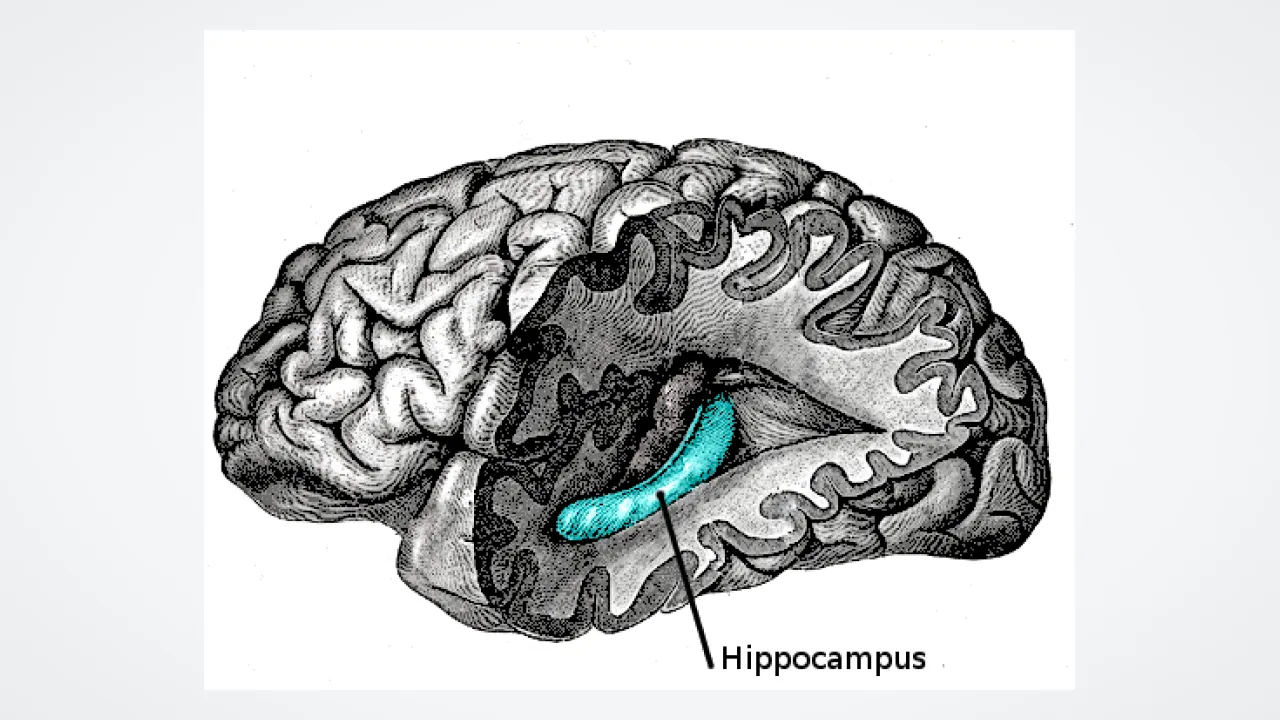
⚡ Body SuperpowerReplays your daytime adventures at high speed while you sleep to lock in memories
🤯 Mind-Blowing Fact • Grade 1
While you sleep tonight, your hippocampus replays what you learned today super fast so you remember it tomorrow!
✨ Word Sparks (Grade 1 Glossary)
Tap 🔊 to hear
seahorse
small curled fish inspiring hippocampus's name
memory
something your brain saves and remembers
map
guide showing where places sit
🪝
Did you know two tiny seahorse-shaped helpers live deep inside your brain?
1
Shaped Like a Seahorse
Peek deep inside your brain behind each ear! You have two curved helpers called the hippocampus. Long ago, doctors thought they looked just like tiny curled !
2
Saving Your Best Days
Remember your last birthday cake or a fun trip to the park? Your hippocampus saved those happy stories so you can keep them!
3
Finding Your Way
It also draws a inside your head. That is how you find your classroom, bedroom, and kitchen without getting lost!
1. Why did scientists name this brain part 'hippocampus,' the Greek word for seahorse?
2. What two big jobs does your hippocampus help you do every day?
🤯 Mind-Blowing Fact • Grade 2
London cab drivers who memorized 25,000 twisting city streets actually grew noticeably bigger back hippocampi than average adults!
✨ Word Sparks (Grade 2 Glossary)
Tap 🔊 to hear
temporal lobe
brain section behind ears holding hippocampus
long-term memory
knowledge saved for months or years
place cell
hippocampus neuron firing at specific locations
🪝
Where does today's science lesson go tonight so it stays in your head for next week?
1
Your Brain's Master Librarian
Imagine walking into a huge library where thousands of brand-new books arrive every single minute! Tucked deep behind each ear inside your , your left and right hippocampus sort out what happened today and file important facts away for keeps.
2
Nighttime Replay Crew
Your hippocampus is NOT the permanent bookshelf where old memories live forever. Instead, during deep sleep at night, it replays today's adventures and sends them out to your wrinkled cerebral cortex for long-term storage!
3
Built-In Mental GPS
Special '' inside your hippocampus also light up whenever you walk through familiar rooms, building an invisible 3D map of your neighborhood.
1. When does your hippocampus do much of its best work transferring new facts into long-term storage?
2. What happened to the hippocampi of London taxi drivers who memorized 25,000 streets without GPS screens?
🤯 Mind-Blowing Fact • Grade 3
Running, biking, and active play trigger your muscles and brain to release a protein nicknamed 'Miracle-Gro for the brain' (BDNF) that helps your hippocampus grow new neurons!
✨ Word Sparks (Grade 3 Glossary)
Tap 🔊 to hear
consolidation
turning fresh experiences into lasting memories
episodic memory
remembering personal events from your life
neurogenesis
birth of brand-new neurons in brain
🪝
Why can someone without a working hippocampus still ride a bicycle yet forget what they ate for breakfast ten minutes ago?
1
Two Very Different Kinds of Memory
Surprise! Your brain doesn't keep all memories in one basket. 'How-to' action skills—like riding a scooter or tying shoelaces—belong to your cerebellum and basal ganglia. Meanwhile, facts and life stories—like naming Jupiter's moons or remembering your puppy's first bark—need your two seahorse-shaped hippocampi!
2
Memory Consolidation
Every sight, sound, and smell from a moment funnels into the hippocampus, which binds them together like pages stapled into one comic book. Over days and months of sleep replay—a process called —those linked memories weave permanently across your outer cortex.
3
Nobel-Prize-Winning Place Cells
In 1971, scientist John O'Keefe discovered 'place cells' inside the hippocampus. One neuron fires whenever you stand near your bedroom door, another fires beside your desk—forming a living coordinate map!
4
Growing Brand-New Neurons!
Most brain regions stop making new neurons early in life, yet the hippocampus's dentate gyrus sprouts fresh baby neurons—especially when you run, swim, and play outside!
1. Which type of memory depends on your hippocampus rather than your cerebellum?
2. What healthy everyday habit boosts the growth of fresh neurons inside your hippocampus?
🤯 Mind-Blowing Fact • Grade 4
Food-caching birds like chickadees—which hide thousands of seeds under tree bark in autumn—actually expand their hippocampus every fall to remember every single hiding spot!
✨ Word Sparks (Grade 4 Glossary)
Tap 🔊 to hear
limbic system
deep brain network handling memory and emotion
declarative memory
facts and events you can consciously state
sharp-wave ripple
fast sleep burst locking in memories
🪝
How does a smell of cinnamon or campfire smoke instantly transport you back to a childhood afternoon years ago?
1
Direct Express Lane From Your Nose
Walk past a bakery and—whoosh!—one whiff of warm cinnamon rolls brings back a vivid scene from three years ago! Unlike sight and sound, which stop first at a central relay station called the thalamus, smell signals zip directly into the right beside your amygdala and hippocampus. Because the hippocampus binds sights, sounds, places, and scents into unified episodic memories, a single sensory clue can unlock the entire stored scene!
2
Patient H.M. and Memory Science
In 1953, a famous patient known for decades as H.M. (Henry Molaison) underwent surgery on both medial temporal lobes to stop dangerous seizures. Afterward, Henry remembered his childhood clearly and learned mirror-drawing puzzles smoothly—yet he could no longer convert any new conversation or face into long-term ! Working with neuroscientist Brenda Milner, Henry generously helped prove that the hippocampus is the printing press of new memories, not the warehouse of old ones.
3
Linking Memories to Future Imagination
Brain scans uncovered another twist: imagining a brand-new future adventure lights up the exact same hippocampal circuits as recalling yesterday! Your hippocampus remixes saved building blocks—beaches, friends, tents—to preview scenes that haven't happened yet.
4
Sharp-Wave Ripples at Night
During slow-wave deep sleep, bursts called replay daytime neuron sequences ten to twenty times faster than real life, cementing lessons into cortical networks.
1. What crucial discovery did neuroscientist Brenda Milner make by studying Henry Molaison (Patient H.M.)?
2. Besides remembering the past and mapping space, what creative mental task uses your hippocampus?
🤯 Mind-Blowing Fact • Grade 5
Your dentate gyrus uses 'pattern separation' so skillfully that you can remember exactly where you parked your bike TODAY without mixing it up with the 180 other times you parked at school this year!
✨ Word Sparks (Grade 5 Glossary)
Tap 🔊 to hear
long-term potentiation
lasting strengthening of synapses when neurons co-fire
pattern separation
keeping similar memories distinct without mixing up
grid cell
entorhinal neuron mapping space in hexagon grids
🪝
How do microscopic electrical bursts strengthen individual hippocampal synapses to turn a fleeting second of experience into a lifelong memory?
1
Archicortex Coiled Inside the Medial Temporal Lobe
Named in 1587 by Venetian anatomist Giulio Cesare Aranzi for its uncanny resemblance to a Mediterranean seahorse (Hippocampus), the human hippocampal formation curls roughly five centimeters along the floor of each lateral ventricle's temporal horn. Unlike the six-layered neocortex, the hippocampus consists of evolutionarily ancient three-layered archicortex folded into two interlocking C-shaped sheets: the dentate gyrus and Cornu Ammonis subfields (CA1, CA2, CA3), coupled closely with the adjacent subiculum and entorhinal cortex.
2
Trisynaptic Loop and Long-Term Potentiation
Sensory associations from across the entire neocortex funnel through the entorhinal cortex into the hippocampus's famous unidirectional trisynaptic circuit: perforant path fibers excite dentate gyrus granule cells (performing '' so two similar Tuesday mornings don't blur together), mossy fibers relay signals to recurrent CA3 pyramidal auto-associative networks ('pattern completion,' reconstructing a whole memory from one partial cue), and Schaffer collaterals project to CA1! Here in 1973, Timothy Bliss and Terje Lømo discovered (LTP): high-frequency co-activation unblocks postsynaptic NMDA receptors, letting calcium ions rush in to insert extra AMPA receptors—physically proving Donald Hebb's rule that 'neurons that fire together, wire together.'
3
Place Cells, Grid Cells, and Cognitive Maps
Awarded the 2014 Nobel Prize in Physiology or Medicine, John O'Keefe along with May-Britt and Edvard Moser revealed how hippocampal CA1/CA3 'place cells' partner with hexagonal '' in the medial entorhinal cortex to map not just physical rooms, but also abstract 'conceptual spaces' such as family trees and musical relationships!
4
Systems Consolidation via Sleep Replay
During slow-wave non-REM sleep, hippocampal sharp-wave ripples (150–250 Hz) synchronize precisely with thalamic sleep spindles and neocortical slow oscillations—compressing daytime firing trajectories twenty-fold to transfer fragile episodic traces into distributed neocortical storage.
5
Adult Neurogenesis and Brain-Derived Trophic Support
Sustained by exercise-induced brain-derived neurotrophic factor (BDNF) inside the subgranular zone of the dentate gyrus, your hippocampus remains a lifelong nexus of curiosity, navigation, and personal identity.