🏢 WorkplaceFabrication shops, shipyards, skyscraper steel frames, and underwater piers
⚡ Everyday Impact SparkUses super-hot electric arcs to melt two separate pieces of steel into one unbreakable piece
🤯 Mind-Blowing Fact • Grade 1
Even astronauts have tested welding tools in space, and specially trained diver-welders can weld steel piers deep underwater!
✨ Word Sparks (Grade 1 Glossary)
Tap 🔊 to hear
Weld
To join two metals by melting them together
Visor
A dark shield on a helmet protecting eyes
Steel
A very strong metal used for bridges and ships
🪝
How do builders stick giant steel bridge beams together so they never come apart?
1
Bright Sparks Fly!
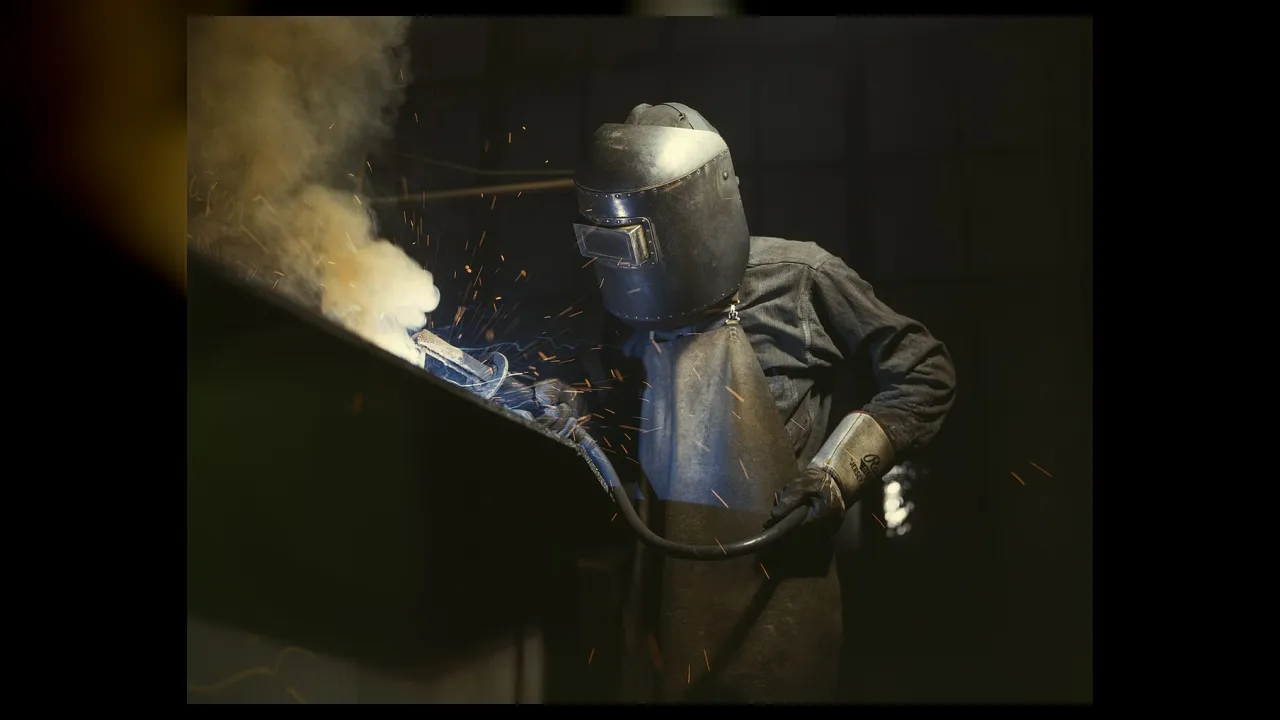
Bzzzz-crackle! Tiny golden sparks dance across a thick table. Behind a dark safety , a welder holds a steady glowing torch.
2
Melting Metal Into One
Glue and tape cannot hold up a giant bridge or ship! Welders use super heat to melt two metal edges together. When the metal cools, it becomes one super-strong piece.
3
Head-to-Toe Gear
A special helmet shields their eyes from bright light, and thick leather gloves keep their hands safe and cool!
1. How does a welder join two separate steel pieces together?
2. Why must a welder always wear a dark-tinted helmet visor?
🤯 Mind-Blowing Fact • Grade 2
An electric welding arc can reach 6,000 to 10,000 degrees Fahrenheit—up to five times hotter than glowing volcanic lava!
✨ Word Sparks (Grade 2 Glossary)
Tap 🔊 to hear
Electric Arc
A super-hot, bright spark jumping across a tiny gap
Weld Bead
The neat rippled line of cooled melted metal
Fabrication
Cutting, shaping, and joining parts to build machines
🪝
What connects roller-coaster tracks, ocean ships, and space rockets?
1
Everyday Metal Magic
Look closely at the smooth metal frame of your bicycle, the sturdy swings on your school playground, or a towering steel roller coaster! Almost every strong metal machine you ride was joined together by skilled welders.
2
Hotter Than Lava
Most welders use electricity to make a tiny lightning-like spark called an '.' That bright arc gets far hotter than volcano lava—melting steel edges and a thin filler wire into a neat, shiny seam called a .
3
Steady Hands and Sharp Math
Welders read detailed blueprints, measure corner angles carefully, and wear flame-safe jackets, dark visors, and heavy leather boots on every job.
1. How hot does an electric welding arc get compared to volcanic lava?
2. What do welders call the neat, rippled metal seam left behind after the joint cools?
🤯 Mind-Blowing Fact • Grade 3
Modern auto-darkening welding helmets use solar-powered liquid-crystal sensors that darken the visor in 1/25,000th of a second when the arc flashes!
✨ Word Sparks (Grade 3 Glossary)
Tap 🔊 to hear
Shielding Gas
Protective gas keeping air away from melted metal
Alloy
A metal made stronger by mixing elements together
X-Ray Inspection
Looking inside solid welds to check for hidden bubbles
🪝
Why do welders blow invisible gas around melted metal while they work?
1
A Bubble of Shielding Gas
Flip down a modern welding helmet—the clear window darkens in a tiny fraction of a second the moment the torch sparks! As steel melts into a glowing orange puddle, everyday air can actually spoil the weld by trapping oxygen bubbles inside. To prevent weak spots, welders wrap the puddle in an invisible blanket of '' like argon.
2
MIG, TIG, and Stick
Different building jobs call for different welding styles. MIG welding feeds metal wire smoothly like a hot-glue gun for steel frames. Stick welding works great outdoors on windy bridges and ranches. TIG welding uses both hands plus a foot pedal for razor-sharp artistry on aluminum bikes and race cars.
3
Testing Welds With X-Rays
On fuel pipelines, submarines, and airplanes, inspectors take special X-ray pictures right through solid steel to prove zero hidden cracks lurk inside!
4
Underwater Commercial Divers
Specially trained underwater diver-welders even strap on heavy diving helmets to repair harbor bridges, ships, and offshore wind turbines deep beneath ocean waves.
1. Why does a welder spray shielding gas like argon around the molten metal puddle?
2. How can inspectors check inside a critical airplane or pipeline weld without cutting it open?
🤯 Mind-Blowing Fact • Grade 4
During World War II, switching ship hulls from millions of heavy metal rivets to smooth electric welding allowed shipyards—including hundreds of thousands of women 'Wendy the Welder' pioneers—to launch cargo ships in weeks instead of months!
✨ Word Sparks (Grade 4 Glossary)
Tap 🔊 to hear
Metallurgy
Science of how metals behave when heated and mixed
Fusion
Melting separate pieces together into one unified whole
Hull
The main watertight outer body of a ship
🪝
How do shipbuilders in Virginia fuse thousands of tons of steel armor into ocean-going vessels and submarines?
1
Metallurgy in Motion
Inside the colossal shipbuilding halls of Newport News and Norfolk, Virginia—home to some of the busiest shipyards on Earth—golden sparks shower like falling stars as master welders join multi-inch plates. Unlike nuts, bolts, or old-fashioned rivets that require drilling holes into metal, welding melts base plates and filler rod together so they cool into one continuous, watertight crystal structure.
2
Reading Welding Symbols and Heat Control
Every structural steel blueprint carries a compact code of arrows, flags, triangles, and numbers standardized by the American Welding Society. A skilled welder decodes those symbols to set the exact groove bevel, weld thickness, wire speed, and electrical amperage. Managing heat takes strategy too: heating one side of an I-beam too rapidly makes expanding metal pull crooked as it cools, so welders alternate short passes on opposite sides to keep girders laser-straight.
3
Different Metals, Different Science
Carbon steel, gleaming stainless steel, lightweight aluminum, and aerospace titanium each melt at distinct temperatures and react differently to oxygen. Titanium rocket propellant tanks, for example, must be welded inside ultra-pure argon enclosures so seams remain tough instead of turning glass-brittle.
4
Robotic and Human Teamwork
Today, certified welders program multi-axis robotic welding arms inside clean-energy and automotive plants while personally executing intricate overhead and pipe joints that only steady human hands can master.
1. Why must welders carefully alternate sides and manage heat when welding big steel frames?
2. What major advantage did welded ship hulls have over older riveted hulls?
🤯 Mind-Blowing Fact • Grade 5
To join aluminum rocket fuel tanks for NASA's Artemis Moon missions without melting weak spots, engineers use 'friction-stir welding'—a spinning pin that kneads solid metal together like warm taffy under immense pressure!
✨ Word Sparks (Grade 5 Glossary)
Tap 🔊 to hear
Plasma
Superheated ionized gas capable of conducting electric current
Tungsten
Element with the highest melting point of any metal
Heat-Affected Zone
Metal beside a weld altered by intense heat
🪝
How do aerospace, nuclear, and structural welders manipulate plasma arcs, crystalline grain structures, and non-destructive physics to build zero-failure hardware?
1
Atomic-Level Metal Joining
Peer through a dark shade-10 filter lens at a Gas Arc Weld (GTAW), and you are observing high-temperature physics and metallurgy unfold inside a half-inch molten pool. At core arc temperatures surpassing 10,000°F, ionized argon gas conducts a focused electrical column that liquefies alloy edges—allowing iron, chromium, or aluminum atoms to share metallic bonds and solidify into a unified crystalline lattice.
2
Core Arc Processes and Polarity
Professional fabricators master distinct processes defined by the American Welding Society (AWS). In Shielded Metal Arc Welding (SMAW), a flux-coated stick electrode vaporizes to form its own protective gas cloud and insulating slag crust outdoors. Gas Metal Arc Welding (GMAW/MIG) feeds continuous wire spooling for rapid bridge and chassis production, whereas GTAW (TIG) uses a non-melting tip—melting point 6,192°F—to sculpt surgical seams on thin aerospace tubing. Switching between direct current and alternating current lets TIG welders blast stubborn surface oxides off aluminum.
3
Managing the Heat-Affected Zone (HAZ)
Immediately bordering every solidified weld bead lies the ''—base metal that never melted, yet absorbed enough thermal energy to alter its microscopic crystal grain structure. On nuclear steam piping, deep-diving submarine hulls, and cryogenic liquid-oxygen rocket tanks, welders preheat thick alloy steel with induction blankets and conduct controlled post-weld cooling so joints retain impact toughness rather than turning brittle.
4
Laser, Friction-Stir, and Hyperbaric Frontiers
Advanced manufacturing pushes even further: focused electron beams fuse turbine gears inside vacuum chambers, solid-state friction-stir pins knead NASA launch-vehicle domes together without melting, and saturation divers weld subsea offshore-wind foundations inside dry pressurized habitats hundreds of feet below ocean swells.
5
Certification and Inspection Rigor
Before touching critical infrastructure, welders earn AWS code certifications by welding test coupons subjected to hydraulic bend presses, radiographic X-rays, and ultrasonic phased-array scans—proving zero internal porosity from skyscrapers to deep space.