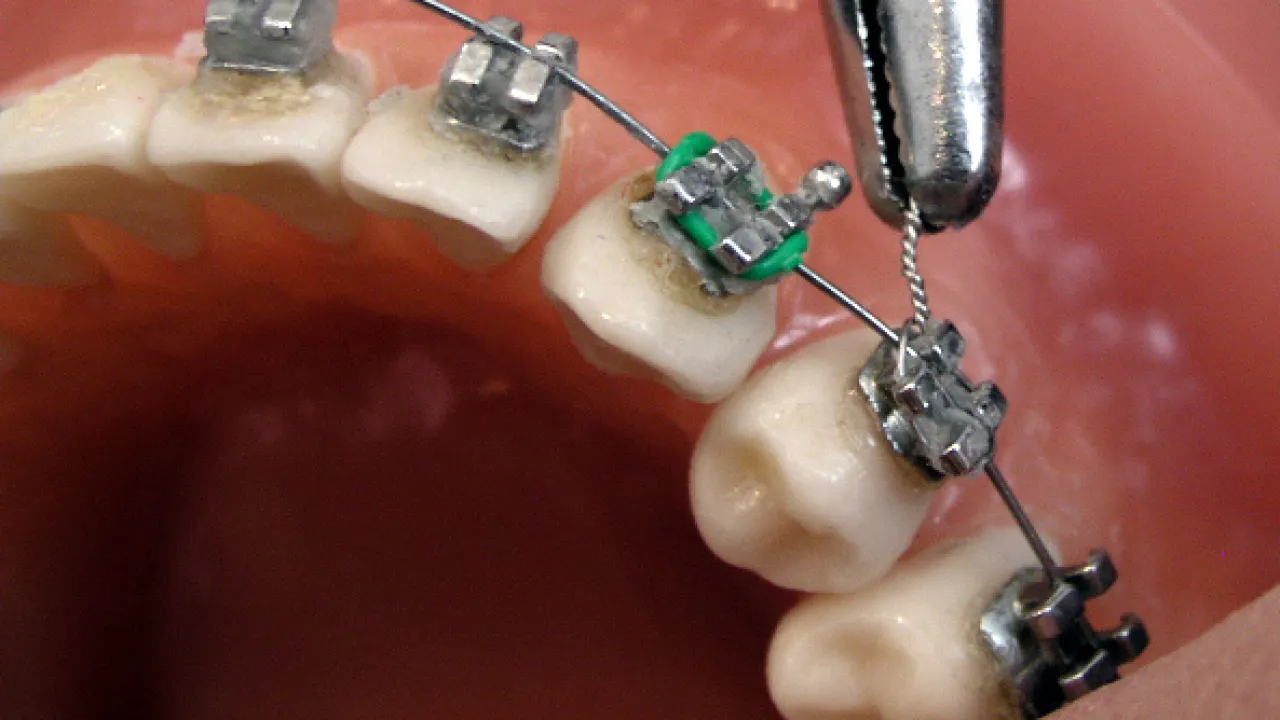
1. What does an orthodontist help your teeth and jaws do?
2. How fast do braces move teeth into new positions?
🤯 Mind-Blowing Fact • Grade 2
Every orthodontist starts out by becoming a regular dentist first—and then goes back to school for two to three extra years just to master moving teeth!
✨ Word Sparks (Grade 2 Glossary)
Tap 🔊 to hear
aligner
Clear, removable tray that guides teeth
retainer
Custom mouthpiece keeping straightened teeth in place
overbite
When upper front teeth overlap too far
🪝
Why should kids visit an orthodontist around age seven even while they still have baby teeth?
1
Peeking Ahead at Age Seven
Whirrr goes a panoramic camera gliding smoothly around your head! Even when you are seven years old and still losing baby teeth, an orthodontist can look at a wide X-ray to see adult teeth hiding up inside your jawbone like airplanes waiting to land.
2
Fixing Bites Like Puzzle Pieces
Upper and lower teeth should fit together like neat gears. If jaws have an , underbite, or crowded corners, orthodontists design custom plans using brackets, colorful rubber bands, expanders, or clear plastic .
3
Retainers Lock In Your Smile
Once braces come off, wearing a custom keeps teeth from drifting back!
1. How can an orthodontist see adult teeth that have not poked through a seven-year-old's gums yet?
2. What tool keeps newly straightened teeth from drifting back after braces come off?
🤯 Mind-Blowing Fact • Grade 3
Modern braces use 'nitinol'—a remarkable nickel-titanium metal alloy warmed by your mouth's 98.6-degree heat so it remembers its ideal shape and gently guides teeth into place!
✨ Word Sparks (Grade 3 Glossary)
Tap 🔊 to hear
ligament
Tough, stretchy fibers connecting bones or teeth
alloy
Strong metal made by blending two metals
biomechanics
Physics of forces acting on living bodies
🪝
How can a tooth move across a solid jawbone without falling out—and what do space-age wires have to do with it?
1
A Hammock Beneath Your Gums
Surprise—your teeth are not fused solidly to your jawbone like concrete! Instead, each tooth root hangs inside a tiny shock-absorbing hammock of stretchy fibers called the periodontal .
2
Bone Cells That Dissolve and Rebuild
When an orthodontist clips a gentle wire onto braces or fits a clear aligner, one side of that gets squeezed while the other side stretches. Your body responds like a microscopic construction crew: cleanup cells dissolve a tiny bit of bone ahead of the tooth, while builder cells lay down brand-new bone right behind it!
3
Shape-Memory Space Wires
Early braces used stiff gold or steel wires that needed frequent tightening. Today's orthodontists use nickel-titanium 'memory' archwires activated by the warm temperature of your mouth—gently springing back toward a smooth U-shape week after week.
4
3D Cameras Replace Goopy Molds
Handheld 3D laser wands now map every tooth on a computer screen in minutes so orthodontists can plan each millimeter of movement!
1. How does your jawbone let a tooth move steadily to a new spot?
2. What activates a shape-memory nitinol archwire so it gently pushes teeth into a smooth arch?
🤯 Mind-Blowing Fact • Grade 4
Orthodontics became the very first official medical-dental specialty in the United States back in 1900, when Dr. Edward Angle founded the first school dedicated solely to bite alignment!
✨ Word Sparks (Grade 4 Glossary)
Tap 🔊 to hear
malocclusion
Misaligned bite where teeth meet unevenly
osteoblast
Specialized cell that builds brand-new bone
vector
Force measured by both strength and direction
🪝
How do physics vectors, cellular bone remodeling, and ten-plus years of university study turn orthodontists into smile engineers?
1
Orthodontics Means 'Straight Tooth'
Derived from the Greek words orthos ('straight') and odous ('tooth'), orthodontics became dentistry's very first recognized specialty in 1900 through pioneer Edward H. Angle. Orthodontists diagnose and correct —misaligned bites such as crowding, crossbites, open bites, and jaw discrepancies that can cause uneven enamel wear, jaw-joint strain, or difficulty chewing and speaking clearly.
2
Osteoclasts and Osteoblasts at Work
Moving teeth relies on a biological marvel called bone remodeling, moving roughly one millimeter per month! When an archwire or thermoformed polymer aligner applies about fifty to one hundred grams of light force, blood flow shifts inside the periodontal ligament. Specialized cells called osteoclasts resorb microscopic bone on the compression side, while deposit fresh mineral bone matrix on the tension side.
3
Engineering Vectors and Anchors
Like civil engineers balancing bridge cables, orthodontists calculate force in three dimensions—tipping, rotating, intruding, or translating roots—using ceramic or stainless brackets, elastic bands, palatal expanders that widen growing upper jaws, and Sequential 3D-printed aligners.
4
A Decade of Schooling
Becoming an orthodontist requires four years of college, four years of dental school (DDS or DMD), and two to three competitive years of accredited orthodontic residency.
1. Which pair of specialized cells team up to remodel jawbone as a tooth moves?
2. About how fast does a tooth safely move during orthodontic treatment?
🤯 Mind-Blowing Fact • Grade 5
The gentle force an orthodontist uses to tip a single tooth through bone is often just thirty-five to fifty grams—lighter than holding a single chicken egg in your palm!
✨ Word Sparks (Grade 5 Glossary)
Tap 🔊 to hear
maxilla
Bone forming the upper jaw and palate
resorb
Break down and absorb old bone tissue
superelastic
Bending far and springing back smoothly
🪝
How do Newtonian mechanics, aerospace metallurgy, and craniofacial growth biology intersect inside a modern orthodontic clinic?
1
Dentofacial Orthopedics and Craniofacial Growth
Notice the full formal name of an orthodontist's specialty: Orthodontics and Dentofacial Orthopedics. While 'orthodontics' governs three-dimensional tooth movement, 'dentofacial orthopedics' guides the skeletal growth of the (upper jaw) and mandible (lower jaw) while children's facial sutures are still adaptable! That biological window explains why the American Association of Orthodontists recommends an initial screening around age seven: before the mid-palatal suture fuses during adolescence, a gentle palatal expander can widen a narrow upper arch non-surgically to create room for erupting canines and improve nasal airflow.
2
Mechanotransduction in the Periodontal Ligament
Every orthodontic appliance—from twin stainless-steel brackets to sequential polyurethane clear aligners—harnesses mechanotransduction, the conversion of mechanical force into cellular biochemical signals. Suspended in a 0.2-millimeter-wide periodontal ligament space, a tooth subjected to continuous light force (often just 35 to 120 grams, comparable to the weight of twenty nickels) experiences localized compression on one side and tension on the opposite side. Osteoclasts alveolar bone along the compressed wall while osteoblasts synthesize new osteoid along stretched Sharpey's fibers, translating the root safely at roughly one millimeter per month.
3
From Naval Lab Nitinol to 3D Digital Twins
In the 1970s, orthodontic researcher Dr. George Andreasen adapted nitinol—a nickel-titanium alloy originally discovered at the U.S. Naval Ordnance Laboratory and tested in aerospace hardware—into orthodontic archwires. Unlike steel wires whose force drops sharply after tiny tooth movements, austenitic nitinol delivers flat, gentle force over weeks. Today, orthodontists fuse cone-beam computed tomography (CBCT) with optical intraoral scans to create virtual 'digital twins,' simulating torque, root parallelism, and Newton's third law (every action force requires balanced anchorage!) on screen before fabricating custom appliances.
4
Retention and Elastic Memory
Even after alveolar bone calcifies around newly aligned roots, gingival elastic fibers retain tension for months; custom retainers hold teeth steady while collagen and elastin networks reorganize permanently.
5
Ten to Eleven Years of Preparation
Following undergraduate STEM study and a four-year DDS or DMD degree, top dental graduates complete a two-to-three-year postdoctoral residency mastering cephalometric geometry, craniofacial genetics, and biomechanical design.