1. What is the hardest substance in the entire human body?
2. Why does a dentist hold a tiny round mirror inside your mouth?
🤯 Mind-Blowing Fact • Grade 2
Just like fingerprints, no two people on Earth—not even identical twins—have the exact same set of teeth!
✨ Word Sparks (Grade 2 Glossary)
Tap 🔊 to hear
molar
Wide, bumpy back tooth for grinding food
fluoride
Natural mineral that strengthens tooth enamel
sealant
Thin protective coating painted on back teeth
🪝
How do sneaky mouth bacteria cause cavities, and how does a dentist stop them?
1
Twenty Baby Teeth to Thirty-Two Adult Teeth
Wiggle, wiggle—out pops a loose baby tooth! Kids grow twenty primary baby teeth first, and as jaws grow bigger, thirty-two permanent adult teeth take their place. Dentists are doctors who keep both your teeth and pink gums healthy.
2
Stopping Sugar Bugs and Acid
Invisible bacteria in sticky plaque love eating leftover sugar from snacks and turning it into weak acid. If acid sits on enamel too long, it dissolves a tiny hole called a cavity! Dentists take quick digital X-rays to spot hidden cavities early and repair them with strong tooth-colored fillings.
3
Shields for Back Molars
Dentists also paint protective and smooth onto bumpy back to block germs!
1. How many baby teeth do children grow before their thirty-two adult teeth come in?
2. What happens when plaque bacteria eat leftover sugars on unbrushed teeth?
🤯 Mind-Blowing Fact • Grade 3
Dentists use a bright blue LED 'curing light' that turns soft, putty-like filling material into rock-solid tooth repair in just twenty seconds through a safe chemical reaction!
✨ Word Sparks (Grade 3 Glossary)
Tap 🔊 to hear
incisor
Flat-edged front tooth used for biting
dentin
Protective layer right underneath tooth enamel
hygienist
Licensed dental pro who cleans teeth
🪝
Why do humans have four differently shaped kinds of teeth inside one mouth, and how do dentists care for each one?
1
A Toolkit Inside Your Smile
Run your tongue gently along your teeth and feel how their shapes change from front to back! Sharp front snip bites like scissors, pointed canines tear chewy foods, and broad premolars and molars grind food so your stomach can digest it easily.
2
Layers Beneath the Enamel
A tooth is a living organ! Beneath its rock-hard outer enamel lies sensitive yellow , and deep in the center sits the pulp chamber filled with tiny blood vessels and nerves anchored into the jawbone by roots.
3
High-Tech Dental Care
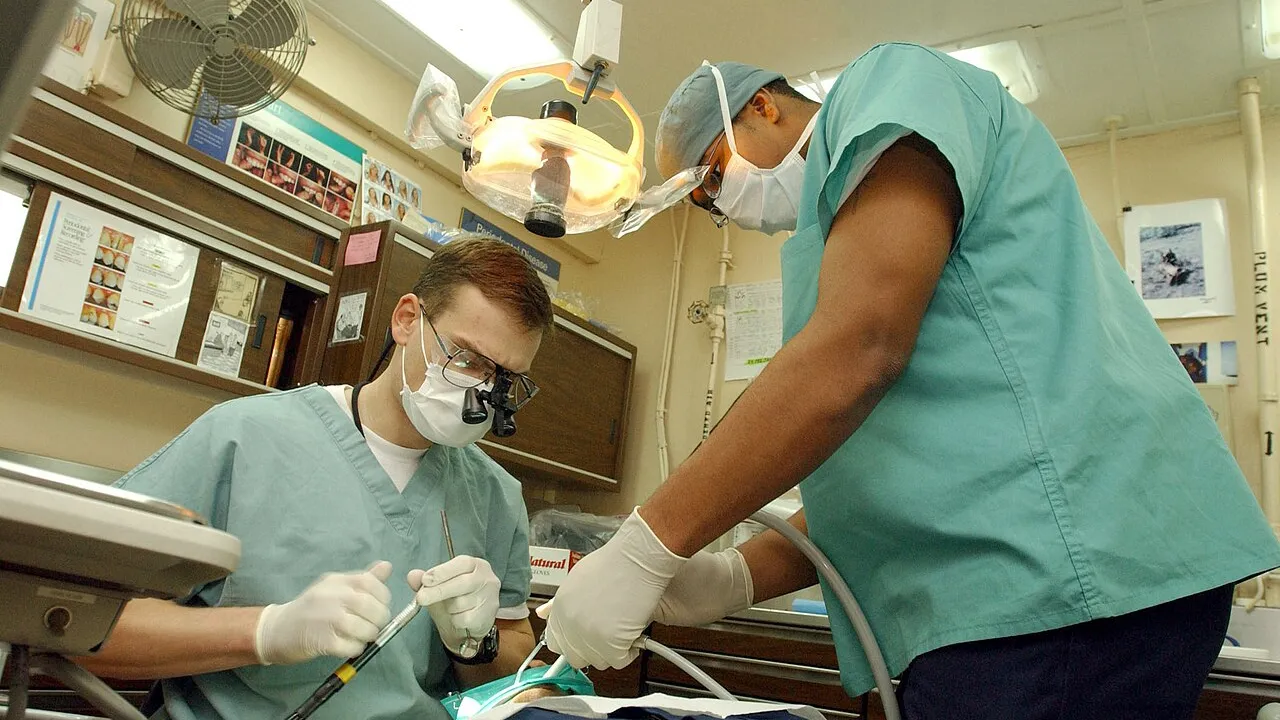
Working alongside dental and dental assistants, dentists use low-radiation digital X-ray sensors to see between teeth and beneath gums. When decay or a sports chip damages enamel, dentists sculpt durable composite resin fillings hardened in seconds with a blue curing light!
4
Becoming a Dentist
Dentists complete four years of college science plus four years of dental school to earn a DDS or DMD degree, and pediatric dentists train two extra years just for kids.
1. Which front teeth work like sharp scissors to snip a bite out of an apple?
2. What does a dentist's bright blue LED curing wand do during a filling?
🤯 Mind-Blowing Fact • Grade 4
DDS and DMD are actually the exact same dental degree—Harvard University simply translated 'Doctor of Dental Surgery' into Latin in 1867, creating the initials DMD!
✨ Word Sparks (Grade 4 Glossary)
Tap 🔊 to hear
hydroxyapatite
Calcium-phosphate crystal making enamel and bone hard
gingivitis
Early gum puffiness caused by plaque buildup
radiograph
X-ray image showing roots and jawbones
🪝
How is mouth health connected to the rest of your body, and what chemistry happens on your enamel every time you eat?
1
Crystal Armor and Mineral Chemistry
Zoom in with an electron microscope on a healthy tooth and you will see millions of tightly packed mineral rods called ! Composed of ninety-six percent mineral, enamel is harder than steel forks, yet vulnerable to acid. Whenever bacteria such as Streptococcus mutans digest carbohydrates, mouth pH drops and minerals dissolve—until calcium, phosphate, and fluoride in saliva remineralize the surface!
2
Tools of Modern Dentistry
Inside a modern dental suite, dental hygienists use ultrasonic scalers vibrating thousands of times per second with a cooling water mist to lift hardened tartar from gumlines. Next, the dentist examines digital , checks jaw joints, screens soft tissues, and repairs damaged crowns or cavities using biomimetic materials engineered to flex and expand just like natural tooth structure.
3
Why Healthy Gums Help the Whole Body
Oral health affects far more than chewing and clear speech. Untreated gum inflammation— and periodontitis—allows harmful bacteria into the bloodstream, which researchers link to heart and systemic health challenges.
4
DDS and DMD Degrees
Whether a dentist's diploma says DDS (Doctor of Dental Surgery, first awarded at Baltimore College of Dental Surgery in 1840) or DMD (Doctor of Medicine in Dentistry, introduced by Harvard in 1867), both degrees represent the exact same four-year doctoral education and licensing exams!
1. How does fluoride in toothpaste and drinking water help protect teeth?
2. What is the difference in medical training between a DDS dentist and a DMD dentist?
🤯 Mind-Blowing Fact • Grade 5
Human back molars can exert more than 150 to 200 pounds of biting force when crunching hard nuts—which is why dentists engineer ceramic crowns to rival natural enamel in strength!
✨ Word Sparks (Grade 5 Glossary)
Tap 🔊 to hear
demineralize
Lose strengthening calcium minerals due to acid
periodontal
Relating to gums and bone holding teeth
CAD/CAM
Computer design and robotic milling of crowns
🪝
How do biomaterials engineering, microbiology, and 3D digital imaging turn modern dentistry into part science lab and part micro-sculpture?
1
Micro-Architecture of the Living Tooth
Consider the engineering demands placed on human dentition: thirty-two permanent teeth must withstand biting forces exceeding 150 pounds per square inch on back molars tens of thousands of times a year in a warm, moist environment teeming with over 700 species of oral microbes! To survive, outer enamel combines 96 percent crystalline calcium-phosphate hydroxyapatite for extreme hardness with resilient underlying dentin tubules that absorb shock without shattering, all nourished by neurovascular pulp anchored via microscopic ligament fibers.
2
Biofilms, pH Thresholds, and Prevention
Dental caries (tooth decay) is a dynamic chemical tug-of-war at the microscopic level. When acidogenic bacteria within dental plaque metabolize fermentable sugars, lactic acid lowers plaque pH below the critical threshold of 5.5, demineralizing enamel rods. Dentists Tip the balance back toward remineralization through topical fluorides—forming acid-resistant fluorapatite—pit-and-fissure resin sealants that shield deep molar grooves by up to eighty percent, and preventive cleanings that disrupt calcified subgingival calculus.
3
Digital Scanners and Chairside CAD/CAM
Gone are many messy putty trays of the past! Modern dentists sweep wand-sized optical intraoral scanners across teeth to capture thousands of laser frames per second, generating a 3D digital model accurate to twenty micrometers. Computer-aided design and manufacturing () mills can carve a custom ceramic crown from a solid block of lithium disilicate in minutes, while photopolymerized nano-hybrid composites bond seamlessly to enamel.
4
Historical Milestones and Specialties
Professional dentistry formalized when Horace Hayden and Chapin Harris founded the world's first dental college in Baltimore in 1840, and pioneers like Dr. Lucy Hobbs Taylor (first woman to earn a DDS in 1866) and Dr. Robert Tanner Freeman (first African American dental graduate at Harvard in 1869) opened doors across the profession. After earning a DDS or DMD, graduates may practice general dentistry or specialize in pediatric dentistry, endodontics, periodontics, oral surgery, or orthodontics.
5
Artistry With Steady Hands
Blending microscopic hand-eye coordination with reassuring communication, dentists restore painless chewing, clear pronunciation, and confident smiles across every stage of life.