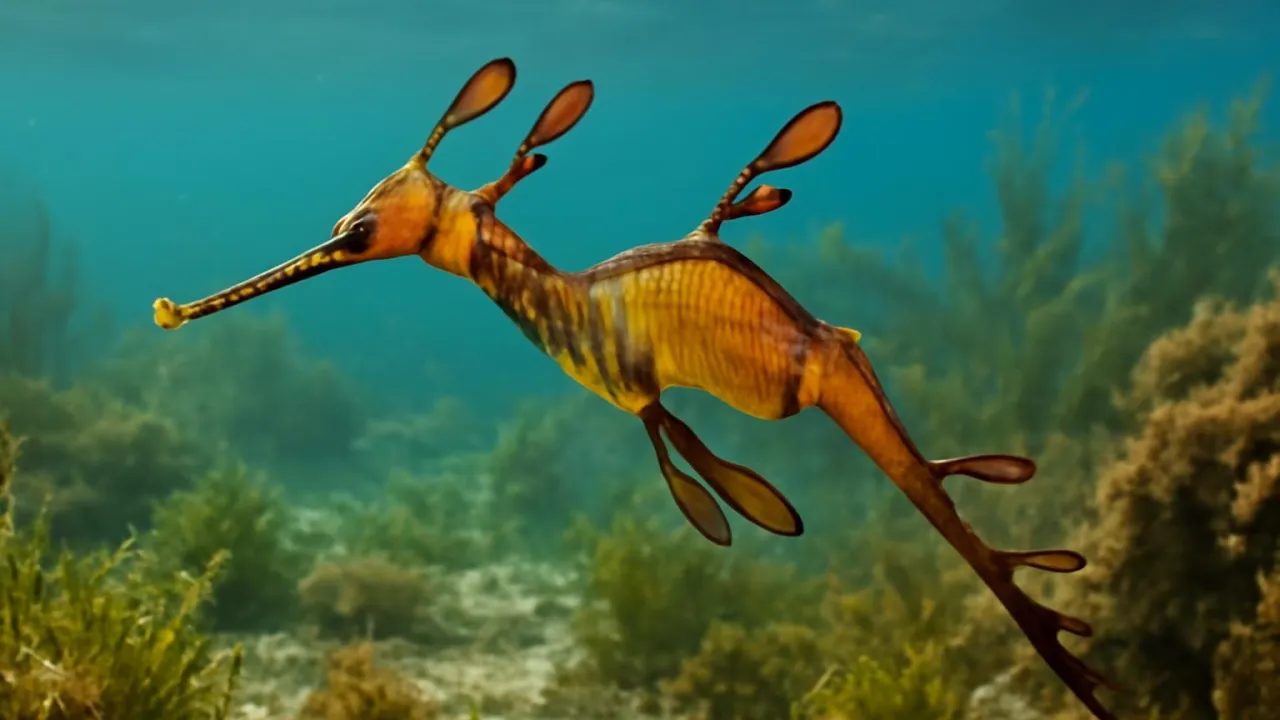
Weedy seadragons can move their leaf-like parts to look just like seaweed swaying in water!
✨ Word Sparks (Grade 2 Glossary)
Tap 🔊 to hear
camouflage
How animals hide by looking like things around them
predator
An animal that hunts other animals for food
plankton
Tiny animals and plants that float in water
🪝
Have you ever seen a fish that looks like a plant?
1
Amazing Camouflage
The weedy seadragon has leaf-like parts that help it blend in. It swims slowly near seaweed beds and kelp forests. This protects it from . It looks like floating sea plants in the ocean.
2
What It Eats and How
It feeds on tiny shrimp and using its long snout. The snout works like a straw to suck in food quickly. The weedy seadragon needs clean water to find enough food. It cannot chew, so it swallows food whole.
3
Where It Lives
This fish lives along the southern coasts of Australia. It hides among seaweed and kelp to stay safe. The water there is cool and full of plants. The seadragon is often found at depths up to 50 feet.
1. Why does the weedy seadragon look like seaweed?
2. Where does the weedy seadragon live?
🤯 Mind-Blowing Fact • Grade 3
Weedy seadragons have no teeth but use their long snouts to suck up tiny prey whole!
✨ Word Sparks (Grade 3 Glossary)
Tap 🔊 to hear
appendages
Body parts that stick out, like leaves or fins
nutrients
Food parts that help animals grow and stay healthy
reproduction
How animals have babies or make young
🪝
How does the weedy seadragon’s look help it survive underwater?
1
Master of Camouflage
The weedy seadragon has leaf-like that provide excellent camouflage. These parts help it blend into seaweed and kelp forests. This adaptation protects it from predators by making it hard to see. Its colors and shapes mimic floating plants perfectly.
2
Feeding and Survival
It feeds on tiny crustaceans and plankton by sucking them through its long snout. Because it cannot chew, it swallows prey whole and quickly. This feeding method helps it get efficiently in its habitat. The seadragon’s slow swimming matches the gentle ocean currents.
3
Habitat and Behavior
Weedy seadragons live in coastal waters of southern Australia, often near kelp forests. They use their camouflage to avoid predators like larger fish. They are solitary creatures but sometimes come together during breeding season. Their habitat provides shelter and food sources.
4
Reproduction and Growth
Male weedy seadragons carry eggs on the underside of their tails until they hatch. This unique role helps protect the young from predators. After hatching, the baby seadragons are independent and must find food quickly. This reproductive strategy increases their survival chances.
1. What helps the weedy seadragon hide from predators?
2. Who carries the eggs in weedy seadragons?
🤯 Mind-Blowing Fact • Grade 4
Weedy seadragons help keep ocean ecosystems balanced by eating tiny animals and serving as prey themselves.
✨ Word Sparks (Grade 4 Glossary)
Tap 🔊 to hear
ecosystem
A community of living things and their environment
predation
When one animal eats another for food
conservation
Protecting animals and their homes from harm
🪝
Why is the weedy seadragon’s camouflage important for its role in the ocean ecosystem?
1
Camouflage and Survival
The weedy seadragon’s leaf-like appendages allow it to blend perfectly into kelp forests, making it nearly invisible to predators. This camouflage is a vital adaptation that helps maintain its population by reducing . Because it moves slowly, blending in helps it avoid detection. Its ability to mimic seaweed also aids in hunting small crustaceans.
2
Role in the Food Web
As a predator of tiny crustaceans and plankton, the weedy seadragon plays an important role in controlling these populations. It also serves as prey for larger fish, linking different levels of the marine food web. This balance helps keep the healthy and diverse. Human activities that damage kelp forests threaten this delicate balance.
3
Habitat and Distribution
Weedy seadragons are found along Australia’s southern coast, favoring rocky reefs and kelp beds. They require clean, cool waters with abundant seaweed to provide shelter and food. Pollution and habitat loss from coastal development have reduced their natural habitats. efforts focus on protecting these critical environments to support seadragon populations.
4
Human Impact and Conservation
Humans impact weedy seadragons through pollution, fishing, and habitat destruction, which threaten their survival. Marine protected areas help conserve their habitats and reduce human threats. Educating people about their ecological role encourages efforts to protect them. Scientists study their behavior and reproduction to improve strategies.
Male weedy seadragons carry and protect eggs on their tails, a rare example of male pregnancy in fish!
✨ Word Sparks (Grade 5 Glossary)
Tap 🔊 to hear
Syngnathidae
Family of fish including seahorses and pipefish
brood patch
A special area where males carry eggs until they hatch
camouflage
How animals hide by blending into their surroundings
🪝
What remarkable adaptations make the weedy seadragon a unique fish in Australia’s coastal waters?
1
Scientific Classification and Unique Features
The weedy seadragon, scientifically named Phyllopteryx taeniolatus, belongs to the family, which includes seahorses and pipefish. It is distinguished by its elaborate leaf-like appendages and vibrant coloration, adaptations that provide exceptional in kelp forests. Unlike many fish, it lacks teeth and uses a long, tubular snout to suction-feed on small crustaceans. This specialized feeding mechanism is highly efficient in its natural habitat.
2
Physiological Mechanics and Movement
Weedy seadragons swim by undulating small fins located near their head and tail, allowing slow, graceful movement that mimics swaying seaweed. Their body shape and appendages reduce water resistance and enhance , making them nearly invisible to predators. They rely on their excellent vision to detect prey and avoid threats. Their slow swimming speed is about 1 foot per second, which suits their stealthy lifestyle.
3
Reproductive Biology and Lifecycle
Male weedy seadragons carry fertilized eggs in a under their tails for about four to six weeks until hatching. This unique parental care increases offspring survival by protecting eggs from predators and environmental hazards. After hatching, juveniles are independent and must quickly learn to feed and themselves. The species’ reproductive strategy reflects evolutionary adaptation to its complex marine environment.
4
Conservation Status and Human Impact
Although not currently endangered, weedy seadragons face threats from habitat destruction, pollution, and climate change affecting kelp forests. Coastal development and water pollution reduce suitable habitats, while rising ocean temperatures impact their food supply. Conservation programs focus on habitat protection, marine reserves, and public education to ensure their survival. Scientific research continues to monitor populations and develop effective conservation methods.
5
Quantitative Comparisons and Environmental Adaptations
Weedy seadragons grow up to 18 inches (45 cm) long and live at depths up to 50 feet (15 meters) in temperate waters ranging from 55 to 68 degrees Fahrenheit (13 to 20 degrees Celsius). Their slow swimming speed contrasts with faster reef fish, emphasizing stealth over speed. Their efficiency rivals that of cuttlefish, making them masters of disguise. These adaptations allow them to thrive in complex kelp ecosystems.