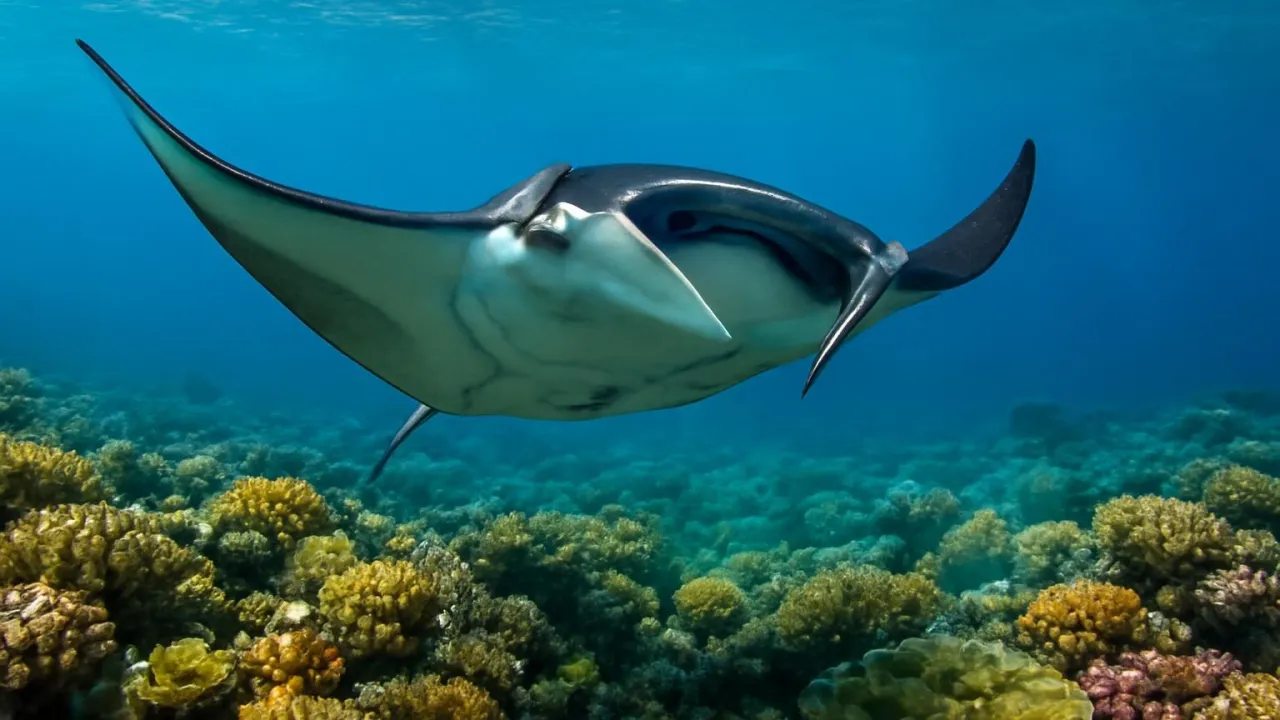
Giant manta rays can have a wingspan as wide as a small bus!
✨ Word Sparks (Grade 2 Glossary)
Tap 🔊 to hear
plankton
Tiny plants and animals in water
filter
To catch tiny things from water
tropical
Warm places near the equator
🪝
Have you ever seen a fish that looks like it can fly underwater?
1
Huge and Graceful
The giant manta ray can grow very large and wide. It has two big fins that look like wings. It glides smoothly through the water like it is flying. Its body is dark on top and white underneath.
2
Eating Tiny Food
This ray eats tiny and small fish by swimming with its mouth open. It food from the water as it moves. It needs clean, warm water to find enough food. The manta ray can swim long distances to feed.
3
Warm Ocean Home
Giant manta rays live in and subtropical oceans around the world. They often stay near coral reefs and shallow waters. They like places with plenty of sunlight and . These rays sometimes jump out of the water for fun.
Giant manta rays use their wing-like fins to glide through water at speeds up to 12 miles per hour!
✨ Word Sparks (Grade 3 Glossary)
Tap 🔊 to hear
camouflage
Colors that help hide in the environment
plankton
Tiny animals and plants in water
breaching
Jumping out of water into the air
🪝
How does the giant manta ray glide so smoothly through the ocean?
1
Amazing Size and Shape
The giant manta ray has a wingspan up to 23 feet wide, making it one of the largest fish. Its large pectoral fins act like wings, helping it to glide gracefully. The ray’s dark top helps it with the ocean depths. Its white belly blends with the sunlight above, protecting it from predators.
2
Feeding with Filtered Water
Giant manta rays feed by filtering and tiny fish from the water. They swim with their mouths wide open, using gill rakers to trap food. This adaptation lets them collect nutrients efficiently. Their slow, steady swimming helps them avoid scaring prey away.
3
Life in Warm Waters
These rays live mostly in tropical and subtropical ocean waters. They often visit coral reefs where is abundant. Their habitat choice helps them find enough food and avoid cold water. Warm water also supports their body temperature and energy needs.
4
Jumping and Social Behavior
Giant manta rays sometimes leap out of the water in a behavior called . Scientists think this helps remove parasites or communicate. They are social animals and often gather in groups near cleaning stations. These behaviors help them survive and stay healthy.
Giant manta rays can migrate over 1,200 miles to find food and suitable habitats each year!
✨ Word Sparks (Grade 4 Glossary)
Tap 🔊 to hear
trophic
Part of a food chain or web
symbiotic
Living together and helping each other
migration
Moving from one place to another
🪝
What role does the giant manta ray play in ocean ecosystems?
1
Physical Adaptations for Survival
The giant manta ray’s enormous wingspan allows it to glide effortlessly through ocean currents, conserving energy during long-distance travel. Its countershaded coloring provides camouflage from predators both above and below. The ray’s cephalic lobes help funnel plankton into its mouth, improving feeding efficiency. These adaptations enable it to thrive in diverse marine environments.
2
Ecological Role and Food Webs
As a filter feeder, the giant manta ray plays a vital role in controlling plankton populations, which supports ocean health. It serves as prey for large sharks and orcas, linking lower and higher levels in the food web. Its presence near coral reefs helps maintain balanced ecosystems by preventing plankton overgrowth. This relationship benefits many marine species.
3
Geographic Distribution and Habitats
Giant manta rays inhabit tropical and subtropical oceans worldwide, favoring shallow coastal waters and coral reefs. They migrate seasonally to follow plankton blooms and warmer water temperatures. Their habitat choices are influenced by water quality and food availability, which are affected by human activities. Protecting these habitats is crucial for their survival.
4
Human Impact and Conservation
Giant manta rays face threats from fishing, habitat destruction, and pollution caused by humans. They are protected under international agreements, but illegal fishing still occurs. Ecotourism provides economic incentives to conserve manta rays and their habitats. Conservation efforts focus on reducing bycatch and preserving clean ocean environments.
1. How does the giant manta ray help ocean ecosystems?
2. What threatens giant manta rays?
🤯 Mind-Blowing Fact • Grade 5
Giant manta rays can swim up to 22 miles per hour when breaching, faster than many large ocean animals!
✨ Word Sparks (Grade 5 Glossary)
Tap 🔊 to hear
pectoral fins
Large fins like wings for swimming
bycatch
Unintended animals caught in fishing nets
IUCN
Group that protects endangered animals
🪝
How do giant manta rays’ unique biology and behavior support their survival in vast oceans?
1
Taxonomy and Scientific Classification
The giant manta ray, scientifically named Manta birostris, belongs to the family Mobulidae within the class Chondrichthyes, which includes cartilaginous fishes like sharks and rays. It is distinguished from its close relative, the reef manta ray, by its larger size and distinct dorsal markings. Taxonomic studies use genetic analysis to clarify relationships within this group. Understanding its classification aids conservation strategies.
2
Physiological Adaptations and Mechanics
Giant manta rays possess large, flexible that function like wings, enabling efficient gliding and maneuvering through water. Their cephalic lobes, located on either side of the mouth, help channel plankton-rich water into their mouths during filter feeding. The gill rakers act as fine sieves to trap microscopic organisms. Their slow, energy-efficient swimming conserves oxygen and supports long-distance migration.
3
Conservation Status and Human Interaction
Classified as vulnerable by the , giant manta rays face threats from targeted fishing, , and habitat degradation. International protections under CITES regulate trade, but enforcement varies globally. Ecotourism has increased awareness and funding for manta ray conservation. Research on population dynamics and migratory patterns informs management plans to ensure their long-term survival.
4
Ecological Role and Quantitative Comparisons
Giant manta rays regulate plankton populations, which influences oceanic carbon cycles and nutrient distribution. They can reach wingspans up to 23 feet, weighing around 3,000 pounds, making them among the largest rays. Their swimming speeds average 12 miles per hour but can burst up to 22 miles per hour during breaching. These quantitative traits highlight their significant ecological presence.
5
Historical and Botanical Context
Although not a plant, the giant manta ray’s filter feeding on plankton connects it to microscopic marine flora and fauna, illustrating complex food webs. Historically, manta rays have been featured in indigenous oceanic cultures as symbols of grace and strength. Scientific exploration has advanced understanding of their behavior and physiology, contributing to marine biology knowledge. Their conservation reflects growing human respect for ocean biodiversity.