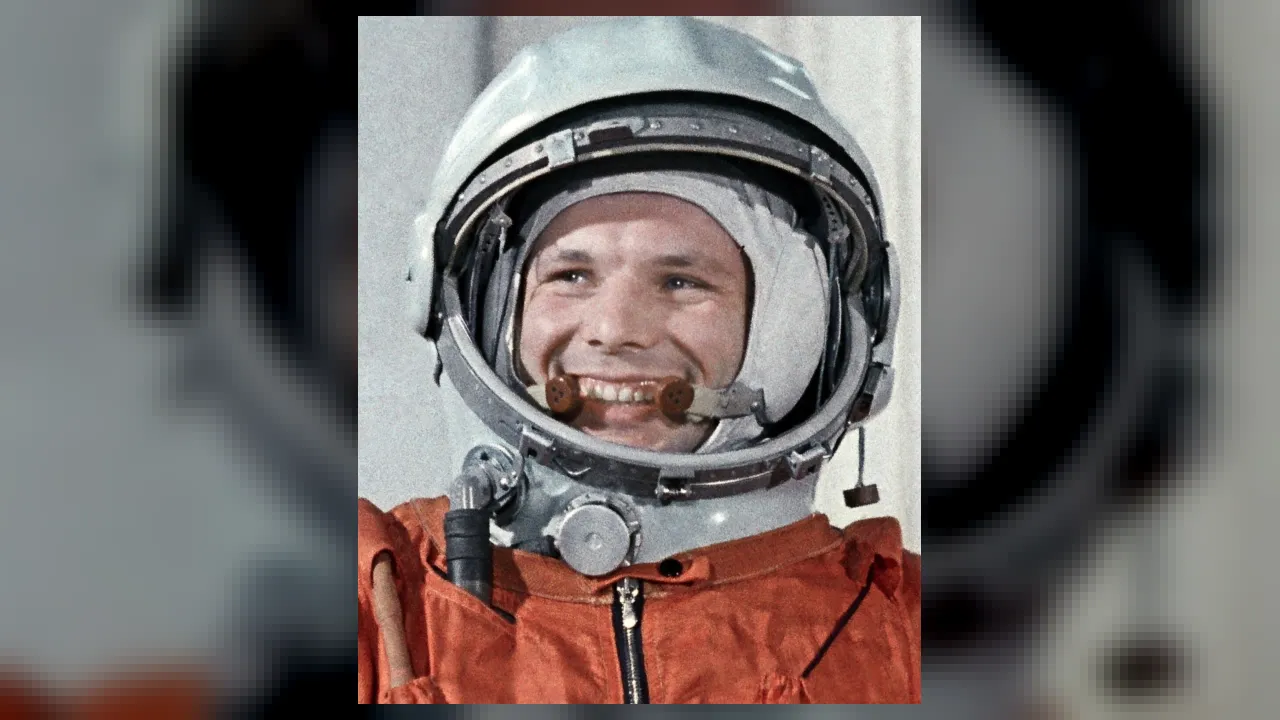
1. Who rode inside Vostok 1 to become the first human in outer space?
2. How many times did Vostok 1 circle Earth before coming home?
🤯 Mind-Blowing Fact • Grade 2
When Yuri Gagarin floated his pencil in zero gravity to take notes, it drifted out of reach—teaching space agencies to attach pens with strings or Velcro!
✨ Word Sparks (Grade 2 Glossary)
Tap 🔊 to hear
weightlessness
floating freely in orbit without weight
automatic
working by itself without hand steering
eject
launch safely out of a cabin seat
🪝
Why were Vostok 1's manual controls locked behind a secret code inside a paper envelope?
1
Stepping into the Unknown
Before April 12, 1961, no human had ever experienced in orbit! Some doctors worried zero gravity might make a person dizzy or unable to swallow, think, or move switches.
2
A Secret Envelope Onboard
To stay safe, engineers ran Vostok 1 automatically from the ground and locked its manual controls. Inside the round cabin hung a sealed envelope holding a secret three-digit code—3-2-5—so cosmonaut Yuri Gagarin could unlock the controls only if he could still read and think clearly!
3
A Skydiver's Landing
felt wonderful! Watching his pencil float playfully beside him, Gagarin circled Earth at 17,500 miles per hour before ejecting high in the sky to parachute safely onto soft farmland.
1. Why did engineers put Vostok 1's unlock code inside an envelope instead of leaving manual steering on?
2. How did Yuri Gagarin touch down for the final few miles of Vostok 1's landing?
🤯 Mind-Blowing Fact • Grade 3
Every April 12, space fans around the globe celebrate 'Yuri's Night' and the UN's International Day of Human Space Flight in honor of Vostok 1!
✨ Word Sparks (Grade 3 Glossary)
Tap 🔊 to hear
braking rocket
engine firing forward to slow orbit
heat shield
thick outer layer blocking reentry heat
microgravity
near-weightless floating felt in free-fall orbit
🪝
Why was Vostok 1 shaped like a giant cannonball instead of a sleek airplane with wings?
1
Clever 'Little Ball' Design
Nicknamed 'Sharik'—Russian for 'little ball'—Vostok 1's crew cabin was a 7.5-foot metal sphere! Engineers chose a ball shape because it was sturdy, easy to calculate, and naturally rolled its thickest heat-shield side downward when plunging back into Earth's atmosphere without needing steering thrusters.
2
Ten Days of Backup Supplies
Just in case Vostok 1's failed in space, Chief Designer Sergei Korolev aimed the orbit low enough that thin upper air would naturally drag the capsule back down within ten days—packing ten full days of food, water, and oxygen inside!
3
A Wild Spin During Reentry
After Gagarin marveled at Earth's delicate blue halo over Africa and the Pacific, Vostok 1's braking engine fired. Suddenly, a bundle of wires failed to detach the equipment cone! The two halves tumbled wildly like bolas until fiery reentry heat melted the wires apart.
4
Greeting Surprised Farmers
Ejecting cleanly at four miles altitude, Gagarin floated down in his bright orange SK-1 suit to greet an astonished grandmother and granddaughter planting potatoes!
1. Why did Vostok 1 carry ten days of food and oxygen for a flight lasting less than two hours?
2. Why was a spherical ball shape so smart for Vostok 1's reentry capsule?
🤯 Mind-Blowing Fact • Grade 4
On Vostok 1's control panel sat a mechanical miniature Earth globe called the 'Globus' driven by clockwork gears that rotated in real time to show Yuri Gagarin the exact spot on Earth directly beneath him!
✨ Word Sparks (Grade 4 Glossary)
Tap 🔊 to hear
apogee
highest point in an Earth orbit
retrorocket
forward-firing rocket slowing orbital speed
G-force
push felt during strong acceleration
🪝
What happened when a valve glitch boosted Vostok 1 seventy miles higher than planned—and cables refused to let go during fiery reentry?
1
Higher Orbit Than Planned
When the Vostok-K rocket thundered off from Baikonur Cosmodrome on April 12, 1961—uttering Yuri Gagarin's joyful 'Poyekhali!'—a radio cutoff command missed the upper stage by seconds! Instead of topping out near 140 miles altitude, Vostok 1 climbed to a 203-mile . Had the TDU-1 liquid-fuel failed at that higher altitude, thin air drag would have taken over twenty days to pull Vostok 1 down—twice its life-support supply!
2
Proving Humans Thrive in Microgravity
Across 108 minutes, 27-year-old Gagarin tested eating pureed food from squeeze tubes, sipped water, monitored the clever 'Globus' mechanical Earth-position globe on his instrument panel, and radioed vivid descriptions of Earth's curved turquoise horizon—proving human vision, inner-ear balance, and swallowing worked smoothly in free fall.
3
EightGs and Burning Cables
Over Africa, the fired cleanly, yet an electrical umbilical bundle failed to sever! Dragged backward by the attached instrument module, Vostok 1 spun furiously through glowing 3,000-degree plasma while crushing 8-G forces pressed Gagarin into his seat—until intense heat finally burned the cable loose.
4
Ejection Over Saratov
At 7 kilometers altitude, explosive bolts blew the hatch and fired Gagarin's ejection sled into the sky near Engels, completing the dawn of human spaceflight!
1. Why was Vostok 1's higher-than-planned 203-mile apogee a hidden danger during the mission?
2. How did Vostok 1 finally break free when a stuck cable bundle kept the instrument module attached during reentry?
🤯 Mind-Blowing Fact • Grade 5
Vostok 1's potassium-superoxide air-regeneration canisters performed double duty without moving parts—chemically absorbing moisture and carbon dioxide from Gagarin's breath while releasing fresh oxygen gas at the exact same time!
✨ Word Sparks (Grade 5 Glossary)
Tap 🔊 to hear
ballistic reentry
unsteered gravity plunge cushioned by drag
vestibular
inner-ear system sensing balance and motion
potassium superoxide
chemical releasing oxygen while absorbing breath
🪝
How did Vostok 1's ballistic sphere solve life support, thermal protection, and orbital navigation before digital onboard computers existed?
1
Engineering the 3KA Spacecraft Architecture
Developed under Sergei Korolev and Konstantin Feoktistov at OKB-1, the 4,725-kilogram Vostok 3KA spacecraft paired a 2.46-ton spherical descent module—2.3 meters in diameter—with a 2.27-ton biconical instrument module housing nitrogen orientation thrusters, telemetry radios, and Isayev's 15.8-kilonewton TDU-1 amine/nitric-acid retrorocket. Because early guidance lacked lift-vector control, engineers chose a pure sphere coated completely in 3-to-18 centimeters of asbestos-phenolic ablator, weighted off-center so aerodynamic drag passively oriented the thickest shield forward.
2
Sea-Level Cabin Life Support and Biomedical Proof
Unlike later pure-oxygen capsules, Vostok 1 maintained a sea-level nitrogen-oxygen atmosphere at 101 kilopascals using potassium-superoxide chemical cartridges that simultaneously released breathable oxygen while scrubbing moisture and exhaled carbon dioxide! Electrocardiogram leads and cabin television cameras monitored Senior Lieutenant Yuri Gagarin throughout his 65-degree-inclination, 169-by-327-kilometer orbit—definitively dispelling pre-1961 aeromedical fears of paralysis, eyeball deformation, or circulatory collapse in microgravity.
3
Optical 'Vzor' Orientation and Analog Navigation
Without a digital flight computer, Gagarin monitored orbital ground track via the electromechanical IMP 'Globus' analog computer while verifying spacecraft attitude through the clever 'Vzor' optical ring porthole: eight radial mirrors projected Earth's horizon ring symmetrically around the viewport whenever the capsule aligned correctly for retrofire!
4
Surviving Ballistic Reentry Anomalies
Following a slight 1-second underburn of the retrorocket at 07:25 UTC and a 10-minute delayed separation of the thermal-tethered instrument module, Vostok 1 endured 8-to-10-G deceleration through incandescent plasma. At 7 kilometers altitude over Saratov Oblast, barometric relays fired the hatch bolts and catapulted Gagarin's ejection seat cleanly clear of the fast-descending metal sphere.
5
Shared Heritage of Space Exploration
Remarkably, Vostok's rugged spherical pressure-hull geometry proved so reliable that Soviet and Russian engineers adapted it for Voskhod spacewalks, Zenit reconnaissance satellites, and decades of Bion biological research missions.