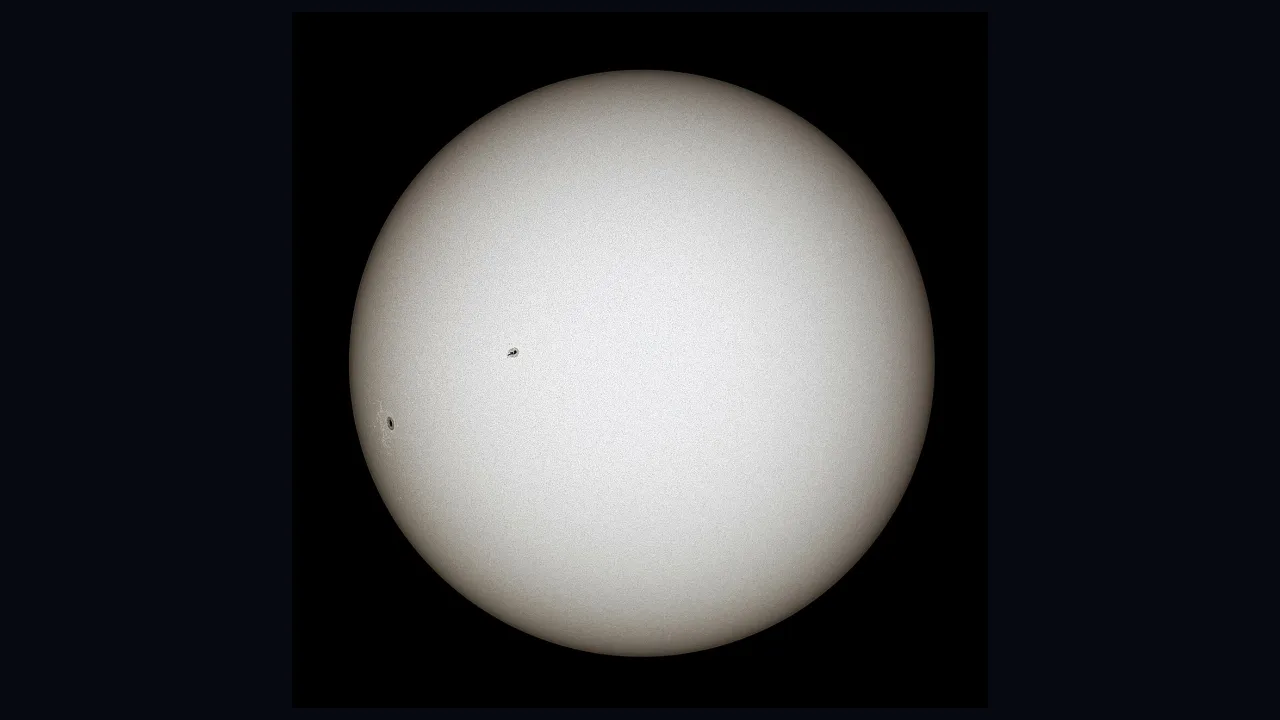
1. Why does the Sun look much bigger than nighttime stars?
2. How many Earths could fit inside the Sun if it were hollow?
🤯 Mind-Blowing Fact • Grade 2
Every single second, the Sun produces more energy than humans have used throughout all of history combined!
✨ Word Sparks (Grade 2 Glossary)
Tap 🔊 to hear
plasma
super-heated glowing gas full of energy
gravity
invisible pull between objects with mass
sunspots
cooler dark magnetic patches on the Sun
🪝
How does the Sun burn brightly in space where there is zero oxygen?
1
Glowing Plasma, Not Campfire
Campfires on Earth need wood and oxygen to burn, yet outer space has no air at all! Instead of ordinary fire, the Sun is a roaring sphere of super-hot fourth-state matter called , made mostly of hydrogen and helium gas.
2
Gravity Holds Eight Planets
Because the Sun holds almost all the mass in our Solar System, its huge acts like an invisible cosmic leash. Eight planets, icy comets, and millions of asteroids circle around it without drifting away!
3
Dark Cool Sunspots
Through special safe solar filters, astronomers spot dark patches called where strong magnets swirl across the Sun's stormy surface.
2. What keeps Earth and the other seven planets circling around the Sun?
🤯 Mind-Blowing Fact • Grade 3
A single solar prominence arch leaping off the Sun's edge can tower taller than twenty planet Earths stacked on top of one another!
✨ Word Sparks (Grade 3 Glossary)
Tap 🔊 to hear
fusion
joining tiny atoms together to release energy
photon
a tiny packet of traveling light energy
auroras
glowing ribbons of light near Earth's poles
🪝
Why does it take 100,000 years for light inside the Sun to escape—and only eight minutes to reach Earth?
1
Deep Inside the Core Engine
Journey to the very center of the Sun, where crushing weight heats temperatures to 27 million degrees Fahrenheit! Down in this core, hydrogen atoms smash together so hard they fuse into helium—a powerhouse process called nuclear that unleashes dazzling light and heat.
2
The Pinball Photon Maze
Once a tiny packet of light—called a —is born in the core, escaping is like playing cosmic pinball! Packed atoms bounce that photon zig-zagging around for roughly 100,000 years before it reaches the visible surface, then zooms to Earth in eight minutes and twenty seconds.
3
Loops of Solar Storms
Because the Sun spins faster at its equator than near its poles, its magnetic lines twist like rubber bands until giant glowing arches called solar prominences leap thousands of miles into space!
4
Painting Earth's Auroras
Streams of charged particles called the solar wind blow constantly outward; when they brush Earth's magnetic shield near the poles, the night sky shimmers with green and violet !
1. What happens inside the Sun's 27-million-degree core to create energy?
2. Why do magnetic field lines twist up across the Sun?
🤯 Mind-Blowing Fact • Grade 4
NASA's Parker Solar Probe zooms past the Sun at 430,000 miles per hour—fast enough to fly from New York to Tokyo in under one minute!
✨ Word Sparks (Grade 4 Glossary)
Tap 🔊 to hear
photosphere
the bright visible surface layer of stars
corona
the super-hot outer atmosphere around the Sun
heliosphere
giant magnetic bubble blown by solar wind
🪝
Why is the Sun's outer atmosphere hundreds of times HOTTER than its glowing surface?
1
Six Layers From Core to Corona
Imagine walking away from a campfire only to feel the air suddenly become three hundred times hotter! That exact mystery happens on the Sun. While its visible surface—the —glows at roughly 10,000 degrees Fahrenheit (5,500 °C), its ghostly outer atmosphere—the , visible as a pearly crown during a total solar eclipse—skyrockets past two million degrees Fahrenheit! Solar physicists discovered that snapping magnetic waves called Alfvén waves and trillions of tiny 'nanoflares' whip super-hot energy high into the corona.
2
The Eleven-Year Heartbeat
Every eleven years, the Sun's north and south magnetic poles completely flip places! During 'solar maximum,' sunspots multiply and powerful bursts called coronal mass ejections hurl billion-ton clouds of magnetized plasma across the Solar System.
3
Touching the Star With Parker Solar Probe
How do you fly a spacecraft right through the Sun's without melting? NASA's Parker Solar Probe hides behind a 4.5-inch carbon-foam heat shield, skimming within four million miles of the solar surface at 430,000 miles per hour—the fastest human-made object in history!
4
A Protective Bubble Around Every Planet
Solar wind inflates a colossal magnetic bubble called the extending far past Pluto, shielding Earth and its sibling planets from harsh interstellar cosmic rays.
1. Which part of the Sun is much hotter than its 10,000 °F visible photosphere surface?
2. How often do the Sun's magnetic north and south poles flip places?
🤯 Mind-Blowing Fact • Grade 5
Every single second, the Sun converts four million metric tons of its own mass directly into pure light and heat energy via Einstein's E = mc²!
✨ Word Sparks (Grade 5 Glossary)
Tap 🔊 to hear
equilibrium
a steady balance between two opposing forces
neutrinos
tiny ghostlike particles zooming from star cores
convective
transferring heat through rising and sinking currents
🪝
How does our middle-aged star balance crushing gravity against an unending nuclear furnace—and what will become of it billions of years from now?
1
Hydrostatic Equilibrium at Cosmic Scale
Born 4.6 billion years ago from the gravitational collapse of a giant molecular nebula, our Sun—classified astronomically as a G2V main-sequence yellow dwarf—contains 99.86 percent of the Solar System's total mass, or roughly two nonillion kilograms! Why doesn't such colossal gravity crush the star into a tiny speck, or its fiery core blow it apart? Every second, inward gravitational pull matches outward radiation and thermal gas pressure in a delicate cosmic truce called hydrostatic .
2
Einstein's Equation Inside the Proton-Proton Chain
Compressed to 150 times the density of liquid water and heated to 15 million kelvins (27 million °F), the solar core fuses 600 million metric tons of hydrogen nuclei into 596 million tons of helium every second via the proton-proton chain. What happens to the 'missing' four million tons of matter each second? Following Albert Einstein's famous law E = mc², that mass transforms directly into pure radiant energy and ghostlike subatomic particles called that zip straight through Earth!
3
Radiative and Convective Transport Zones
Above the core stretches the radiative zone, where gamma-ray photons scatter off dense ions for roughly 100,000 to 170,000 years, gradually losing energy until they enter the zone—boiling Texas-sized cells of rising plasma called granules that tile the 5,778-kelvin photosphere.
4
Differential Rotation and Space Weather
Because equatorial plasma completes a rotation in 25 days while polar latitudes take 35 days, this differential rotation winds internal magnetic fields into a solar dynamo, unleashing X-class solar flares and coronal mass ejections monitored round-the-clock by NASA's Solar Dynamics Observatory and Parker Solar Probe.
5
Galactic Orbit and Distant Future
Right now, our Sun carries the entire planetary family around the Milky Way's center at 828,000 kilometers per hour, completing one 'galactic year' every 230 million years! Halfway through its ten-billion-year main-sequence lifespan, it will eventually exhaust core hydrogen five billion years from now, swell into a luminous red giant, shed a glowing planetary nebula, and leave behind an Earth-sized diamond-dense ember called a white dwarf.