🌌 COSMOS
🔭 Mars II • Outer Natural Satellite of Mars
VA Science SOL 1.6, 4.5, 4.6 (Solar System, Stars & Space Exploration)
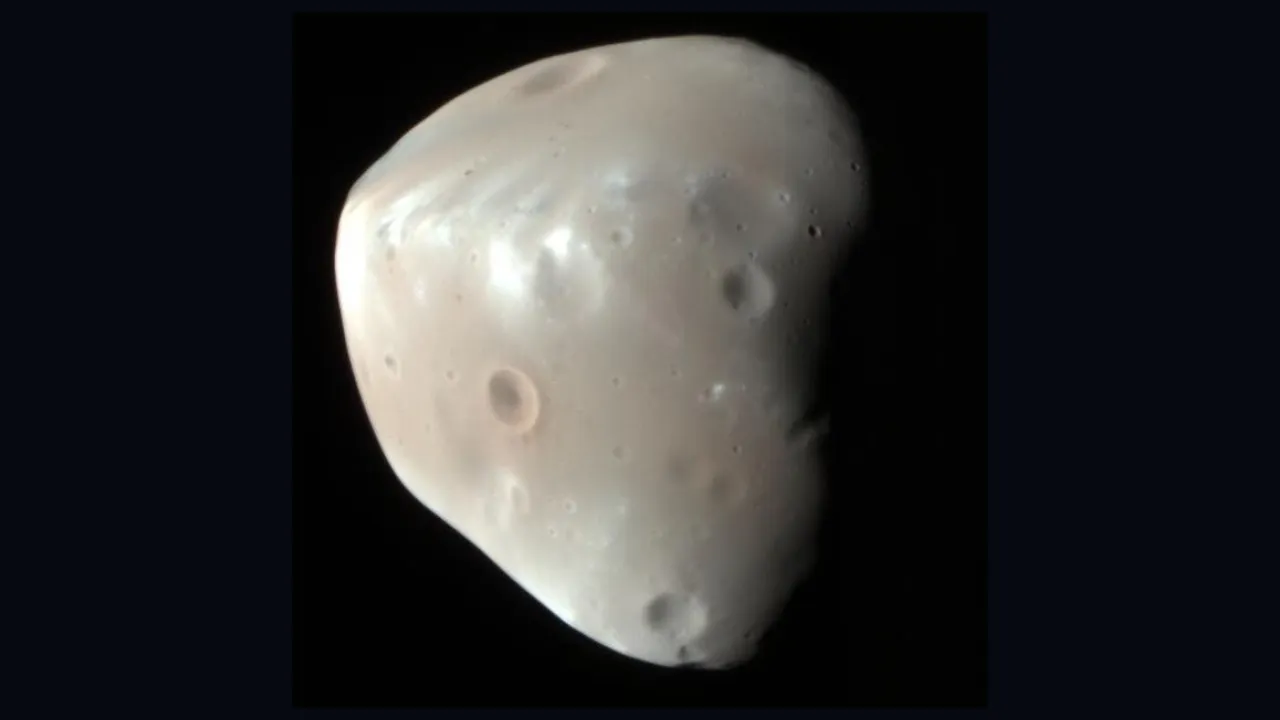
Deimos
Tiny Smooth-Dusted Outer Moon of Mars
Grade 3 • Fluent • 148 words
🌌 Cosmic Location & DistanceOuter Orbit Around Mars • 14,576 mi (23,458 km) from Mars center
🪐 Scale / Diameter9 × 7.6 × 6.8 mi (15 × 12.2 × 11 km) • City-sized moon
☄️ Composition & OrbitDark Carbon-Rich Porous Rock • 30.3-hour orbit around Mars
⚡ Cosmic SparkSo small you could ride a bicycle faster than its escape speed!
🤯 Mind-Blowing Fact • Grade 1
Gravity on tiny Deimos is so light that if you pedaled a bicycle fast up a ramp, you would float right into space!
✨ Word Sparks (Grade 1 Glossary)
Tap 🔊 to hear
drift
float gently and slowly along
smooth
even and soft without sharp bumps
blanket
a thick soft layer covering ground
🪝
Could an entire moon fit inside a single city?
1
Mars's Little Moon
Look past Phobos into the dark sky above Mars! Drifting farther out is tiny Deimos, the smaller of Mars's two moons. Measuring only nine miles long, it could fit right inside a city!
2
Soft Dusty Blanket
Unlike rough and bumpy Phobos, Deimos looks and soft! Thick gray dust fills up almost all of its craters.
3
Like a Bright Star
From the ground on Mars, tiny Deimos looks like a bright evening star gliding slowly overhead.
2. Why does Deimos look smoother than its sibling moon Phobos?
🤯 Mind-Blowing Fact • Grade 2
Over 150 years before telescopes spotted Deimos, Gulliver's Travels author Jonathan Swift guessed in 1726 that Mars had two tiny moons!
✨ Word Sparks (Grade 2 Glossary)
Tap 🔊 to hear
author
a person who writes books or stories
honor
show special respect or celebration for
escape
break free from a world's gravity
🪝
Why were two craters on tiny Deimos named after famous book authors?
1
Authors Who Guessed Right!
More than 150 years BEFORE astronomer Asaph Hall discovered Deimos in 1877, writer Jonathan Swift wrote a storybook guessing that Mars had two tiny moons! French Voltaire wrote about two Martian moons too. To their lucky guesses, scientists named Deimos's only two named craters Swift and Voltaire!
2
Slow Stroll Across Mars's Sky
While inner brother Phobos zips rapidly west-to-east, outer Deimos takes 30.3 hours per orbit—rising calmly in the east and taking nearly three Martian days before setting in the west!
3
Drifting Gently Away
Just like Earth's Moon, Deimos inches slowly farther from Mars instead of spiraling inward.
1. Why did scientists name Deimos's two main craters Swift and Voltaire?
2. How is Deimos's orbit changing over millions of years?
🤯 Mind-Blowing Fact • Grade 3
Escape velocity on Deimos is only 12.5 miles per hour—meaning an Olympic sprinter could literally run fast enough to leap off the moon into space!
✨ Word Sparks (Grade 3 Glossary)
Tap 🔊 to hear
velocity
speed traveling in a specific direction
mythology
traditional ancient stories about heroes and gods
streaks
long differently colored bands across ground
🪝
How can a nine-mile rock with almost zero gravity hold onto a hundred-foot blanket of dust?
1
Why Dust Stays Put
Throw a pebble at just thirteen miles per hour on Deimos and it escapes into orbit around Mars! Wait—if Deimos's gravity is 2,500 times weaker than Earth's, shouldn't meteor impacts blast all its dust away into space? Here is the trick: blasted dust enters a narrow 'Deimos ring' around Mars until Deimos gently sweeps its own dust right back up like a vacuum cleaner!
2
Downhill Dust Slides
Close-up photos from Viking 2 and the UAE's Hope Mars probe show bright snaking down gentle hills on Deimos, where powdery regolith slowly slid into low valleys.
3
Twin Horses of Mythology
Discoverer Asaph Hall named Phobos ('Fear') and Deimos ('Dread') after the mythological twin attendants who drove the chariot of Ares, the Greek counterpart of Mars.
4
Passing Across the Sun
When Deimos passes in front of the Sun as viewed by Mars rovers, it sits so far out that it looks like a tiny dark peppercorn gliding across a bright dinner plate!
1. How does tiny Deimos get back dust blasted into space by meteoroids?
2. About how fast is escape velocity on Deimos?
🤯 Mind-Blowing Fact • Grade 4
In 2023, the UAE's Hope spacecraft flew within 62 miles of Deimos and found mineral clues matching Martian basalt rather than outer-system asteroids!
✨ Word Sparks (Grade 4 Glossary)
Tap 🔊 to hear
infrared
invisible heat light beyond red rainbows
spectrometer
instrument identifying minerals by light wavelengths
coalesced
came together to form one body
🪝
What did the Hope spacecraft's 2023 close-up flyby reveal about where tiny Deimos came from?
1
A Rare Close-Up Visit in 2023
Because most Mars orbiters hug low altitudes to photograph Martian canyons and landing sites, outer moon Deimos rarely gets close visitors! In March 2023, the United Arab Emirates' Emirates Mars Mission ('Hope' probe) swooped within just 62 miles (100 kilometers) of Deimos, snapping humanity's first sharp images of Deimos's Mars-facing and far sides in nearly half a century!
2
Clues Inside Infrared Light
Before Hope's flyby, dark reddish-black colors led many astronomers to assume Deimos was a captured D-type asteroid from near Jupiter. However, Hope's measured heat and mineral signatures matching basaltic rocks much closer to Mars itself—adding strong new weight to the hypothesis that Phobos and Deimos from a giant impact ring around young Mars!
3
Safe Above Synchronous Altitude
Recall that Mars spins once every 24 hours and 37 minutes—matching a synchronous orbit 12,690 miles from Mars's center. Orbiting just outside that boundary at 14,576 miles, Deimos takes 30.3 hours per lap, keeping it forever safe from Phobos's inward spiral!
4
Future Astronaut Lookout Post
Sitting outside Mars's steepest gravity well with a commanding view of almost the entire globe, Deimos could someday serve as an ideal low-gravity communication and tele-robotics station for human explorers controlling rovers below!
1. What did the UAE Hope probe's infrared spectrometer discover about Deimos in 2023?
2. Why won't Deimos spiral down into Mars like inner sibling Phobos?
🤯 Mind-Blowing Fact • Grade 5
As Deimos crawls for 65 hours across the Martian sky between rising and setting, watchers on Mars see it go through TWO complete cycles of Moon phases!
✨ Word Sparks (Grade 5 Glossary)
Tap 🔊 to hear
areosynchronous
orbiting Mars in exact sync with its spin
torus
a doughnut-shaped ring of orbiting dust
inclination
tilt angle of an orbit above equators
🪝
How did Johannes Kepler's mathematical guesswork inspire fiction writers to 'discover' Deimos 151 years early—and what does its orbit teach planetary physicists?
1
From Kepler's Pattern Puzzle to Naval Observatory Triumph
In 1610, learning Galileo had found four moons around Jupiter while Earth possessed one, German mathematician Johannes Kepler reasoned by geometric progression—1, 2, 4—that Mars in between ought to harbor two moons! Satirizing scientific societies in Gulliver's Travels (1726), Jonathan Swift playfully gifted Laputan astronomers two tiny Martian moons orbiting in 10 and 21.5 hours—startlingly close to actual Phobos (7.65 hours) and Deimos (30.31 hours)! Real discovery waited until August 12, 1877, when Asaph Hall masked Mars's blinding glare inside the U.S. Naval Observatory's 26-inch Clark refractor and spotted faint 12.9-magnitude Deimos.
2
Regolith Re-Accretion in Microgravity
Measuring just 15 × 12.2 × 11 kilometers with a low bulk density of 1.47 g/cm³ and surface acceleration of 0.003 m/s² (three ten-thousandths of an Earth g!), Deimos appears mysteriously velvety in Viking Orbiter 2's 30-kilometer flyby mosaics from October 1977. Although meteoroid impacts routinely exceed Deimos's 5.6-meter-per-second escape velocity, ejecta remains gravitationally bound within Mars's Hill sphere as a transient gossamer —allowing tidally locked Deimos to sweep up and re-accrete a 100-meter-thick regolith blanket smoothing craters smaller than 2.3-kilometer Voltaire and 1-kilometer Swift.
3
Super-Synchronous Orbital Dynamics
Positioned at 23,458 kilometers from Mars's center—just outside Mars's 20,428-kilometer radius—Deimos exhibits a nearly circular (eccentricity 0.00033), near-equatorial (1.79° ) orbit! From a Martian observer's perspective, subtracting Deimos's 30.3-hour eastward motion from Mars's 24.62-hour eastward spin makes Deimos linger roughly 65 hours between rising in the east and setting in the west, cycling through two full lunar phase cycles on a single trip across the sky!
4
Ancient Giant-Impact Disk Models
Numerical N-body simulations by Robin Canup and colleagues show that an ancient basin-forming impact on Mars would spawn massive inner moons inside synchronous orbit alongside two small survivors straddling the outer disk edge: Phobos and Deimos! Earlier giant inner moons have already spiraled down onto Mars, leaving Deimos untouched as a pristine time capsule.
5
Hera and Emirates Mars Mission Insights
Recent flybys by the UAE's Hope probe (2023) and ESA's asteroid-bound Hera spacecraft (March 2025 gravity-assist flyby) calibrated thermal-infrared and hyperspectral maps across Deimos's far side, revealing carbon-poor silicate spectra consistent with coalesced Martian ejecta.