🌌 COSMOS
🔭 Jupiter II • Ocean-Bearing Galilean Moon
VA Science SOL 1.6, 4.5, 4.6 (Solar System, Stars & Space Exploration)
Europa
Cracked Ice Moon Hiding a Deep Salty Ocean
Grade 3 • Fluent • 131 words
🌌 Cosmic Location & DistanceOrbits Jupiter • 417,000 mi (670,900 km) from Jupiter's center
🪐 Scale / Diameter1,940 mi (3,122 km) diameter • Slightly smaller than Earth's Moon
☄️ Composition & Orbit10–15 mi Ice Shell Over 60-mi Salty Ocean • 3.55-Earth-day orbit
⚡ Cosmic SparkHolds twice as much liquid water beneath its ice shell as all Earth's oceans!
🤯 Mind-Blowing Fact • Grade 1
Europa is the smoothest solid world in the Solar System—it has no tall mountains or deep canyons anywhere!
✨ Word Sparks (Grade 1 Glossary)
Tap 🔊 to hear
shell
a hard outer layer covering inside
crisscross
lines crossing over one another
salty
tasting or mixed with dissolved salt
🪝
Could a moon smaller than ours hold twice as much ocean water as Earth?
1
Smooth Icy Shell
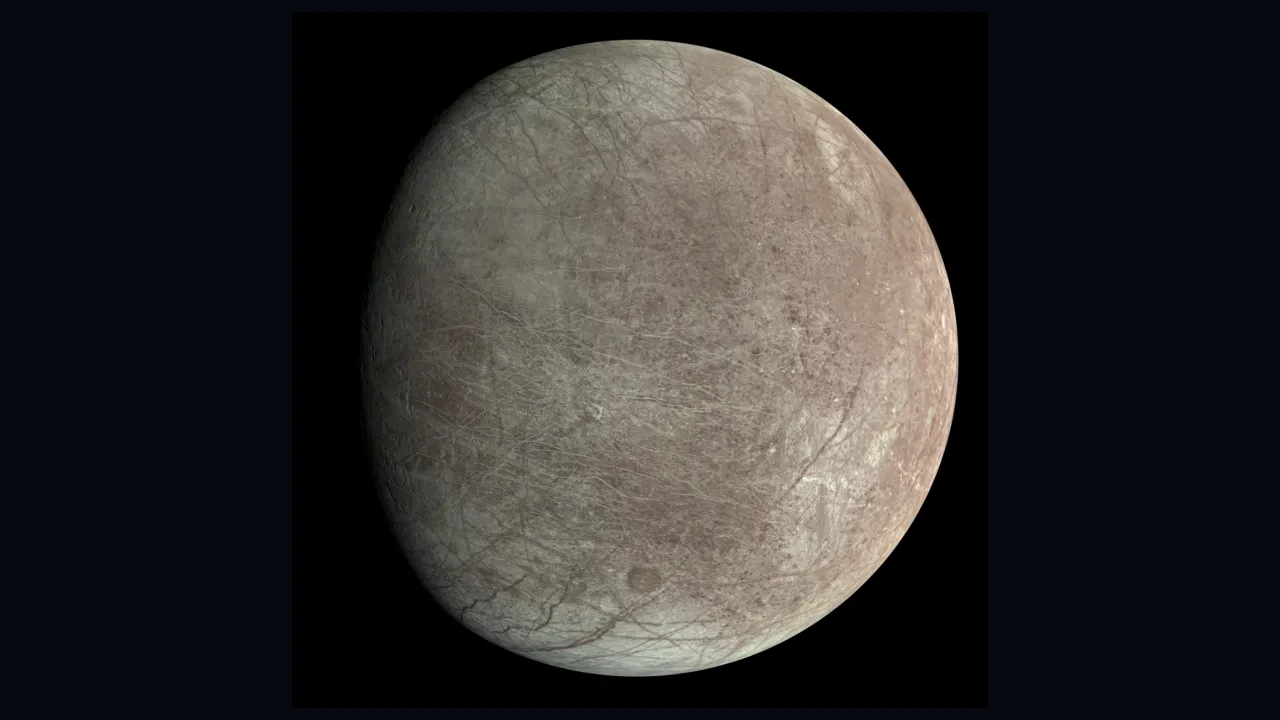
Glide past giant Jupiter to a sparkling white moon! Meet Europa, wrapped from pole to pole in bright frozen ice. Reddish lines its smooth like ice-skating tracks!
2
A Secret Ocean
What hides underneath all that thick ice? A dark, deep ocean of liquid water sloshes around the whole moon!
3
Twice Earth's Water!
Even though Europa is smaller than our Moon, its deep ocean holds twice as much water as all Earth's seas!
1. What hides underneath Europa's bright frozen ice shell?
2. How much liquid water does Europa's hidden ocean hold compared to Earth?
🤯 Mind-Blowing Fact • Grade 2
While Earth's deepest ocean trench goes down seven miles, Europa's hidden ocean plunges forty to one hundred miles deep!
✨ Word Sparks (Grade 2 Glossary)
Tap 🔊 to hear
granite
very hard speckled rock on Earth
lineae
long dark cracks streaking Europa's ice
microbes
tiny living creatures seen with microscopes
🪝
How does Europa's underground ocean stay liquid half a billion miles from the Sun?
1
Warmed by Gravity Flexing
Far out at Jupiter, Europa's icy crust freezes to minus 260 degrees Fahrenheit—hard as rock! Yet every 3.5 Earth days as Europa circles Jupiter, tidal tugs gently flex the moon's insides, creating enough warmth to keep a sixty-mile-deep ocean liquid underneath!
2
Reddish Cracks Called Lineae
Instead of tall mountains or lots of craters, reddish-brown streaks called '' stretch for hundreds of miles across the ice! Salty ocean minerals bubble up through cracks and turn rusty-red when Jupiter's radiation zaps them.
3
Searching for Tiny Life
Because life on Earth loves liquid water, Europa is one of NASA's top places to search for alien !
1. What keeps Europa's hidden ocean from freezing completely solid?
2. What turns the cracks across Europa's white ice shell reddish-brown?
🤯 Mind-Blowing Fact • Grade 3
Europa's smooth ice shell reflects nearly five times more sunlight than Earth's dusty Moon—making Europa one of the brightest worlds in the Solar System!
✨ Word Sparks (Grade 3 Glossary)
Tap 🔊 to hear
chaos
jumbled broken ice rafts refrozen together
hydrothermal
warm mineral-rich water vents on seafloors
geyser
a natural jet spraying water upward
🪝
How did a spacecraft prove an ocean hides inside Europa without drilling a single hole?
1
Galileo's Clever Compass Clue!
Between 1995 and 2003, NASA's Galileo spacecraft flew past Europa carrying a sensitive magnetic sensor. Whenever Jupiter's tilted magnetic field swept past Europa, Europa generated an echoing magnetic signal back! Only a global layer of electrically conducting SALTWATER beneath the ice could create that exact signal!
2
Jumbled 'Chaos Terrain' Rafts
Close-up photos reveal patches called ' terrain' where giant blocks of surface ice broke apart like jigsaw pieces, drifted around in slushy water underneath, and refroze at tilted angles!
3
Touches the Rocky Seafloor
Unlike bigger moons where thick bottom ice seals water away from rock, Europa's salty ocean rests directly on a rocky seafloor—where warm vents might bubble minerals upward just like in Earth's deep sea!
4
Possible Water Vapor Plumes
Observations from the Hubble Space Telescope and Galileo hinted that -like plumes of ocean mist may occasionally spray through cracks high into space!
1. How did NASA's Galileo spacecraft prove Europa holds a global salty ocean?
2. Why is it exciting to astrobiologists that Europa's ocean touches a rocky seafloor?
🤯 Mind-Blowing Fact • Grade 4
In 2023, the James Webb Space Telescope detected carbon dioxide concentrated on Europa's youngest chaos ice—originating straight from its hidden ocean below!
✨ Word Sparks (Grade 4 Glossary)
Tap 🔊 to hear
subsurface
located underneath a world's outer surface
subduct
one crustal slab sliding beneath another
penitentes
tall jagged blades of sublimating ice
🪝
What did the James Webb Space Telescope spot sitting right on Europa's icy surface—and how will Europa Clipper explore it?
1
Carbon Dioxide From the Deep!
For living cells as we know them to thrive, a world needs three ingredients: liquid water, chemical building blocks like carbon, and an energy source! In 2023, astronomers pointed the James Webb Space Telescope at Europa and hit a scientific bull's-eye: carbon dioxide ice concentrated right inside Tara Regio, a young patch of jumbled 'chaos terrain'! That proved Europa's ocean isn't sterile distilled water—carbon-bearing chemistry wells up from the ocean below!
2
Table Salt and Ice Tectonics
Hubble also detected ordinary sodium chloride—kitchen table salt!—tinting yellow patches in Tara Regio. Meanwhile, Europa's ten-to-fifteen-mile-thick ice shell behaves remarkably like Earth's plate tectonics in miniature: fresh ice spreads apart along double ridges while older ice slabs slide ('') back down to recycle surface oxygen into the dark ocean!
3
Spikes of Ice Called Penitentes?
Along Europa's sunlit equator where water ice sublimates without melting, radar models suggest jagged blades of ice called ''—named after tall snow spikes in South America's Andes—could tower yards high!
4
NASA's Europa Clipper Arrives in 2030!
Launched in October 2024 with wings larger than a basketball court, NASA's Europa Clipper spacecraft will swing past Europa forty-nine times starting in 2030, using ice-penetrating radar to measure ocean depth and sniff any misty plumes!
1. Where did the James Webb Space Telescope find carbon dioxide concentrated on Europa in 2023?
2. How might oxygen created at Europa's icy surface reach its dark underground ocean?
🤯 Mind-Blowing Fact • Grade 5
With fewer than forty large craters across the entire moon, Europa's icy surface is only 40 to 90 million years old—meaning T. rex walked on Earth before Europa's current surface froze!
✨ Word Sparks (Grade 5 Glossary)
Tap 🔊 to hear
induction
changing magnetic fields generating electric currents
chemosynthesis
making life energy from chemicals without sunlight
radiolysis
radiation splitting water ice into oxygen
🪝
How can life potentially flourish under fifteen miles of solid ice with zero sunlight—and why must spacecraft dodge Europa's radiation belts?
1
Induced Magnetometry and Internal Differentiation
Co-discovered by Galileo Galilei on January 8, 1610, Europa (3,122 km diameter; bulk density 3.01 g/cm³) is overwhelmingly a rocky world—wrapping a metallic iron-nickel core and silicate mantle beneath an outer hydrosphere roughly 100 to 150 kilometers thick! How did Margaret Kivelson's Galileo magnetometer team prove in 1998–2000 that most of that outer H2O layer is liquid rather than solid ice? As Jupiter's 10-degree-tilted magnetic field sweeps across Europa every eleven hours, Faraday's law of electromagnetic drives eddy currents inside a global, electrically conductive briny ocean beneath a 15-to-25-kilometer ice lid!
2
Chemosynthesis Powered by Radiolysis and Serpentinization
Cut off from sunlight beneath kilometers of ice, any putative Europan biosphere could never rely on photosynthesis—instead requiring ! Energetic electrons trapped in Jupiter's lethal radiation belts bombard Europa's surface ice, splitting H2O molecules via into escaping hydrogen and reactive oxidants (O2, H2O2, and sulfates). Meanwhile, sixty to one hundred kilometers down at the ocean-mantle boundary, seawater percolating into warm ultramafic rock can drive serpentinization—releasing dissolved hydrogen and methane reducers. Where sinking ice slabs ('subsumption') deliver surface oxidants to meet seafloor reducers, a chemical battery capable of sustaining microbial ecosystems emerges!
3
Youngest Surface Among Icy Worlds
Counting fewer than forty large impact craters—headed by 26-kilometer Pwyll with its bright ray system and shallow concentric rings of Tyre—dates Europa's visible ice crust to an extraordinarily youthful 40 to 90 million years! Cycloidal ('flexus') arc cracks trace shifting diurnal tidal stresses as Europa traverses its 3.55-day eccentric orbit inside the 4:2:1 Laplace resonance.
4
Surviving Jupiter's Radiation Vault
Orbiting Europa continuously would fry unshielded spacecraft electronics within weeks inside Jupiter's 540-rem-per-day radiation belts! To beat the radiation hazard, NASA's Europa Clipper—launched October 2024 for April 2030 arrival—uses looping Jupiter orbits to dive briskly past Europa forty-nine times while protecting its computers inside a thick aluminum-zinc vault.
5
Twin Explorers: Europa Clipper and ESA's JUICE
Equipped with dual-frequency ice-penetrating radar (REASON), thermal imagers, and the SUDA dust/ice mass spectrometer—capable of detecting parts-per-million amino acids or fatty acids inside a single microscopic ice grain—Europa Clipper and Europe's JUICE orbiter will map Europa's habitability in unprecedented detail.