⚡ Everyday Impact SparkSpots subtle ground swelling, gas puffs, and tremors weeks before an eruption so towns evacuate safely
🤯 Mind-Blowing Fact • Grade 1
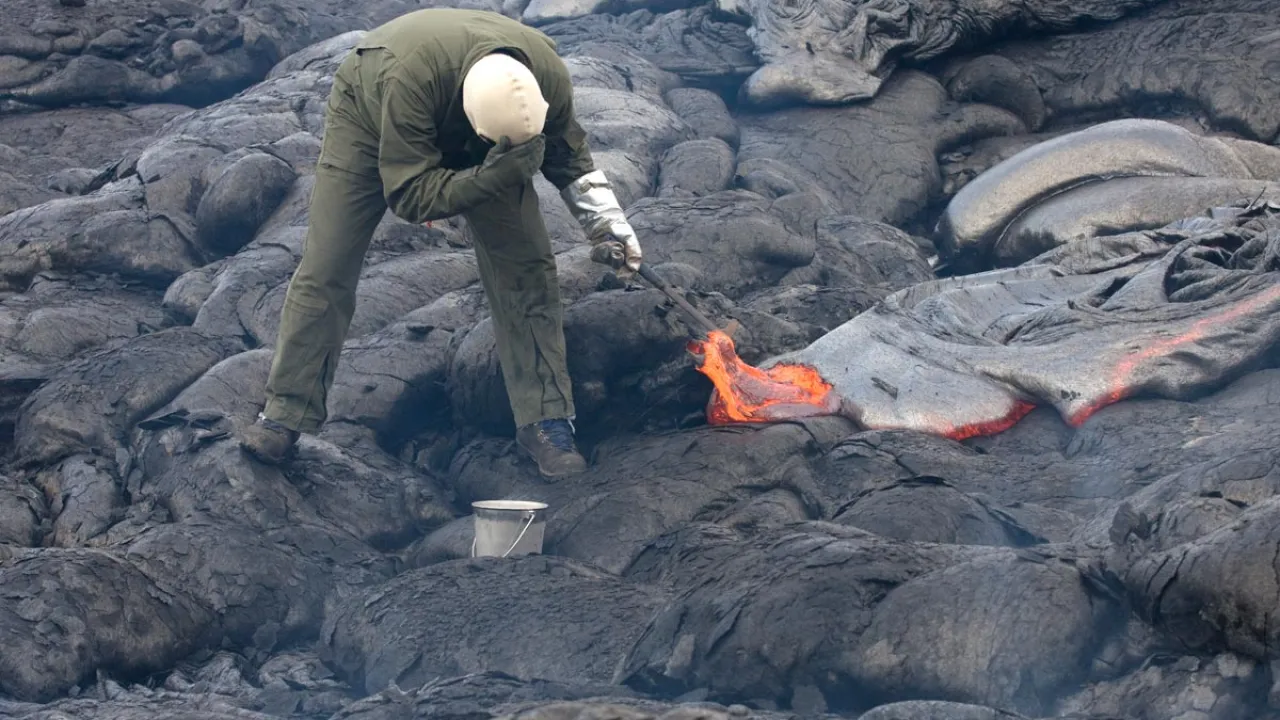
Fresh orange lava oozing out of Hawaii's Kilauea volcano is over two thousand degrees Fahrenheit—about five times hotter than a kitchen oven!
✨ Word Sparks (Grade 1 Glossary)
Tap 🔊 to hear
lava
melted hot rock flowing above the ground
crater
bowl-shaped opening at a volcano's top
erupt
bursting out steam, ash, or melted rock
🪝
How can a scientist walk near glowing orange melted rock without getting burned?
1
Shiny Silver Space Suits!
Hiss, crackle! Bright orange oozes slowly across black rock. Stepping carefully nearby, a volcano scientist wears a shiny silver suit that bounces fierce heat right back!
2
Checking Steam and Shakes
Before a big mountain , it gives clues. Tiny ground shakes start, steam puffs rise, and the hilltop swells up a tiny bit.
3
Early Warnings Save Towns
Watching those clues on computers lets volcano teams warn nearby towns early so families stay safe!
1. Why do volcano scientists wear shiny silver suits near hot lava?
2. What clues often happen before a sleeping volcano wakes up?
🤯 Mind-Blowing Fact • Grade 2
Some volcanic rock called pumice traps so many tiny gas bubbles as it cools that the finished stone actually floats on water!
✨ Word Sparks (Grade 2 Glossary)
Tap 🔊 to hear
magma
melted rock still hidden deep underground
pumice
bubbly volcanic rock light enough to float
observatory
science station watching volcanoes or skies closely
🪝
What is the difference between magma and lava—and why do scientists scoop hot samples into water buckets?
1
Magma Below, Lava Above
Deep beneath Earth's crust, melted rock mixed with dissolved gases is called . Once it squeezes up through cracks and pours onto the mountainside, its name changes to lava! Wearing heat-reflecting gloves and helmets, field geologists scoop glowing blobs with long steel poles.
2
Quenching Hot Rock in Water
Dropping that red-hot scoop straight into a metal bucket of cold water—sizzle!—freezes the liquid into shiny black glass in seconds. Back in the lab, crystal clues inside that sample reveal how deep underground the started!
3
Drones Over Smoky Craters
When craters are too steep or smoky to hike, scientists fly rugged drones carrying gas sensors and thermal cameras to keep close watch safely.
1. Why do geologists plunge a freshly scooped bit of hot lava into cold water?
2. How do scientists safely measure toxic gases rising from a steep, dangerous crater?
🤯 Mind-Blowing Fact • Grade 3
Electronic volcano tiltmeters are so sensitive they could detect the tilt if you slipped a single thin dime underneath one end of a board a kilometer long!
Why do some volcanoes ooze gentle rivers of lava while others blast ash clouds miles into the sky?
1
Runny Syrup vs. Shaken Soda
Not every volcano behaves the same way! Hawaiian shield volcanoes like Mauna Loa erupt thin, runny basalt lava that lets gas bubbles pop gently. Steep cone volcanoes like Mount St. Helens hold thick, sticky magma rich in —trapping gas pressure like a shaken soda bottle until it blasts skyward!
2
Measuring a Mountain's Breath
Weeks before an eruption, rising magma inflates the volcano's slopes by a few centimeters—too small for eyes to notice, yet easy for sensitive ! Just as carpenter levels use tiny bubbles, electronic tiltmeters detect tilting steeper than a dime slipped under a mile-long board.
3
Sniffing Sulfur and Ash Warnings
Scientists also point optical spectrometers at steam plumes to measure sulfur dioxide gas, which spikes as fresh magma nears the surface. If blasts into jet flight paths, volcano observatories immediately alert airlines because tiny glass-sharp ash particles can clog jet engines!
4
Saving Tens of Thousands of Lives
In 1991, U.S. and Philippine scientists spotted warning signs at Mount Pinatubo in time to evacuate over 58,000 residents before a massive eruption!
1. Why do volcanoes with thick, silica-rich magma often erupt explosively?
2. Why must volcano observatories warn airplanes right away when an ash cloud rises?
🤯 Mind-Blowing Fact • Grade 4
Mole Hill in Highland County, Virginia, is the core of an ancient volcano that erupted 47 million years ago—long after the dinosaurs vanished!
✨ Word Sparks (Grade 4 Glossary)
Tap 🔊 to hear
basalt
dark volcanic rock formed from runny lava
lahar
fast volcanic mudflow of ash and melted snow
geothermal
clean heat energy tapped from underground rock
🪝
Did you know ancient volcanoes once towered right over Virginia's Blue Ridge—and how do modern scientists forecast eruptions around the Pacific Ring of Fire?
1
Ancient Lava Beneath Virginia's Feet
Hike along Skyline Drive in Shenandoah National Park, and you are walking across Catoctin greenstone—ancient lava flows that poured across Virginia more than 550 million years ago! Even higher in Highland County sits Mole Hill, an eroded volcanic plug active 47 million years ago, making it one of the youngest volcanic formations in eastern North America. Reading ancient rocks helps geologists reconstruct how continents split and collided.
2
Where Modern Volcanoes Cluster
Today roughly 1,350 potentially active volcanoes dot Earth, with seventy-five percent circling the Pacific 'Ring of Fire' where ocean plates dive beneath continents and melt. Others rise over mid-ocean ridges like Iceland or deep mantle hotspots like Hawaii and Yellowstone. Five U.S. Geological Survey Volcano Observatories watch over more than 160 active U.S. volcanoes around the clock.
3
Four Clues to an Upcoming Eruption
Predicting volcanic unrest relies on four interlocking streams of data: swarms of harmonic earthquakes as magma cracks rock; millimeter ground inflation measured by GPS and radar satellites; surges in carbon dioxide and sulfur dioxide gases; and rising crater temperatures on infrared cameras.
4
Volcanoes Build Habitable Worlds
Although eruptions pose hazards like fast mudflows called , volcanoes also sustain life! Over time, weathered volcanic ash creates some of Earth's richest farmland soils, steam powers clean electricity in places like Iceland and Hawaii, and ancient volcanic outgassing helped form our planet's early atmosphere and oceans.
1. What kind of ancient rock beneath Shenandoah National Park proves lava once flowed across Virginia?
2. Why are seventy-five percent of Earth's active volcanoes located along the Pacific Ring of Fire?
🤯 Mind-Blowing Fact • Grade 5
Orbiting radar satellites using InSAR can spot a volcano's slopes swelling upward by a single centimeter from more than four hundred miles up in space—even right through thick storm clouds!
✨ Word Sparks (Grade 5 Glossary)
Tap 🔊 to hear
viscosity
how thick, sticky, and slow liquids flow
pyroclastic
fast-moving avalanche of superheated ash and gas
cryovolcano
icy moon volcano erupting water and slush
🪝
How do radar satellites orbiting 400 miles in space detect a sleeping volcano breathing upward by less than half an inch?
1
Magma Plumbing and Viscosity Physics
Whether an eruption unfolds as tranquil Hawaiian fire fountains or a stratospheric Plinian ash column up to forty kilometers tall depends on magma rheology—specifically silica content, temperature, crystal cargo, and dissolved volatiles like water vapor and carbon dioxide. Low-silica mafic basalt (around 50 percent SiO2 at 1,200 degrees Celsius) flows easily, allowing gas bubbles to escape non-explosively. Conversely, cooler, high-silica felsic rhyolite or dacite possesses millions of times higher, locking pressurized gas inside until brittle fragmentation shatters magma into currents.
2
InSAR Satellite Interferometry and Harmonic Tremor
Less than a third of the world's dangerous stratovolcanoes host dense ground sensor networks, so modern observatories look down from orbit using Interferometric Synthetic Aperture Radar (InSAR). By comparing phase shifts between radar pulses bounced off a volcano weeks apart—even through thick clouds or tropical jungle—scientists map concentric rainbow 'fringes' revealing surface inflation as small as one centimeter caused by magma intruding five to ten kilometers underground. Simultaneously, borehole seismometers distinguish sharp brittle-fracture quakes from low-frequency 'long-period' harmonic tremors generated as pressurized fluids resonate through volcanic conduits.
3
Crystal Clocks and Petrological Forensics
Inside clean geochemistry laboratories, petrologists slice quenched lava and tephra thinner than a human hair—thirty micrometers—to examine zoned olivine and plagioclase crystals under electron microprobes. Because chemical elements diffuse across crystal growth rings at known temperature-dependent rates, these microscopic 'crystal clocks' reveal whether fresh, hot mantle magma injected into a shallow reservoir days, weeks, or years prior to eruption.
4
Planetary Volcanism Across the Solar System
Volcanology extends far beyond Earth: planetary geologists study colossal Olympus Mons on Mars, sulfur-spewing tidal volcanoes on Jupiter's moon Io—the most volcanically active body in our solar system—and icy '' on Saturn's moon Enceladus that vent liquid water plumes from subsurface oceans.
5
VDAP International Response and Aviation Safety
Through the USGS Volcano Disaster Assistance Program (VDAP) and nine global Volcanic Ash Advisory Centers, volcanologists deploy rapid-response telemetry kits to restless peaks worldwide, co-designing evacuation maps against flows and lahars that have already saved tens of thousands of lives.