🧬 HUMAN BODY
🧬 Plicae Vocales & Larynx • Respiratory System
VA Science & Health SOL 1.1, 3.1, 4.2, 5.1 (Cells, Organs & Body Systems)
Vocal Cords (Larynx)
Twin Vibrating Ribbons That Turn Every Breath Into Music
Grade 5 • Advanced • 274 words
🩺 Body System & LocationRespiratory System • Perched atop the trachea inside the neck's voice box
🔬 Size / Cell Count0.5–1 inch (12–24 mm) long • Vibrates 100 to 1,000+ times per second
⚙️ Core JobVibrates outgoing breath into sound waves for speaking, laughing, and singing
⚡ Body SuperpowerStretches tighter or looser in milliseconds to leap from deep rumbles to high soprano notes
🤯 Mind-Blowing Fact • Grade 1
When a child talks or laughs, their tiny vocal cords wiggle back and forth about 250 to 300 times every single second!
✨ Word Sparks (Grade 1 Glossary)
Tap 🔊 to hear
Larynx
The sturdy voice box inside your neck
Vibrate
To wiggle back and forth very fast
Pitch
How high or low a sound is
🪝
Why does your throat buzz like a bumblebee when you hum?
1
Feel the Friendly Buzz
Put two fingers gently on your throat and hum 'mmmmmm!' Do you feel that tickly buzz? Inside your neck sits a special voice box called the .
2
Two Little Ribbons
Stretched across your voice box are two stretchy bands called vocal cords. When you breathe quietly, they stay wide open. When you talk or sing, air makes them wiggle super fast!
3
Shaping Words
That fast wiggle makes sound waves, and your tongue and lips shape them into words and giggles!
1. What makes the tickly buzz you feel on your throat when you hum?
2. What do your vocal cords do while you are just breathing quietly without talking?
🤯 Mind-Blowing Fact • Grade 2
When you whisper a secret, your vocal cords do not vibrate at all—only rushing air and your tongue shape the words!
✨ Word Sparks (Grade 2 Glossary)
Tap 🔊 to hear
Vocal folds
Another accurate name for stretchy vocal cords
Sound wave
Invisible ripples of vibrating air we hear
Volume
How loud or soft a sound feels
🪝
How can two tiny bands smaller than a quarter sing every note of your favorite song?
1
More Folds Than Strings
Have you ever pinched the neck of an inflated balloon to make a squeaky note? Your vocal cords work almost the exact same way! Tucked inside a protective cartilage box called the larynx, they are actually two smooth, stretchy folds of muscle tissue rather than guitar strings.
2
High Notes and Low Notes
Tiny muscles pull those folds tighter and thinner when you squeak a high note, making them vibrate super fast. When you rumble like a bear, the muscles relax so the folds grow looser and vibrate more slowly!
3
Whisper Mode
Try whispering a secret while touching your throat—no buzz! During a whisper, your vocal cords stay slightly apart so air just rustles softly past.
1. How do your vocal cords change to sing a high-pitched musical note?
2. Why don't you feel your throat buzz when you whisper?
🤯 Mind-Blowing Fact • Grade 3
Trained opera sopranos can vibrate their vocal folds over 1,000 times per second to hit shimmering high notes!
✨ Word Sparks (Grade 3 Glossary)
Tap 🔊 to hear
Resonate
To echo and enrich sound inside hollow spaces
Laryngitis
Mild vocal cord swelling causing a croaky voice
Thyroid cartilage
Shield-shaped front cartilage protecting your voice box
🪝
Why does your voice sound deeper as you grow up, and why does a cold make you sound croaky?
1
Inside the Cartilage Voice Box
Sitting right on top of your trachea like a shield is the larynx, framed by nine interlocking pieces of cartilage. Its largest front shield is the —the bump on the front of the neck often nicknamed the Adam's apple.
2
Changing Pitch and Loudness
Stretched horizontally inside that shield are two pearly-white vocal folds. Pushing stronger gusts of air up from your lungs makes the folds swing wider, boosting your volume from a quiet chat to a playground cheer. Meanwhile, longer and thicker folds vibrate more slowly—just like thick bass strings on a piano—which is why voices deepen naturally as kids grow into teenagers and adults!
3
Your Built-In Echo Chambers
By themselves, vibrating vocal folds would only make a plain buzz. Your throat, mouth, nose, and sinuses act as hollow resonating chambers that enrich that buzz into your one-of-a-kind voice!
4
Why Laryngitis Sounds Raspy
Catching a cold or cheering non-stop can puff up the vocal folds with mild swelling called , temporarily turning clear notes into a frog-like croak until you rest your voice.
1. Why do adult voices usually sound lower in pitch than young children's voices?
2. What turns the plain buzz of your vocal folds into your unique, recognizable voice?
🤯 Mind-Blowing Fact • Grade 4
Your larynx actually holds a second upper pair of 'false vocal cords' that lock air in your chest to brace your upper body whenever you push or lift heavy objects!
✨ Word Sparks (Grade 4 Glossary)
Tap 🔊 to hear
Glottis
The adjustable V-shaped opening between vocal folds
Bernoulli effect
Drop in sideways pressure caused by fast-flowing air
Mucosal wave
Smooth ripple traveling across jelly-cushioned vocal folds
🪝
How does fast-moving air pull your vocal cords back together using the exact same physics that lifts airplane wings?
1
The Aerodynamic Wave Dance
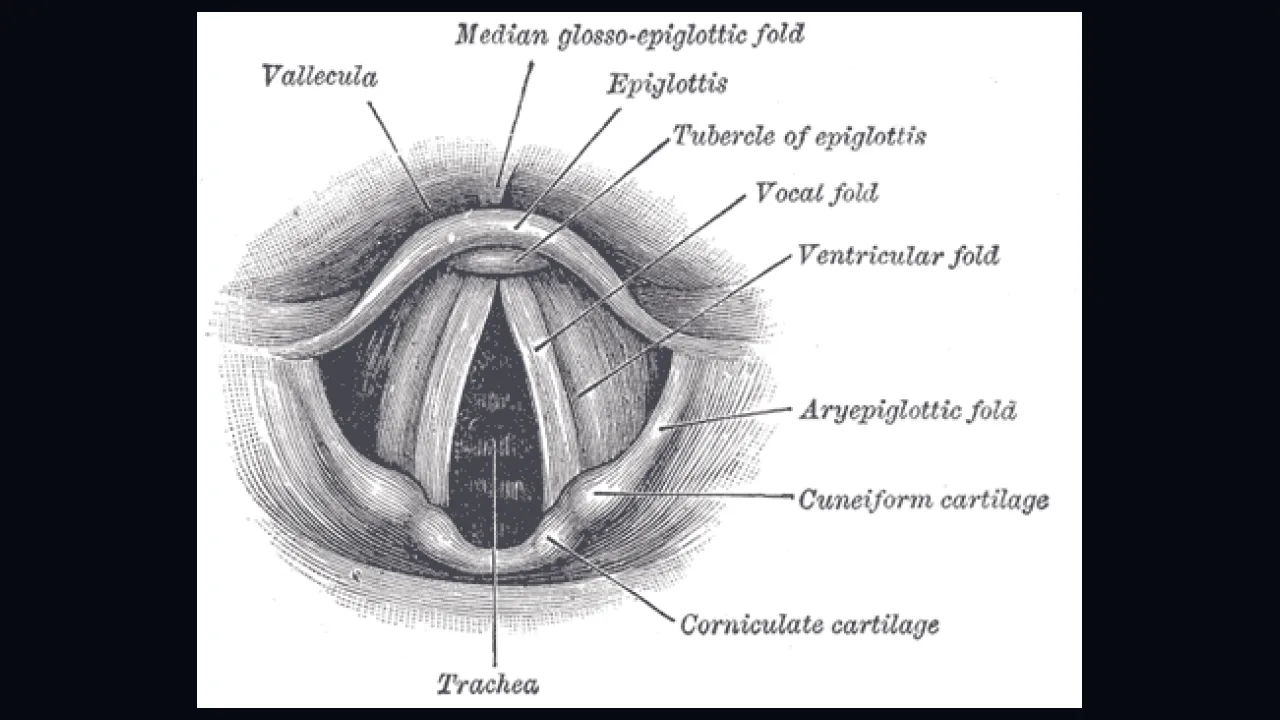
When you decide to speak, tiny swiveling cartilages at the back of your larynx pivot your two vocal folds gently together across the airway, closing the gap known as the . Air pushed upward from your lungs builds pressure underneath until it nudges the folds apart for a millisecond. As that puff of air rushes rapidly through the narrow slit, the —where faster-moving fluid creates lower sideways pressure—helps suck the elastic vocal folds right back together, repeating hundreds of times per second!
2
Layered Like Gel Cushions
Why don't vocal folds bruise from clapping together thousands of times during a single conversation? Under their tough outer skin lies a jelly-like middle layer (Reinke's space) perched atop elastic ligaments and fine vocalis muscle fibers. That hydrated gel cushion ripples in a smooth ',' which is why drinking plenty of water keeps a singer's voice clear and effortless.
3
True Folds and False Folds
Just above your true pearly-white vocal folds sit a second pair of pink cushions called vestibular folds—often nicknamed 'false vocal cords.' Rather than making everyday speech, they help lubricate the true folds and seal the airway tightly so chest pressure stabilizes your torso when you lift something heavy!
4
Puberty's Growth Spurt
During puberty, hormones enlarge the larynx—growing vocal folds roughly 60 percent longer in boys and 30 percent longer in girls—occasionally causing funny voice cracks while the brain recalibrates muscle tension.
1. How does the Bernoulli effect help keep your vocal folds vibrating smoothly?
2. Why does staying well hydrated help protect your vocal folds when talking or singing?
🤯 Mind-Blowing Fact • Grade 5
Living human vocal cords were first seen in 1854 not by a surgeon, but by singing teacher Manuel García using a tiny dentist's mirror and reflected Paris sunlight!
✨ Word Sparks (Grade 5 Glossary)
Tap 🔊 to hear
Phonation
Production of voiced sound by vibrating vocal folds
Arytenoid
Paired swiveling cartilages that open or close cords
Hertz
Scientific unit measuring vibrations per single second
🪝
How did a nineteenth-century Spanish singing teacher invent modern throat medicine using a tiny dental mirror and sunlight?
1
Precision Cartilage-Muscle Architecture
Suspended from the horseshoe-shaped hyoid bone at neck levels C3 to C6, the human larynx is a masterpiece of biomechanical micro-engineering. Nine cartilages—three unpaired (thyroid, cricoid, epiglottis) and three paired (, corniculate, cuneiform)—articulate via true synovial joints! Pivoting atop the signet-ring-shaped cricoid cartilage, the pyramid-like arytenoid cartilages anchor the posterior ends of the vocal ligaments. Intrinsic muscles driven by branches of the vagus nerve (cranial nerve X) rotate or slide the arytenoids to abduct the rima glottidis wide for sprint breathing or adduct the folds cleanly for .
2
Myoelastic-Aerodynamic Phonation Theory
For centuries, scientists debated whether nerves fired once for every single vocal vibration. Modern high-speed stroboscopy proved the myoelastic-aerodynamic theory instead: muscles simply set baseline tension and adduction—with cricothyroid muscles tilting the thyroid shield forward to stretch folds for higher fundamental frequencies (measured in , Hz), while thyroarytenoid (vocalis) fibers fine-tune internal stiffness—and subglottic air pressure plus Bernoulli aerodynamics sustain self-oscillating mucosal waves from ~85 Hz in deep bass voices to over 1,000 Hz in coloratura sopranos.
3
Low Laryngeal Position and Human Speech
Compared with other primates—and even human newborns—the adult human larynx descends lower in the neck during early childhood. That expanded supraglottic pharynx creates a two-tube acoustic tract capable of sculpting crisp formants for every vowel across all spoken human languages!
4
Manuel García's Mirror Breakthrough
No human had ever seen living vocal folds in action until 1854, when Spanish voice professor Manuel García angled a small dentist's mirror inside his own throat while flashing sunlight off a hand mirror—inventing laryngoscopy and launching modern otolaryngology!
5
Only One Muscle Opens the Airway
Among all laryngeal muscles, only the paired posterior cricoarytenoid muscles pull the vocal folds apart—making them tireless guardians of every single breath you take.