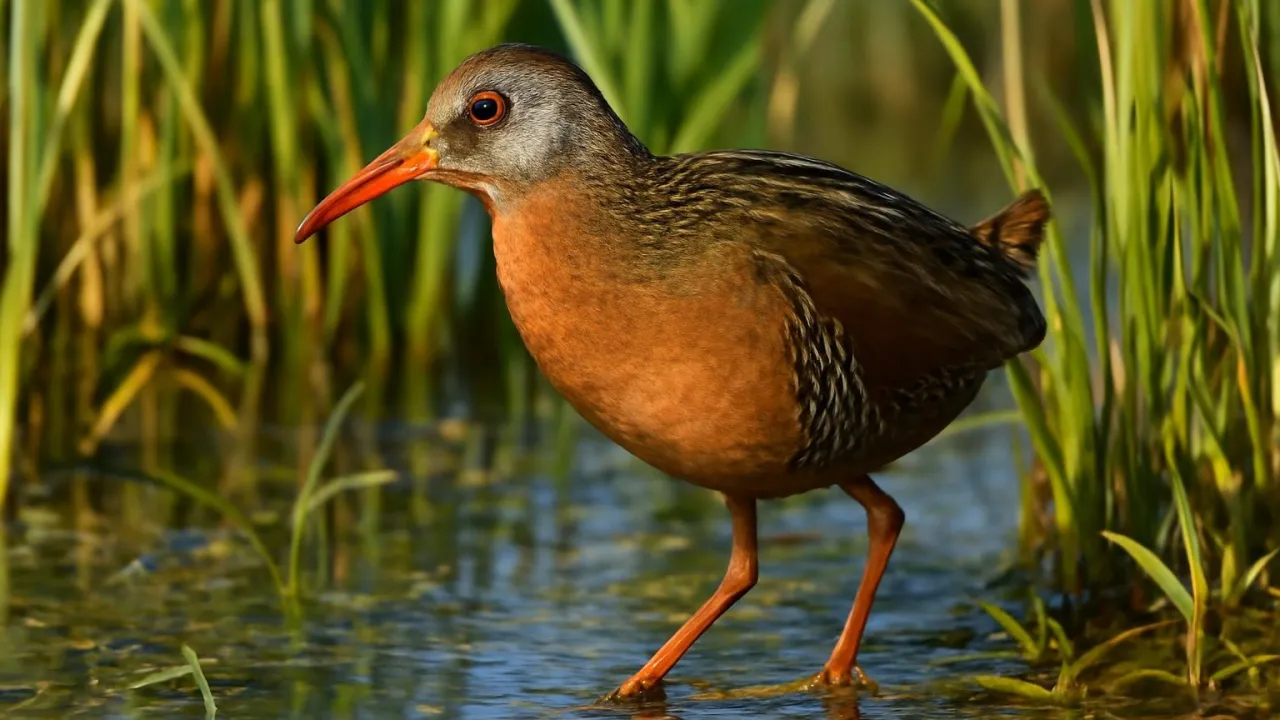
Virginia Rails can run fast through dense marsh plants, even faster than they can fly!
✨ Word Sparks (Grade 2 Glossary)
Tap 🔊 to hear
marshes
Wet places with lots of water and tall plants
nest
A bird’s home made of grass and sticks
insects
Small animals like bugs that birds eat
🪝
Have you heard a bird run through marsh plants without flying?
1
A Bird That Hides Well
The Virginia Rail lives in where water and plants grow. It has brown and gray feathers that help it blend in well. This bird is small but moves quickly through thick plants to stay safe.
2
Where It Grows Up
Virginia Rails build hidden in tall marsh grasses near water. The eggs hatch after about three weeks. Baby rails stay hidden while they grow strong and learn to find food.
3
A Special Long Beak
This bird uses its long beak to catch , small fish, and seeds. The beak helps it reach deep into mud and water to find tasty food. It needs clean water and healthy plants to survive.
Virginia Rails can squeeze through plants so tightly that they seem to disappear from sight!
✨ Word Sparks (Grade 3 Glossary)
Tap 🔊 to hear
camouflage
Colors that help animals hide in their homes
adaptation
A body change that helps animals survive better
predator
An animal that hunts other animals for food
🪝
How does a secretive bird survive in thick marshes without being seen?
1
Camouflage in the Marsh
The Virginia Rail uses to blend into marsh plants and mud. Its brown and gray feathers match the colors of wetland grasses and soil. This helps it avoid that hunt by sight. Camouflage is an important for survival.
2
Life in Wetlands
Virginia Rails live in freshwater wetlands across North America. These habitats provide food and shelter. They build nests hidden in dense vegetation near water. The wetland ecosystem supports many creatures, making it a rich environment for the rails.
3
Feeding with a Long Beak
The bird’s long, slender beak helps it probe mud and shallow water for insects and small fish. This specialized beak is an that allows it to reach hidden prey. It feeds mostly at dawn and dusk when insects are active. This feeding behavior helps it get enough nutrients.
4
Escaping Predators
Virginia Rails can run quickly through dense marsh plants to escape . Their small bodies and strong legs allow them to move silently and swiftly. They rarely fly because running is safer in thick vegetation. This behavior reduces the risk of being caught.
1. Why do Virginia Rails have brown and gray feathers?
2. How do Virginia Rails mostly escape danger?
🤯 Mind-Blowing Fact • Grade 4
Virginia Rails can run faster through marsh plants than many birds can fly in those habitats!
✨ Word Sparks (Grade 4 Glossary)
Tap 🔊 to hear
ecosystem
A community of plants and animals living together
biodiversity
Many different kinds of living things in one place
conservation
Protecting nature to keep animals and plants safe
🪝
What makes the Virginia Rail a master of marsh survival and hiding?
1
Camouflage and Habitat
Virginia Rails blend perfectly with marsh grasses due to their brown and gray feathers, which help them avoid predators. They inhabit freshwater wetlands across much of North America, where dense vegetation provides shelter and food. These wetlands are vital supporting diverse plants and animals. The bird’s ability to remain unseen is a key survival strategy in these habitats.
2
Role in the Ecosystem
As both predator and prey, Virginia Rails play an important role in wetland food webs. They consume insects, small fish, and seeds, helping control insect populations. In turn, they provide food for larger predators like hawks and foxes. This balance maintains healthy and supports in marsh environments.
3
Unique Physical Adaptations
The Virginia Rail’s long, slender beak allows it to probe mud and shallow water for hidden prey, demonstrating a specialized feeding adaptation. Its strong legs and small body enable it to move swiftly and quietly through dense marsh plants, often running instead of flying to avoid danger. These physical traits help it survive in challenging wetland conditions.
4
Human Impact and Conservation
Wetland loss and pollution threaten Virginia Rail populations by reducing habitat quality and food availability. efforts focus on protecting and restoring wetlands to support these birds and other wildlife. Public awareness about wetland importance helps encourage habitat preservation and sustainable environmental practices.
1. How do Virginia Rails help keep wetlands healthy?
2. What threatens Virginia Rail habitats today?
🤯 Mind-Blowing Fact • Grade 5
Virginia Rails can run faster than 10 miles per hour through thick marsh plants, outpacing many birds' flight speeds in those habitats!
✨ Word Sparks (Grade 5 Glossary)
Tap 🔊 to hear
Rallidae
The bird family that includes rails and coots
habitat fragmentation
When animal homes are broken into smaller parts
omnivorous
An animal that eats both plants and animals
🪝
How does the Virginia Rail’s unique biology enable it to thrive in North America’s wetlands?
1
Scientific Classification and Range
The Virginia Rail, scientifically named Rallus limicola, belongs to the family of marsh birds. It inhabits freshwater wetlands across much of North America, from southern Canada to the Gulf Coast. This species prefers dense emergent vegetation in marshes, swamps, and wet meadows where it can find abundant food and shelter. Its widespread range reflects adaptability to various wetland environments.
2
Physiological Adaptations for Survival
Virginia Rails possess slender, laterally compressed bodies that allow them to slip through dense marsh vegetation with ease. Their long, slightly curved beaks are specialized for probing mud and shallow water to extract insects, crustaceans, and small fish. Strong legs and long toes provide stability on soft, uneven wetland substrates, enabling rapid terrestrial movement to avoid predators. These adaptations optimize feeding efficiency and predator evasion.
3
Conservation Status and Challenges
Although currently listed as Least Concern, Virginia Rail populations face threats from wetland destruction, pollution, and climate change. reduces breeding and feeding areas, while water quality degradation impacts prey availability. Conservation efforts focus on wetland restoration and protection, emphasizing the importance of maintaining healthy aquatic ecosystems for this species and other wetland-dependent wildlife.
4
Ecological Role and Food Web Impact
As an bird, the Virginia Rail contributes to wetland food webs by controlling insect populations and serving as prey for raptors and mammals. Its feeding habits influence invertebrate community dynamics, while its presence supports biodiversity. The species’ role exemplifies interconnectedness in marsh ecosystems, highlighting the importance of preserving such habitats for ecological balance.
5
Quantitative Comparisons and Behavior
Virginia Rails measure approximately 7.5 to 10 inches (19 to 25 centimeters) in length and weigh between 3 to 5 ounces (85 to 140 grams). They can run through dense marsh vegetation at speeds exceeding 10 miles per hour (16 kilometers per hour), often preferring running over flying to escape threats. Their vocalizations, including pig-like grunts and clucks, serve as communication signals during breeding and territorial defense.