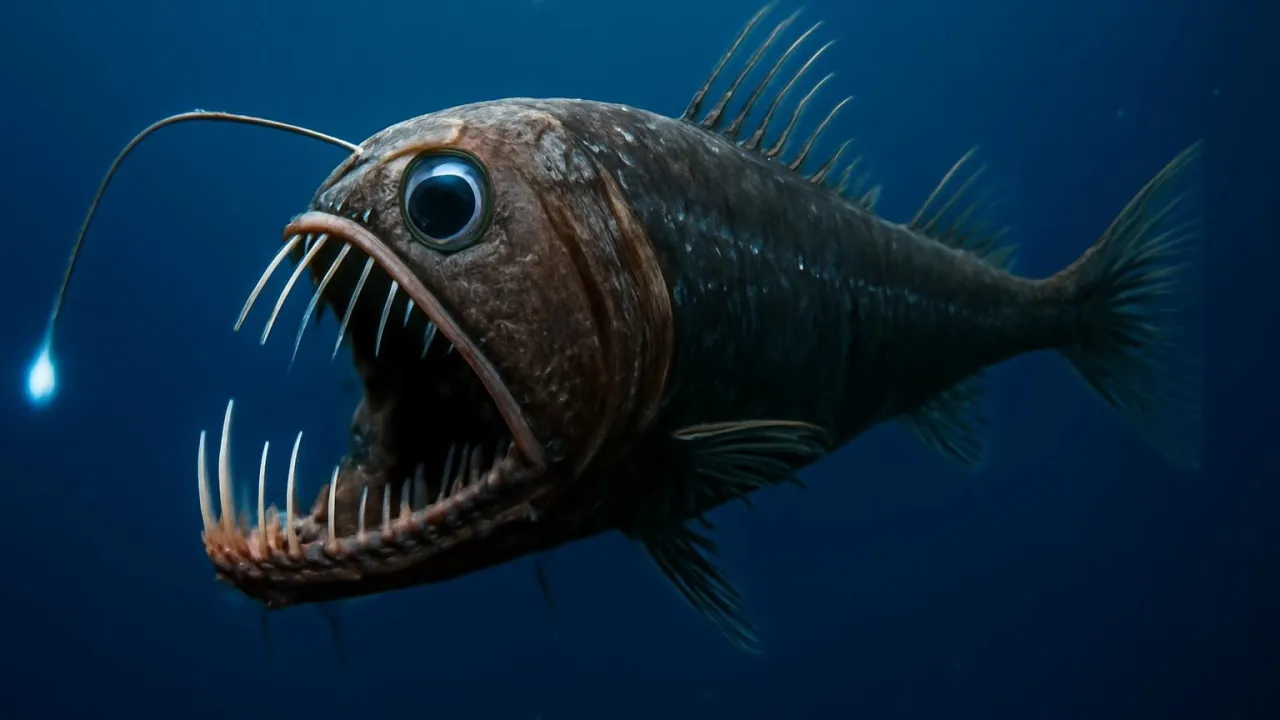
Viperfish use glowing teeth to lure prey close before they snap them up quickly.
✨ Word Sparks (Grade 2 Glossary)
Tap 🔊 to hear
prey
Animals that other animals eat
habitat
The place where an animal lives
fang
A long, sharp tooth for biting
🪝
Have you ever seen a fish with glowing, sharp teeth in the dark ocean?
1
Glowing Teeth Help Hunt
The viperfish has sharp teeth that glow in the dark deep ocean. It uses these teeth to catch small fish and shrimp. Its teeth look scary but help it survive in the dark water.
2
Deep Ocean Habitat
Viperfish live very deep in the ocean where sunlight cannot reach. They swim slowly and wait to find their . This deep is cold and very dark all the time.
3
Body and Size
Viperfish can grow up to two feet long. Their long bodies help them swim well in deep water. They have a large mouth with -like teeth that open wide to catch .
Viperfish’s glowing teeth are made from special light-producing cells called photophores.
✨ Word Sparks (Grade 3 Glossary)
Tap 🔊 to hear
adaptation
A change that helps animals survive
prey
Animals that are hunted for food
camouflage
Colors or shapes that hide animals
🪝
How does the viperfish’s glowing teeth help it survive in the deep ocean?
1
Deep Ocean Adaptation
The viperfish lives in the deep ocean where sunlight cannot reach. This dark habitat makes hunting difficult. Its glowing teeth act as a lure to attract close. This helps it survive in a tough environment.
2
Fang-Like Teeth
Viperfish have long, sharp fang-like teeth that curve backward. These teeth help trap slippery so they cannot escape. The large mouth opens wide to swallow prey whole. This physical is key for catching food.
3
Hunting and Diet
Viperfish are carnivores that feed on small fish and crustaceans. They use their glowing teeth and sharp fangs to catch at night. Their slow swimming helps them conserve energy in cold, deep water. This hunting style suits their environment well.
4
Camouflage and Movement
Their dark bodies blend into the deep ocean to avoid predators. Viperfish move with a gentle, undulating motion to sneak up quietly. This and movement help them both avoid danger and catch . It is a perfect survival strategy.
Viperfish’s glowing teeth are so bright they can be seen from several feet away in the deep ocean.
✨ Word Sparks (Grade 4 Glossary)
Tap 🔊 to hear
bioluminescent
Making light inside the body
predator
An animal that hunts other animals
ecosystem
All living things in one place
🪝
Why is the viperfish’s glowing teeth a brilliant adaptation for deep-sea life?
1
Deep Ocean Environment
The viperfish lives at depths between 1,000 and 5,000 feet where sunlight never reaches. This dark, cold environment requires special adaptations for survival. Because food is scarce, the viperfish’s glowing teeth act as a lure to attract prey close enough to catch. This cause-and-effect relationship helps it thrive in the deep sea.
2
Role in the Food Web
As a , the viperfish plays an important role in the deep ocean food web. It controls populations of smaller fish and crustaceans by hunting them. In turn, larger predators may prey on viperfish. This balance keeps the healthy and stable.
3
Physical Adaptations
The viperfish’s large mouth and fang-like teeth allow it to catch and swallow prey whole. Its teeth glow to attract prey in the dark water. The fish’s dark body provides camouflage from and prey alike. These adaptations work together to improve its chances of survival.
4
Geographic Distribution and Human Impact
Viperfish are found in deep oceans worldwide, especially in tropical and temperate waters. Human activities like deep-sea fishing and pollution can impact their habitat. Protecting deep ocean environments is important to conserve species like the viperfish.
The viperfish’s bioluminescent teeth can attract prey from over 2 meters away in total darkness.
✨ Word Sparks (Grade 5 Glossary)
Tap 🔊 to hear
bioluminescence
Light made by living creatures
mesopelagic
Ocean zone 300-1,000 meters deep
predator
Animal that hunts other animals
🪝
What unique features allow the viperfish to thrive in the deep ocean’s extreme darkness and pressure?
1
Scientific Classification and Habitat
The viperfish, scientifically named Chauliodus sloani, belongs to the family Stomiidae. It inhabits to bathypelagic zones ranging from 300 to 1,500 meters deep. This deep-sea environment is characterized by near-total darkness, high pressure, and cold temperatures averaging 4 degrees Celsius. The viperfish’s adaptations allow it to survive and hunt efficiently in these extreme conditions.
2
Physiological Adaptations and Bioluminescence
Viperfish possess large, fang-like teeth that are so long they cannot fit inside their mouths fully. Their bioluminescent photophores produce blue-green light, which they use to attract prey in the pitch-black waters. This light is generated through a chemical reaction involving luciferin and luciferase enzymes. The fish’s flexible jaw and hinged skull enable it to swallow prey up to half its own body length.
3
Ecological Role and Conservation
As a mid-level , the viperfish regulates populations of smaller fish and crustaceans, maintaining deep-sea food web balance. Though not currently endangered, deep-sea fishing and habitat disruption pose potential threats. Conservation efforts focus on protecting deep ocean ecosystems to preserve biodiversity, including species like the viperfish.
4
Comparative Size and Speed
Viperfish typically grow up to 60 centimeters in length and weigh around 1 kilogram. They can swim at speeds up to 3 miles per hour, which is slow compared to surface fish but efficient for energy conservation in cold, deep waters. Their glowing teeth can be seen from distances of several meters, aiding in prey attraction.
5
Historical and Botanical Context
The viperfish was first described scientifically in the 19th century, highlighting its unique adaptations to the deep sea. Unlike surface fish, it relies heavily on rather than vision to hunt. This evolutionary path showcases the diversity of life forms adapting to extreme habitats on Earth.