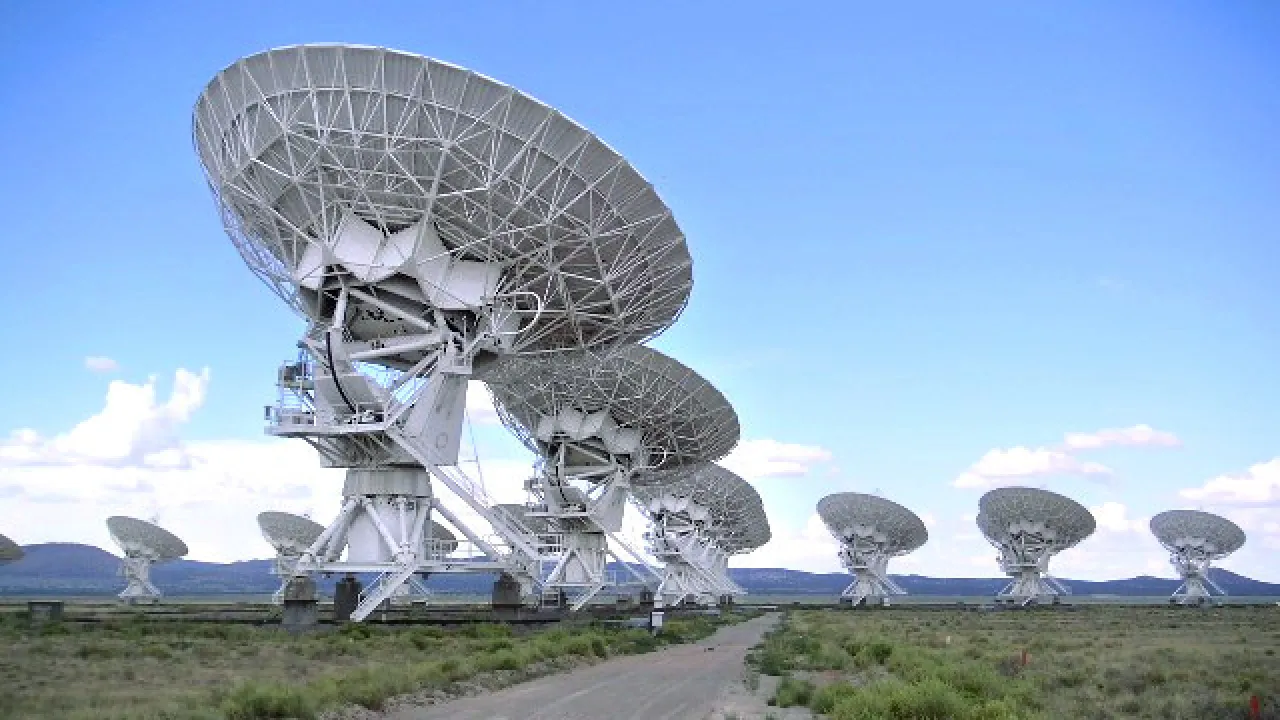
1. How many active dishes work together at the Very Large Array?
2. How do engineers move these giant dishes closer together or farther apart?
🤯 Mind-Blowing Fact • Grade 2
In 1989, the Very Large Array helped NASA catch faint radio pictures beamed back from Voyager 2 as it flew past icy Neptune!
✨ Word Sparks (Grade 2 Glossary)
Tap 🔊 to hear
antenna
a metal structure catching radio signals
supercomputer
an ultra-fast computer solving huge math
plain
a wide, flat stretch of land
🪝
Why would astronomers lay railroad tracks in the shape of a giant letter Y across New Mexico?
1
A Giant Y on the Plains
Stand on a quiet high in New Mexico, and twenty-seven white dishes tower into the blue sky! Together they form the Very Large Array, arranged along three railroad arms shaped like a giant letter Y.
2
Acting Like One Super Dish
Each dish measures 82 feet wide and weighs 230 tons. A powerful combines the radio signals from all twenty-seven so they work like a single giant telescope up to 22 miles across!
3
Zooming In and Out
Every few months, crews move the dishes along the tracks—spreading them wide like a zoom lens for sharp close-ups, or clustering them close for wide sky pictures.
1. What letter of the alphabet do the three railroad arms of the Very Large Array form?
2. What happens when engineers spread the 27 dishes out to the very ends of their tracks?
🤯 Mind-Blowing Fact • Grade 3
The observatory was renamed the Karl G. Jansky Very Large Array to honor the engineer who accidentally discovered cosmic radio waves from the Milky Way in 1932!
✨ Word Sparks (Grade 3 Glossary)
Tap 🔊 to hear
interferometry
combining multiple telescopes for sharper images
wavelength
distance from one wave crest to another
correlator
computer blending signals from many antennas
🪝
Why are radio waves millions of times longer than light waves—and how did scientists build a 22-mile zoom lens to focus them?
1
Solving the Blurry Wave Problem
Imagine trying to paint tiny eyelashes using a giant house-painting roller! Radio waves from space are much longer than visible light waves, so a single radio dish sees a much blurrier picture than an optical mirror. To get sharp images without building an impossible 22-mile solid metal bowl, astronomers created the Very Large Array in 1980.
2
High and Dry in New Mexico
Built at nearly 7,000 feet elevation on the Plains of San Agustin, the observatory sits ringed by mountains that block stray radio noise from cities, cell towers, and highways.
3
The Magic of Interferometry
Fiber-optic cables carry radio waves from twenty-seven 82-foot dishes into a central supercomputer. Using a technique called , the computer compares the exact split-second arrival times of waves at every pair of dishes as Earth rotates.
4
Four Configurations
Twenty-eight dishes rotate through service—twenty-seven observing while one gets maintained in the barn. Every four months, twin-rail transporters shift the array among four spacing layouts from 0.6 miles to 22 miles wide.
1. Why did astronomers choose a mountain-ringed plain in New Mexico for the Very Large Array?
2. Why are there actually 28 dishes on-site even though 27 observe at once?
🤯 Mind-Blowing Fact • Grade 4
The WIDAR supercomputer at the heart of the VLA performs quadrillions of calculations every single second—matching the computing power of millions of laptops!
✨ Word Sparks (Grade 4 Glossary)
Tap 🔊 to hear
baseline
exact distance separating two linked antennas
aperture synthesis
using Earth's spin to simulate giant dishes
plasma jet
high-speed beam of superheated charged gas
🪝
How do twenty-seven scattered dishes mathematically fill in the missing metal of a 22-mile-wide giant telescope?
1
351 Pairs Working Together
Picture twenty-seven musicians standing across a vast desert valley, all listening to the same faint chord drifting down from a distant galaxy. At the Karl G. Jansky Very Large Array, each pair of 25-meter parabolic antennas forms what astronomers call a . With twenty-seven active dishes, the observatory simultaneously measures 351 unique baselines of different lengths and angles! As Earth's rotation slowly turns the Y-shaped array beneath the stars, those 351 pairs sweep out rings that mimic a giant filled dish—a Nobel-Prize-winning method called .
2
Moving 230-Ton Giants on Double Rails
Moving an eight-story, 230-ton precision instrument without bending it by even a millimeter takes specialized engineering. Custom 68-wheel diesel transporters straddle a double set of parallel railroad tracks, hydraulically lift an antenna off its concrete pier, roll it at five miles per hour to a new station pad, and bolt it down with survey accuracy.
3
Upgraded Fiber-Optic Brain
A major 2012 upgrade replaced 1970s copper waveguides with lightning-fast fiber optics and the WIDAR supercomputer correlator, multiplying sensitivity tenfold across continuous frequencies from 74 megahertz to 50 gigahertz.
4
Jets, Rings, and Baby Planets
With resolution rivaling optical space telescopes, the VLA mapped twin blasting thousands of light-years from galaxy Cygnus A, spotted gravitational 'Einstein rings' where foreground galaxies bend distant radio waves into circles, and imaged planet-forming gaps inside dusty disks around newborn stars.
1. How does Earth's natural rotation help the Very Large Array build clearer radio pictures?
2. What cosmic phenomenon did the VLA map shooting out from the core of galaxy Cygnus A?
🤯 Mind-Blowing Fact • Grade 5
Even though its 25-meter steel dishes weigh 230 tons apiece, their white paint isn't for looks—it reflects intense New Mexico desert sunlight so uneven heat expansion doesn't warp their millimeter-precise parabolic curves!
✨ Word Sparks (Grade 5 Glossary)
Tap 🔊 to hear
diffraction limit
sharpness limit set by wavelength and diameter
Fourier transform
math turning wave patterns into clear images
quasar
ultra-bright distant galaxy core powered by black hole
🪝
Why does optical physics force a centimeter-wave radio observatory to stretch thirty-six kilometers wide just to match the sharpness of a backyard telescope?
1
Conquering the Diffraction Limit
In wave physics, any telescope's angular resolution is governed by the ratio of observed wavelength to aperture diameter. Because a 6-centimeter radio wave is roughly 100,000 times longer than a 600-nanometer visible light wave, a radio telescope must span tens of kilometers to achieve the sub-arcsecond clarity of optical observatories! Constructed across the 2,124-meter-high Plains of San Agustin in central New Mexico and dedicated in 1980, the Karl G. Jansky Very Large Array solves this challenge without a monolithic dish.
2
Fourier Transforms and 351 Baselines
Deploying twenty-seven 25-meter Cassegrain antennas along three 21-kilometer rail arms angled 120 degrees apart creates 27 times 26 divided by 2—or 351—simultaneous interferometer pairs. Each pair measures one spatial Fourier component—or 'visibility'—of the sky's brightness distribution by correlating phase delays between arriving wavefronts. Over hours of Earth rotation synthesis, those 351 baselines trace dense tracks across the virtual aperture plane, which computers invert via fast into detailed radio maps.
3
Balancing Resolution and Surface Brightness
No single antenna spacing suits every target, so crews reconfigure the array every four months through four standard footprints labeled A, B, C, and D. Extended 'A-configuration' (36.4 km maximum baseline) pinpoints compact and pulsar wind nebulae down to 0.04 arcseconds, whereas compact 'D-configuration' (1 km span) packs dishes tightly to capture diffuse, faint hydrogen clouds sprawling across entire galaxy clusters.
4
Cryogenic Receivers and WIDAR Rebirth
Completed in 2012, the Expanded VLA project installed helium-cooled cryogenic receivers spanning eight contiguous frequency bands (1–50 GHz plus low-band dipoles) feeding buried single-mode optical fibers and the Canadian-built WIDAR correlator capable of 10 quadrillion operations per second.
5
From Einstein Rings to Fast Radio Bursts
Whether discovering the very first gravitational Einstein ring (MG 1131+0456), pinpointing repeating millisecond Fast Radio Bursts to dwarf galaxies billions of light-years away, or imaging the warm radio glow of kilonova mergers, the VLA remains humanity's most versatile centimeter-wave eye.
1. Why do astronomers switch the VLA into its compact 1-kilometer 'D-configuration' instead of keeping the dishes spread 36 kilometers apart year-round?
2. Why are the VLA's giant aluminum dishes painted bright matte white rather than left shiny silver?