🪐 Scale / DiameterPole: 1.98M mi (3.18M km) • Equator: 2.38M mi (3.83M km) • 2.14 solar masses
☄️ Composition & Orbit40× Sun-luminous hydrogen core • Spins every 12.5 hours inside a smooth icy debris disk
⚡ Cosmic SparkSpins so fast it bulges like a squashed beach ball and served as astronomy's 'zero-point' brightness ruler
🤯 Mind-Blowing Fact • Grade 1
If Vega spun just a tiny bit faster—about ten percent faster—pieces of its gas middle would fly right off into space!
✨ Word Sparks (Grade 1 Glossary)
Tap 🔊 to hear
Lyra
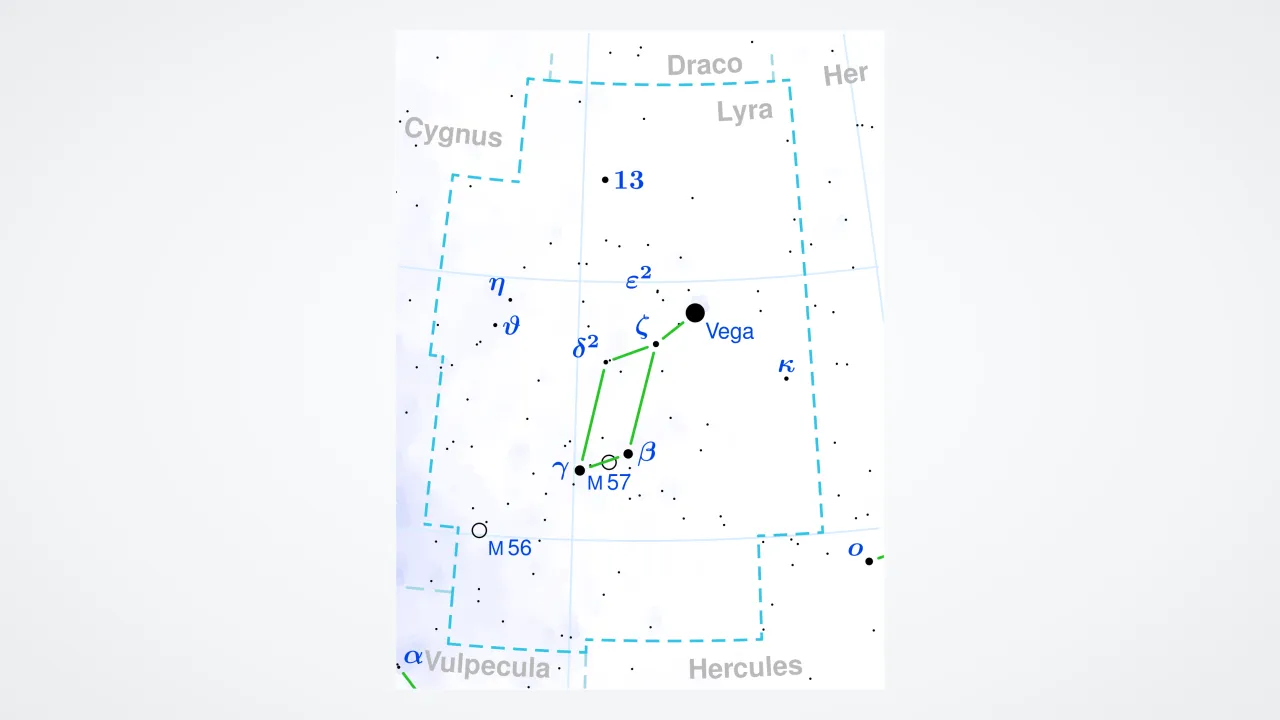
Star pattern shaped like a small musical harp
bulge
To puff or squish wider around the middle
sapphire
Sparkling gemstone with a cool blue-white shine
🪝
Can a giant star spin so fast that its middle squishes out wide like pizza dough?
1
Crown of the Summer Sky
Lie back on warm summer grass and look straight up! Shining overhead like an icy blue-white gleams Vega in the little harp star group. It is one of the brightest stars of summer!
2
Spinning Super Fast
Our Sun takes nearly a month to spin once, yet this speedy star spins all the way around in half a day! That fast spin squishes its middle out wide like a pumpkin.
3
First Star Photo Ever
Long ago in 1850, astronomers snapped the very first night star photo of this bright gem!
1. What happens to Vega's shape because it spins once every twelve and a half hours?
2. What photography record did Vega set way back in the year 1850?
🤯 Mind-Blowing Fact • Grade 2
In about 12,000 years, Earth's slow wobble will point our North Pole near Vega—making dazzling Vega our future North Star!
✨ Word Sparks (Grade 2 Glossary)
Tap 🔊 to hear
Summer Triangle
Big three-star pattern high in summer skies
Magnitude Zero
Baseline brightness mark originally set using Vega
debris disk
Wide dusty ring of colliding comets and rocks
🪝
Why did astronomers pick one summer star to be the 'Number Zero' ruler for measuring every other star?
1
Corner of the Summer Triangle
Step outside on a July or August evening and spot three bright stars forming the giant overhead! Anchoring its brightest corner in Lyra the Harp shines blue-white Vega, fifth-brightest star in Earth's entire night sky and just 25 light-years away.
2
Astronomy's Brightness Ruler
When scientists needed a fair ruler for ranking star brightness and color, they chose steady, dazzling Vega as '.' Stars dimmer than Vega get positive numbers like +1 or +2, while even brighter objects like Sirius get negative numbers!
3
Wrapped in a Giant Dusty Halo
Far around this young 455-million-year-old star swirls a huge, icy ring of comet dust wider than Pluto's orbit!
1. How did astronomers use Vega on the star brightness scale?
2. What cool job will Vega take over in about 12,000 years?
🤯 Mind-Blowing Fact • Grade 3
Vega's poles are more than 3,500°F (2,000°C) hotter than its equator because its fast spin stretches the equator far away from its central furnace!
✨ Word Sparks (Grade 3 Glossary)
Tap 🔊 to hear
gravity darkening
Cooling of a fast-spinning star's puffed-out equator
pole-on
Viewed looking straight down onto a spinning pole
infrared satellite
Space telescope built to sense warm cosmic dust
🪝
How can one star have scorching poles AND a much cooler equator at the exact same time?
1
Looking Straight Down on a Speed Demon
For decades, astronomers puzzled over why Alpha Lyrae—25 light-years away in Lyra—shone almost twice as bright as other A-type stars of the exact same 2.14-solar-mass weight! Optical interferometers finally cracked the riddle: Vega spins at 600,000 miles per hour around its equator, yet its north pole points almost straight at Planet Earth!
2
Gravity Darkening in Action
Spinning every 12.5 hours flings Vega's equator 400,000 miles farther from its hot core than its poles. Because the poles sit closer to the furnace core, they sizzle at 18,000°F (10,000 K), while the puffed-out equator cools to 14,000°F (7,900 K)—an effect called !
3
Why Earth Sees Extra Brightness
Because we gaze straight down onto Vega's blazing-hot pole instead of its dimmer, cooler waist, the star beams extra brightness in our direction!
4
First Dusty Disk Found Around Another Star
In 1983, the IRAS discovered warm dust glowing around Vega—humanity's first direct clue that planet-making debris orbits other sunlike stars!
1. Why does Vega look unexpectedly bright from Earth compared with twin stars of the same mass?
2. What groundbreaking discovery did the IRAS space telescope make around Vega in 1983?
🤯 Mind-Blowing Fact • Grade 4
In 2024, Hubble and the James Webb Space Telescope showed Vega's 100-billion-mile debris disk is 'smooth as a pancake,' proving two similar stars can build utterly different planetary neighborhoods!
✨ Word Sparks (Grade 4 Glossary)
Tap 🔊 to hear
daguerreotype
Early 1800s photograph made on polished silver plate
centrifugal
Outward flinging pull felt on spinning objects
absorption spectrum
Star rainbow crossed by dark chemical fingerprint lines
🪝
Why did the James Webb Space Telescope find Vega's 100-billion-mile dust disk astonishingly smooth—with zero giant planets carving gaps?
1
Trailblazer of Photographic and Spectral History
Few stars have shaped astronomy's toolkit like Alpha Lyrae. On July 16–17, 1850, William Cranch Bond and John Adams Whipple used Harvard's 15-inch refractor to record Vega on a silver-plated —the first photograph of any star beyond the Sun. Twenty-two years later, Henry Draper photographed Vega's rainbow for the first time, paving the way for modern astrophysics and Vega's century-long role defining zero magnitude across visible and infrared filter bands.
2
Spinning at Eighty-Eight Percent of Breakup Speed
Because Vega's rotation axis tilts less than five degrees from our line of sight, spectrographs saw minimal Doppler spin broadening—fooling astronomers into thinking Vega rotated slowly! Only when Mount Wilson's CHARA optical interferometer mapped uneven brightness across its 3.2-to-3.8-million-kilometer disk in 2006 did scientists realize Vega rotates at ~236 km/s—nearly 88 percent of the critical speed where force would tear its equator apart!
3
Webb's 2024 Surprise: A Pancake Smooth Disk
Sibling A-type star Fomalhaut sports dramatic dust rings sculpted by suspected planets. Yet when Hubble and the James Webb Space Telescope teamed up in 2024 to zoom into Vega's 100-billion-mile-wide debris disk, it looked shockingly smooth from outer edge to inner glow—save one subtle gap near 60 AU—ruling out any planets heavier than Neptune!
4
Halfway Through a Brief Main-Sequence Life
At ~455 million years old—just a tenth our Sun's age—2.14-solar-mass Vega is already halfway through its main-sequence hydrogen supply, destined to swell into a red giant within half a billion years.
1. Why did Vega's fast spin stay hidden from spectrographs for decades?
2. What surprised scientists when JWST and Hubble imaged Vega's giant debris disk in 2024?
🤯 Mind-Blowing Fact • Grade 5
Because astronomy's 'Magnitude Zero' star Vega turned out to be an oddball pole-on rapid rotator wrapped in glowing infrared dust, modern calibration slightly adjusted Vega itself to magnitude +0.026!
✨ Word Sparks (Grade 5 Glossary)
Tap 🔊 to hear
oblate spheroid
Sphere squished flat at poles, wide at middle
von Zeipel theorem
Law linking lower surface gravity to cooler starlight
photometry
Precision measurement of brightness across specific color filters
🪝
How did a pole-on oblate spheroid obey von Zeipel's gravity-darkening theorem while calibrating a century of astronomical photometry?
1
Etymology, First Astrophotography, and Zero-Point Calibration
Derived from the Arabic al-Nasr al-Waqi' ('the Swooping Eagle'), Alpha Lyrae shines at visual magnitude +0.026 from a distance of 25.04 light-years (7.68 parsecs). After Friedrich Georg Wilhelm Struve measured one of the earliest stellar parallaxes on Vega in 1837–1840, Bond and Whipple captured its historic 1850 Harvard daguerreotype and Henry Draper recorded its first stellar spectrogram in 1872. Throughout the 20th century, the Johnson-Morgan UBV photometric system anchored zero color index (U−B = B−V = 0.00) and zero apparent magnitude across wavelengths directly to Vega's A0Va continuum.
2
Oblate Geometry and von Zeipel Gravity Darkening
Ironically, astronomy's 'standard star' turned out to be anything but ordinary! Long-baseline optical interferometry with the CHARA Array and Navy Precision Optical Interferometer in 2006 revealed that Vega spins with a 12.5-hour period inclined just ~4.5 degrees from Earth's sightline. Equatorial rotational speeds of ~236 km/s deform Vega into an whose equatorial radius (2.726 solar radii) exceeds its polar radius (2.292 solar radii) by 19 percent! In crisp agreement with Hugo von Zeipel's 1924 theorem—stating radiative flux scales with local effective surface gravity—Vega's poles blaze near 9,988 K while its equator cools to ~7,900 K.
3
Sub-Solar Photospheric Metallicity and Weak Magnetism
Spectropolarimetric Zeeman measurements at Pic du Midi uncovered an ultra-weak sub-gauss polar magnetic field (~0.6 gauss)—making Vega the prototype for weak magnetism among radiative-envelope A-type stars—alongside a curiously dust-depleted surface metallicity ([M/H] ≈ −0.5) shaped by selective radiative diffusion.
4
Size-Sorted Dust in JWST and Hubble Disk Maps
Following IRAS's watershed 1983 detection of far-infrared excess around Vega—coining the 'Vega-like' debris-disk archetype—joint 2024 JWST/MIRI and Hubble coronagraphic imaging mapped the face-on disk across >100 AU. Radiation pressure and stellar wind sort grains cleanly by size: sand-sized particles trace an inner warm belt to ~85 AU (with a subtle 60-AU dip), while smoke-fine grains drift into a smooth outer halo free of Jupiter-mass shepherds.
5
Main-Sequence Midlife and Future Pole-Star Reign
At ~455 million years old, CNO-burning Vega sits roughly halfway through its ~1-billion-year main-sequence lifetime—more than long enough to shine near magnitude 0 within a few degrees of Earth's precessing North Celestial Pole around 13,727 CE.