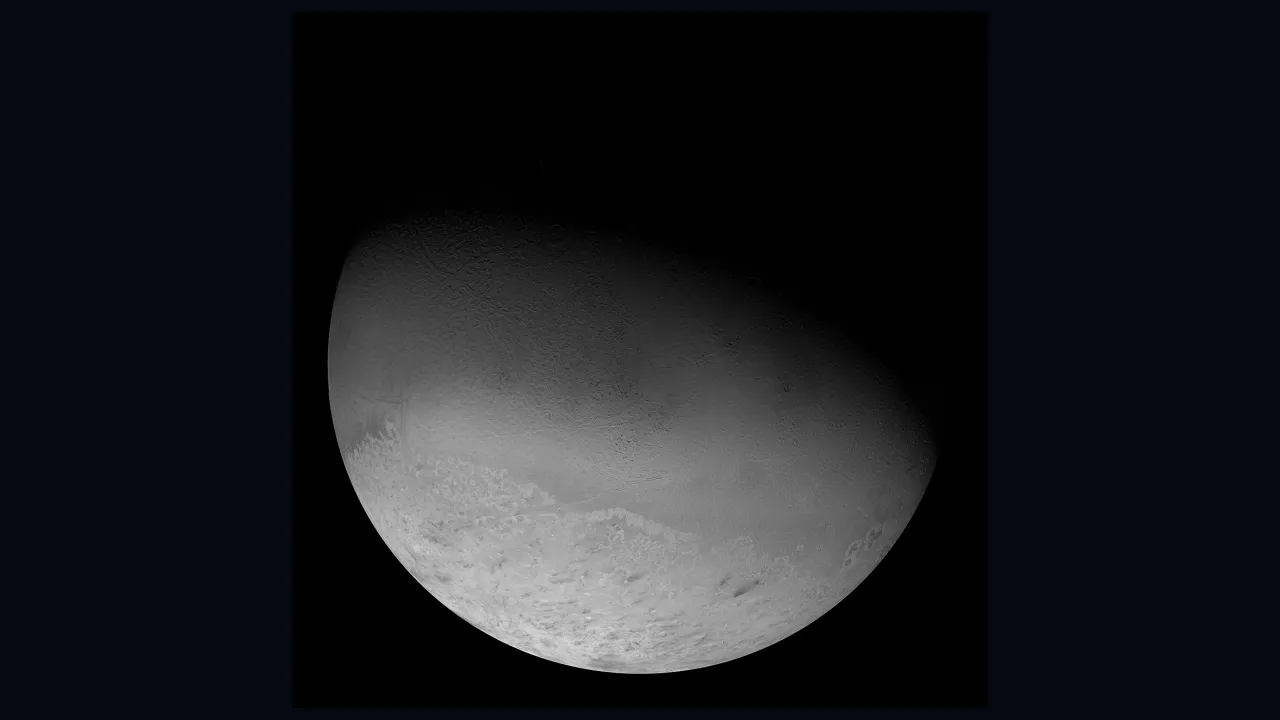
1. What makes Triton's orbit different from every other large moon in our Solar System?
2. Which fruit gave Triton's dimpled icy plains their fun nickname?
🤯 Mind-Blowing Fact • Grade 2
Triton is actually about 200 miles wider than its famous Kuiper Belt cousin Pluto!
✨ Word Sparks (Grade 2 Glossary)
Tap 🔊 to hear
Capture
When planet gravity grabs a passing world into orbit.
Retrograde
Traveling backward opposite a planet's spin direction.
Kuiper Belt
Ring of icy worlds beyond Neptune's orbit.
🪝
How did giant Neptune kidnap a whole dwarf planet to become its moon?
1
A Captured Cosmic Cousin
Just seventeen days after Neptune was discovered in 1846, astronomer William Lassell spotted big Triton beside it! Because Triton orbits backward—called a orbit—scientists know it didn't grow next to Neptune. Instead, Triton once roamed the like Pluto before Neptune's gravity snared it!
2
Solar-Powered Cold Geysers
At minus 391 degrees Fahrenheit, Triton is one of the coldest worlds ever measured. Yet weak sunlight shines through clear nitrogen ice, warms dark dust underneath, and blasts smoky geysers five miles high!
3
Wrinkled Like a Melon
Hardly any craters dent Triton's smooth ice plains and dimpled cantaloupe ridges, proving fresh ice paved over old scars!
1. Where do astronomers think Triton lived before becoming Neptune's moon?
2. How does Triton's size compare to dwarf planet Pluto?
🤯 Mind-Blowing Fact • Grade 3
In about 3.6 billion years, inward-spiraling Triton will break apart around Neptune to create an icy ring system even bigger and brighter than Saturn's!
✨ Word Sparks (Grade 3 Glossary)
Tap 🔊 to hear
Greenhouse effect
Trapping sunlight warmth beneath a clear layer.
Plume
A rising column of gas and dark dust.
Spiral
To curve gradually inward closer and closer.
🪝
What happens when faint sunlight turns clear nitrogen ice into an exploding greenhouse?
1
Melting From Capture Friction
When Neptune captured Triton billions of years ago, Triton's wild initial orbit stretched into a huge oval. Intense gravitational tides squeezed Triton so hard that its entire interior melted for hundreds of millions of years, erasing every early crater and separating a big rocky core from an icy shell!
2
Solid Greenhouse Geysers
In August 1989, Voyager 2 shocked astronomers by filming dark geyser erupting across Triton's pinkish south polar cap! Clear nitrogen frost acts like greenhouse glass: faint sunlight passes through, warms dark carbon dust four feet down, and boils nitrogen into pressurized gas jets.
3
Thin Winds High Above
Once those dark shoot five miles straight up, Triton's whisper-thin nitrogen atmosphere catches the soot and carries dark streaks ninety miles downwind!
4
Future Ring System
Because Triton orbits backward, Neptune's tides slowly brake its speed. In 3.6 billion years, Triton will too close and shatter into dazzling rings!
1. How did Voyager 2 prove Triton still has winds in a super-thin atmosphere?
2. Why will Triton eventually turn into a giant ring system around Neptune?
🤯 Mind-Blowing Fact • Grade 4
Count the craters on smooth parts of Triton and you will find fewer than a dozen—meaning icy lava repaved its surface while mammoths and early apes already walked on Earth!
✨ Word Sparks (Grade 4 Glossary)
Tap 🔊 to hear
Binary pair
Two worlds orbiting each other around shared gravity.
Cryolava
Slushy water-ammonia mixture erupting onto a cold surface.
Kinetic energy
Energy an object carries because of its motion.
🪝
How could single-planet gravity capture fast-moving Triton—unless Triton arrived with a twin partner?
1
Binary Exchange Capture Mechanics
In orbital physics, a lone dwarf planet zooming past Neptune moves too fast to be captured unless something slows it down. Planetary dynamicists solved the puzzle in 2006: Triton likely arrived as half of a binary Kuiper Belt pair—just like Pluto and Charon! During a close three-body encounter with Neptune, gravitational slingshot flung Triton's lost twin away with the excess , trapping Triton in a steep 157-degree retrograde orbit.
2
Youngest Surface Beyond Io and Europa
Crater counts from Voyager 2 show parts of Triton's icy plains are fewer than ten million years old—geologically yesterday! Smooth walled lakes of frozen water-ammonia (like Ruach and Tuonela Planitia) sit beside Bubembe Regio's cantaloupe terrain, where warm nitrogen-or-water ice diapirs welled upward.
3
High Density and Subsurface Ocean
At 2,707 kilometers wide and 2.06 grams per cubic centimeter, Triton is over sixty-five percent rock and metal—denser than any major moon of Saturn or Uranus! Decay of radioactive elements in that big core, assisted by obliquity tides and ammonia antifreeze, likely sustains a global liquid ocean beneath the ice.
4
Seasonal Nitrogen Atmospheres
Stellar occultations from Earth show Triton's nitrogen surface pressure fluctuates wildly with Neptune's 40-year seasons as polar frost sublimates into gas.
1. According to leading orbital models, how did Triton lose enough speed to get captured by Neptune?
2. What does the tiny number of impact craters on Triton's smooth plains tell geologists?
🤯 Mind-Blowing Fact • Grade 5
Triton's orbit around Neptune has been tidally smoothed into the closest thing to a mathematical circle of any moon or planet in our Solar System—deviating by less than 0.002 percent!
✨ Word Sparks (Grade 5 Glossary)
Tap 🔊 to hear
Eccentricity
Measure of how oval or circular an orbit is.
Ionosphere
Upper sky layer filled with electrically charged atoms.
Torque
A twisting force that tilts a spinning object.
🪝
How do obliquity tides and intense ionosphere currents make captured Triton a premier ocean-world target?
1
Circularization Catastrophe and Core Differentiation
Following binary-exchange capture into a highly eccentric retrograde orbit around Neptune, tidal dissipation inside Triton unleashed catastrophic global heating exceeding inner Io's current heat flux for hundreds of millions of years. That thermal pulse damped Triton's orbital to a razor-sharp 0.000016—virtually a perfect circle!—while fully differentiating its 2.06-gram-per-cubic-centimeter bulk into a massive 1,900-kilometer silicate-metal core beneath a 350-kilometer water-ice shell.
2
Obliquity Tides Sustain an Ammonia-Water Sea
Why might Triton's internal ocean still remain liquid even after its orbit circularized? Because Triton orbits inclined 156.9 degrees relative to Neptune's equator while Neptune's own spin axis tilts 28.3 degrees, complex solar and planetary force subtle axial obliquity oscillations. Combined with radiogenic heating from Triton's large rocky core, obliquity tides generate enough internal warmth to keep an ammonia-enriched ocean liquid 150 kilometers down.
3
James Webb Spectroscopy Compared With Pluto
In 2023, JWST's Near-Infrared Spectrograph mapped Triton alongside Pluto, confirming rich surface ices of molecular nitrogen, methane, and carbon monoxide perched over crystalline water-ice bedrock—yet with much higher surface albedo (0.76) on Triton due to rapid seasonal frost turnover across its southern cap.
4
Surprisingly Dense Ionosphere
Despite surface atmospheric pressure hovering near a mere 14 microbars (one seventy-thousandth of Earth's!), Voyager 2 radio occultation detected a remarkably dense 350 kilometers up, energized as Triton plows backward through Neptune's tilted magnetosphere and collects streaming charged electrons.
5
Trident and Future Ocean Detection
Proposed flagship and discovery concepts like NASA's Trident flyby and international Neptune-Triton orbiters aim to photograph Triton's unseen northern hemisphere in detail and use three-axis magnetometry to confirm whether a captured Kuiper Belt ocean endures beneath its geysers.