⚡ Everyday Impact SparkGuides thousands of tons of rolling steel smoothly over hills and bridges using minimal fuel
🤯 Mind-Blowing Fact • Grade 1
Why is there no steering wheel inside a train cab? Curved steel wheel rims hug the iron rails and steer the train around bends automatically!
✨ Word Sparks (Grade 1 Glossary)
Tap 🔊 to hear
Locomotive
The powerful front engine car pulling a train
Rails
Twin steel bars forming a smooth train track
Signal
Colored trackside lights telling trains stop or go
🪝
Who sits up front and drives a long, rumbling train?
1
All Aboard!
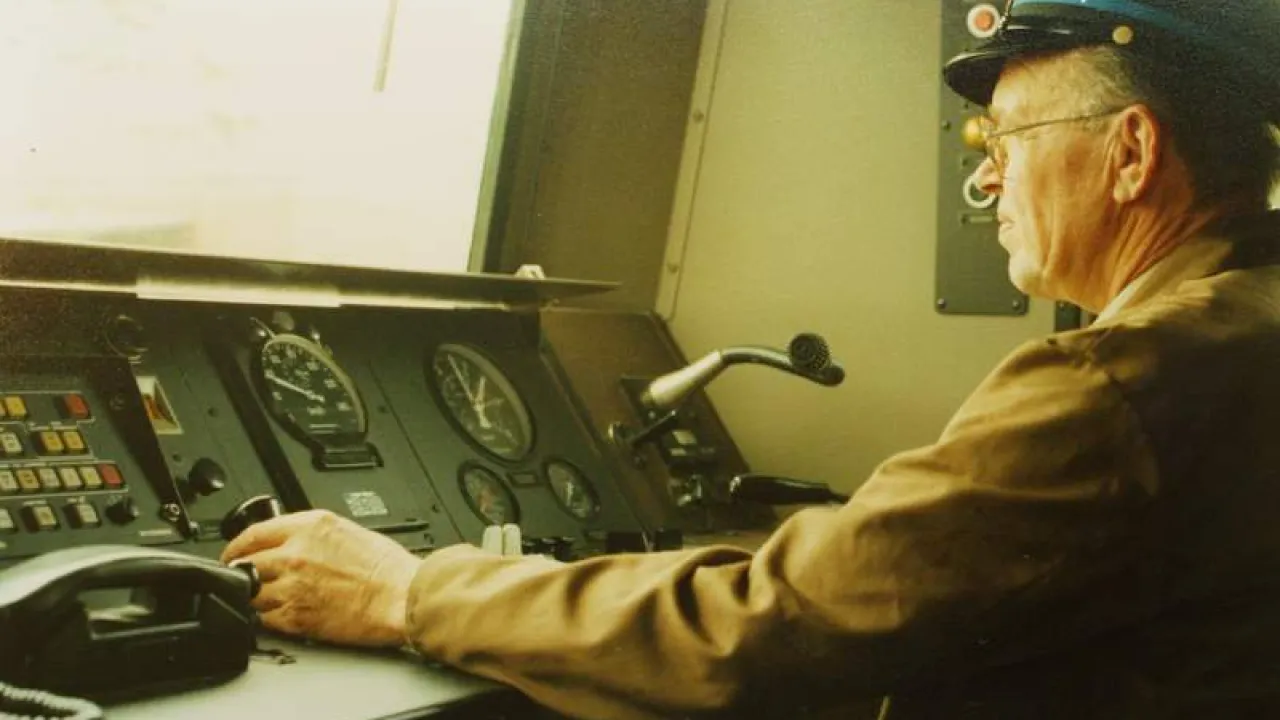
Whooo-whooo! Two long blasts, one short, and one long sound at a road crossing. Smooth steel wheels roll along shiny tracks. Up in the front cab sits the train engineer!
2
People and Boxes
Some engineers drive fast passenger trains between cities. Others pull long lines of boxcars filled with food, lumber, and cars.
3
Watching Every Signal
Tracks guide the wheels, so there is no steering wheel! Instead, the engineer controls speed, brakes, and colored lights.
1. Why doesn't a train locomotive engineer need a steering wheel?
2. Why does an engineer blow a special horn pattern near road crossings?
🤯 Mind-Blowing Fact • Grade 2
One freight train pulled by a locomotive engineer can carry as much cargo as 300 big highway trucks while using way less fuel!
✨ Word Sparks (Grade 2 Glossary)
Tap 🔊 to hear
Conductor
Crew partner managing train cars, tickets, and safety
Freight
Goods and supplies carried in bulk by vehicles
Friction
Rubbing force that slows moving wheels or shoes
🪝
Why can it take more than a whole mile for a heavy freight train to come to a stop?
1
Planning Way Down the Track
Feel the deep, gentle rumble as a 100-car train glides past a town station! Because smooth steel wheels roll with very little and the loaded train weighs millions of pounds, it cannot stop quickly like a family car. A train locomotive engineer must plan miles ahead.
2
Teamwork With the Conductor
Engineers never work alone on the rails. They partner with a train , who checks cargo lists, throws yard switches, and helps travelers board passenger cars safely. Clear radio calls connect them to central dispatchers.
3
Knowing Every Curve and Hill
Skilled engineers memorize every river bridge, speed limit, mountain tunnel, and steep hill along their route—even in thick fog or pitch-black night!
1. Why does a heavy freight train need up to a mile or more to stop completely?
2. Who works alongside the locomotive engineer to manage cargo cars, switches, and passengers?
🤯 Mind-Blowing Fact • Grade 3
A single freight locomotive can move one ton of cargo nearly 500 miles on just a single gallon of fuel—making railroads the greenest land freight movers!
✨ Word Sparks (Grade 3 Glossary)
Tap 🔊 to hear
Traction Motor
Electric motor mounted on axles turning train wheels
Air Brake
Fail-safe train brake system powered by compressed air
Dispatcher
Control-center coordinator routing trains safely along tracks
🪝
Did you know most modern diesel locomotives are actually driven by electric motors?
1
Diesel-Electric Powerhouse
Climb up the sturdy iron ladder into a modern freight locomotive, and listen to its deep 4,400-horsepower hum! Here is a cool surprise: the giant diesel engine does not turn the wheels directly. Instead, it spins an onboard generator that makes electricity for powerful electric mounted right on the wheel axles!
2
George Westinghouse's Air Brakes
Back in 1869, American inventor George Westinghouse created fail-safe compressed-air train brakes. A connected air hose runs beneath every single boxcar on the train. If two cars ever uncouple by accident, air pressure drops instantly and every car's brakes clamp tight automatically!
3
Positive Train Control
Inside the engineer's cab, glowing screens run Positive Train Control (PTC)—a smart satellite GPS and radio safety shield that slows the train automatically if a curve speed limit or red stop signal approaches.
4
High-Speed Electric Corridors
Between Virginia, Washington, D.C., New York, and Boston, passenger engineers pilot sleek electric trains fed by overhead wires at speeds up to 150 miles per hour!
1. How does a 'diesel-electric' locomotive actually spin its heavy steel wheels?
2. What makes compressed-air train brakes 'fail-safe' if a hose ever breaks?
🤯 Mind-Blowing Fact • Grade 4
Each steel wheel on a heavy locomotive touches the steel rail on a 'contact patch' roughly the size of a single U.S. dime—which is why rolling resistance is so astonishingly low!
✨ Word Sparks (Grade 4 Glossary)
Tap 🔊 to hear
Dynamic Braking
Slowing a train by turning wheel motors into generators
Slack Action
Gentle bunching or stretching between coupled train cars
Grade
The uphill or downhill steepness of railroad track
🪝
How does one engineer manage a two-mile-long train when the front cars are rolling downhill while the back cars are still climbing uphill?
1
Taming Slack Action Over Mountains
Picture piloting a two-mile-long freight train across Virginia's Blue Ridge Mountains toward the seaport docks of Norfolk. While the lead locomotives begin coasting down the eastern mountain slope, the last sixty loaded cars are still chugging up the western side! Because every steel coupler has a few inches of free play, cars gently bunch together or stretch apart—a force railroaders call '.' Managing throttle and brake notches smoothly so couplers never jerk takes remarkable skill.
2
Dynamic Braking: Turning Motors Into Generators
If an engineer relied only on friction brake shoes down a ten-mile mountain , rubbing metal would glow red-hot and wear down wheels. Instead, engineers engage '.' Flipping that control turns the locomotive's axle electric motors into electrical generators—using the heavy train's own downhill push to create magnetic resistance that holds speed steady without touching brake pads!
3
Sand Nozzles for Slippery Rails
Crushed autumn leaves, light drizzle, or dawn frost can make polished steel rails slick as ice. Pressing a cab button puffs dry silica sand through tiny tubes right in front of the locomotive wheels for instant climbing traction.
4
Federal Certification and Simulators
Every locomotive engineer earns Federal Railroad Administration (FRA) certification after months of railroad academy classes, full-motion cab simulators, and supervised runs memorizing every signal, siding, and crossing on their route.
1. Why do locomotive engineers use 'dynamic braking' down long mountain hills?
2. What secret weapon do locomotives carry for icy or leaf-slicked rails?
🤯 Mind-Blowing Fact • Grade 5
On electrified passenger railroads with regenerative braking, a single decelerating high-speed train can pump megawatts of electricity back into the overhead wire—enough to help launch another train departing a nearby station!
✨ Word Sparks (Grade 5 Glossary)
Tap 🔊 to hear
Distributed Power
Radio-linked locomotives placed mid-train to balance pulling forces
Pantograph
Hinged roof arm drawing power from overhead wires
Regenerative Braking
Capturing braking energy and turning it into electricity
🪝
How do locomotive engineers balance Newtonian momentum, distributed radio-linked locomotives, and high-speed catenary physics across modern rail networks?
1
Commanding 18,000 Tons of Kinetic Energy
Seated before the digital displays of a 4,400-horsepower AC-traction locomotive, an engineer orchestrates Newtonian mechanics on a monumental scale. A loaded 150-car freight consist can top 18,000 tons; rolling at 50 miles per hour, its kinetic energy (½mv²) rivals dozens of airborne commercial airliners combined. Because steel-wheel-on-steel-rail adhesion is tiny, every throttle notch and brake reduction requires mile-ahead foresight.
2
Distributed Power and Coupler Forces
Hauling two miles of heavy hoppers solely from lead engines could exceed the 390,000-pound tensile limit of steel knuckle couplers on steep Appalachian mountain grades, where even a '2 percent grade' (rising 2 vertical feet per 100 horizontal feet) adds immense gravitational drag. Modern engineers command (DP)—operating unmanned locomotives spliced mid-train and at the rear via encrypted radio telemetry. Independent throttle and brake control on rear units keeps in-train buff and draft forces balanced across cresting hills and tight S-curves.
3
Regenerative Catenary and High-Speed Rail
Along electrified passenger arteries—from Amtrak's Northeast Corridor linking Washington, D.C., and Boston to 200-mph Japanese Shinkansen and European TGV lines—roof-mounted draw 25,000-volt alternating current from overhead catenary wires. When slowing for a station, regenerative traction inverters convert wheel momentum straight back into synchronized grid electricity, helping power neighboring trains!
4
Battery-Electric and Hydrogen Horizons
To decarbonize heavy non-electrified freight corridors, rail engineers are now piloting multi-megawatt battery-electric tender locomotives alongside hydrogen fuel-cell power units whose only tailpipe emission is clean water vapor.
5
Rigorous Federal Qualification
Regulated under federal rule 49 CFR Part 240, FRA-certified locomotive engineers master pneumatic air-brake propagation physics, Positive Train Control (PTC) computer architectures, route-specific physical track characteristics, and recurrent full-motion simulator checks to safeguard millions of passengers and vital commerce.