🧬 HUMAN BODY
🧬 Substantia Adamantina • Digestive & Dental System
VA Science & Health SOL 1.1, 3.1, 4.2, 5.1 (Cells, Organs & Body Systems)
Tooth Enamel
Crystal-Woven Armor Harder Than Steel on Every Smile
Grade 5 • Advanced • 280 words
🩺 Body System & LocationDigestive System • Outer protective crown coating every human tooth
🔬 Size / Cell CountUp to 2.5 mm thick on chewing cusps • 96% pure mineral crystals
⚙️ Core JobShields sensitive inner tooth layers from crushing bite forces, heat, cold, and acids
⚡ Body SuperpowerStands as the single hardest biological substance in the entire human body—harder than bone or iron!
🤯 Mind-Blowing Fact • Grade 1
Your shiny tooth enamel is harder than your arm bones—and even harder than a piece of iron!
✨ Word Sparks (Grade 1 Glossary)
Tap 🔊 to hear
Enamel
Hard, shiny outer shield covering every tooth
Mineral
Natural rock-hard building material inside teeth
Crown
Top part of a tooth above gums
🪝
What is the very hardest part of your whole body—even harder than your bones?
1
Super-Strong Smile Armor
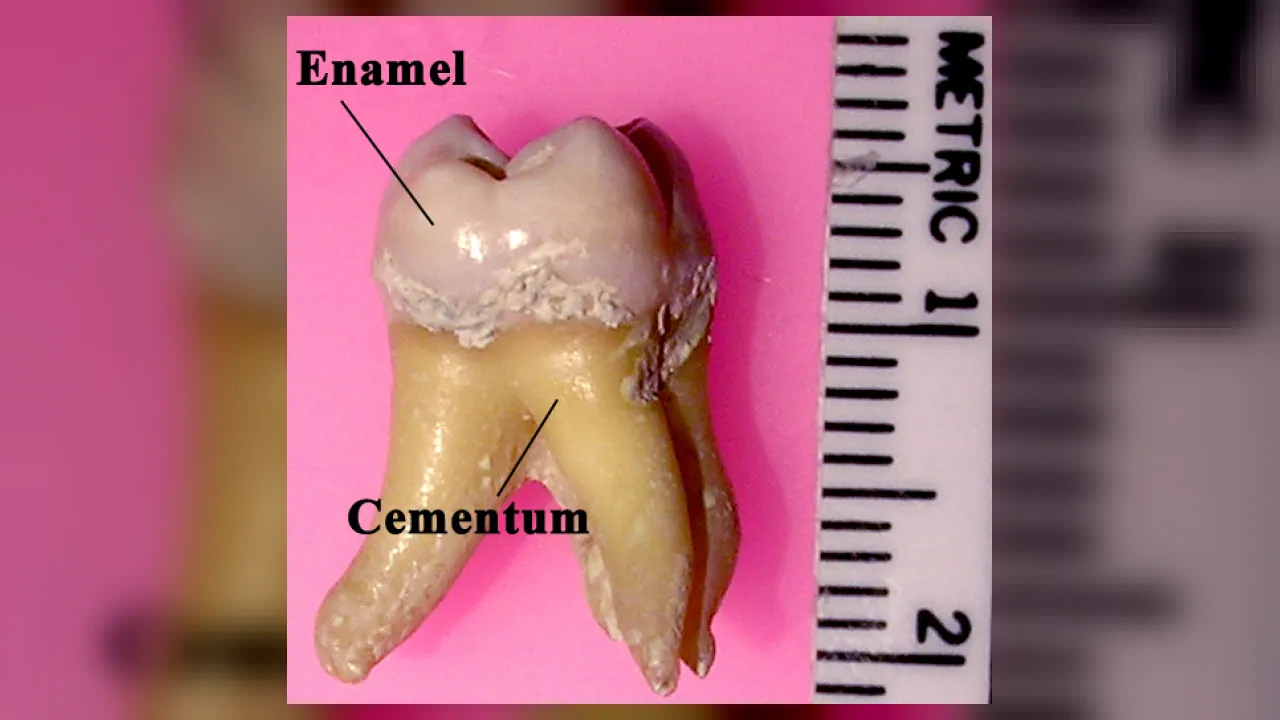
Crunch! Bite into a crisp red apple and listen to that sound. Wrapping the outside of every tooth is a shiny helmet called tooth . It is the hardest part of your entire body!
2
Protecting Inside Layers
Deep inside each tooth live soft nerves that feel hot soup and cold ice cream. Tough keeps those inner parts safe while you chew.
3
Brush Day and Night
Sugary snacks help mouth germs make weak spots in , so brushing twice a day keeps your armor sparkling!
Why can a broken arm bone heal itself, yet a chipped tooth needs a dentist's help?
1
Ninety-Six Percent Rock Crystal
Tap your front teeth gently together—clink! Unlike skin or muscle, tooth enamel is 96 percent pure mineral crystal, mostly made of and phosphate. That crystal shell lets your crush crunchy carrots thousands of times without wearing flat.
2
No Living Cells Left Behind
Before a tooth pokes up through your gums, special builder cells weave its enamel coat and then disappear forever! Because finished enamel has zero living cells or blood tubes inside it, it cannot grow back if it chips.
3
Why Teeth Look Pearly White
Pure enamel is actually slightly see-through! The warm ivory layer underneath, called , shines gently through to give your smile its natural color.
1. Why can't chipped tooth enamel grow back by itself the way scraped skin heals?
2. What gives healthy teeth their warm, pearly ivory shade?
🤯 Mind-Blowing Fact • Grade 3
Archaeologists regularly find ancient human teeth with shiny intact enamel hundreds of thousands of years old—long after bones have crumbled!
✨ Word Sparks (Grade 3 Glossary)
Tap 🔊 to hear
Plaque
Sticky invisible film of germs coating teeth
Fluoride
Helpful mineral in toothpaste that strengthens enamel
Cavity
Tiny hole in enamel caused by germ acids
🪝
How does fluoride in toothpaste act like a superhero repair crew for microscopic weak spots on your teeth?
1
Woven Crystal Rods
Zoom in on tooth enamel with an electron microscope, and you won't see a flat smooth sheet! Instead, millions of microscopic mineral rods—called hydroxyapatite prisms—interlock side by side from the inner dentin all the way to the chewing surface, resisting cracks from heavy bites.
2
The Acid Tug-of-War
Whenever you sip fizzy soda or munch sticky candy, harmless-looking bacteria living in feast on those sugars and release sour acid! Acid dissolves tiny amounts of calcium out of enamel crystals. Left unchecked over months, that acid digs a tiny hole called a .
3
Saliva and Fluoride to the Rescue
Thankfully, your mouth fights back! Mineral-rich saliva washes away acid and puts calcium right back onto microscopic weak spots. Brushing with toothpaste upgrades those crystals into an even tougher mineral shield that resists future acid attacks!
4
Cushioned by Springy Dentin
Hard crystals alone could shatter like glass, so slightly softer, springier dentin sits right beneath enamel like a shock absorber.
1. How do mouth bacteria actually cause a cavity in tooth enamel?
2. Why is having springy dentin directly underneath hard enamel so helpful?
🤯 Mind-Blowing Fact • Grade 4
Builder cells weave microscopic enamel rods in crisscrossed wavy bundles so tiny micro-cracks get trapped in a maze instead of splitting your tooth!
✨ Word Sparks (Grade 4 Glossary)
Tap 🔊 to hear
Ameloblast
Specialized cell that builds enamel before tooth eruption
Hydroxyapatite
Calcium-phosphate crystal forming enamel and bone
Remineralization
Natural crystal repair using minerals from saliva
🪝
How can a coating thinner than two stacked dimes withstand seventy years of crushing jaw forces without shattering?
1
Nature's Crack-Stopping Weave
At its thickest peaks atop chewing molars, human tooth enamel measures only 2.5 millimeters thick, yet adult jaws clamp down with forces exceeding 150 pounds of pressure! On the Mohs mineral hardness scale (where talc is 1 and diamond is 10), enamel scores around 5—harder than iron or steel nails. Why doesn't a substance that hard shatter like a ceramic teacup? Master builder cells called weave millions of hexagonal rods in undulating, crisscrossed bundles (decussation). If a microscopic fracture starts at the surface, those interwoven wave patterns zigzag the crack to a dead stop!
2
Daily Demineralization and Remineralization
Inside your mouth, a silent chemical tug-of-war plays out after every meal. When plaque microbes such as Streptococcus mutans ferment carbohydrates into lactic acid and drop surface pH below the critical threshold of 5.5, calcium and phosphate ions leach out of enamel—a process called demineralization. Between meals, bicarbonate buffers in saliva raise pH back near 7.0, driving dissolved calcium and phosphate ions back into weakened crystal lattices in natural !
3
Upgrading to Fluorapatite
When fluoride ions from toothpaste or drinking water join that repair process, they swap places with hydroxyl groups in to forge fluorapatite—a crystal lattice that stays solid all the way down to pH 4.5!
4
Wait After Sour Juice!
Because sour orange juice temporarily softens surface crystals, dentists recommend rinsing with plain water right away and waiting thirty minutes for saliva to reharden enamel before brushing.
1. How does the wavy, crisscrossed arrangement of enamel rods protect your teeth?
2. How does fluoride make repaired enamel crystals even stronger than original ones?
🤯 Mind-Blowing Fact • Grade 5
Developing tooth enamel grows in daily and weekly microscopic layers—called striae of Retzius—just like tree rings, preserving a permanent chemical diary of childhood!
✨ Word Sparks (Grade 5 Glossary)
Tap 🔊 to hear
Amelogenesis
Biological process of building crystal tooth enamel
Isotope
Atom version whose weight reveals diet and climate
Biomimetic
Human technology designed by copying nature's blueprints
🪝
How do paleoanthropologists read microscopic tree-ring lines inside fossilized tooth enamel to discover what ancient children ate a million years ago?
1
Amelogenesis and Protein Scaffolding
Unlike bone, dentin, and cementum—which arise from embryonic mesenchyme and retain collagen scaffolds—tooth enamel is ectodermal in origin! Deep inside the jawbone before eruption, columnar epithelial cells called ameloblasts secrete an organic matrix of amelogenin and enamelin proteins that guide calcium-phosphate ribbon growth. During the maturation stage, protease enzymes digest nearly 99 percent of those scaffolding proteins away so crystalline carbonated hydroxyapatite expands to 96 percent by weight (with just 3 percent water and 1 percent residual protein), after which ameloblasts undergo programmed apoptosis as the crown erupts.
2
Hunter-Schreger Bands and Tuft Toughness
At the nanoscale, thousands of elongated crystallites bundle into keyhole-shaped enamel rods roughly five micrometers wide. Groups of rods weave across neighboring groups in alternating orientations visible optically as Hunter-Schreger bands, boosting fracture toughness up to three times higher than pure geological hydroxyapatite! Right at the dentinoenamel junction (DEJ), protein-rich 'enamel tufts' act like microscopic stress-relieving cushions that redistribute concentrated bite forces smoothly into underlying collagenous dentin.
3
Striae of Retzius: Biological Time Capsules
Because ameloblasts lay down enamel in daily circadian increments (~4 micrometers per day) punctuated by weekly rhythm lines called striae of Retzius, every tooth crown records a permanent diary of childhood! Stable of carbon, oxygen, and strontium locked inside fossilized enamel never remodel, allowing paleoanthropologists to reconstruct ancient diets, seasonal rainfall, and exact weaning ages millions of years later.
4
Discovery of Water Fluoridation
In the early 1900s, dentist Frederick McKay and researcher H. Trendley Dean investigated why residents of Colorado Springs had remarkably few cavities, tracing the protective factor to natural trace fluoride in groundwater and launching one of the twentieth century's greatest public-health breakthroughs.
5
Biomimetic Peptide Regeneration
Today, materials scientists are testing self-assembling amelogenin-inspired peptides that guide saliva ions to regrow organized hydroxyapatite micro-layers directly onto early enamel lesions without a dentist's drill!