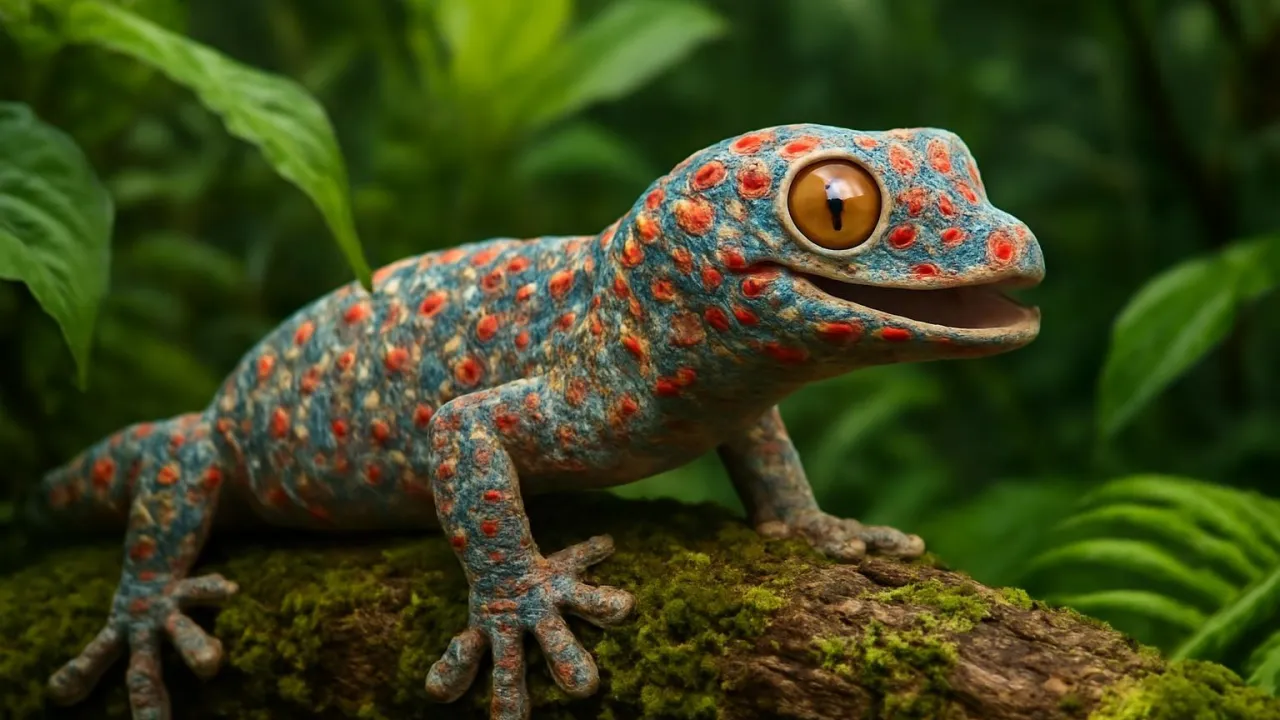
Tokay Geckos can catch prey twice their size with their strong jaws!
✨ Word Sparks (Grade 2 Glossary)
Tap 🔊 to hear
rainforest
A warm forest with many trees and rain
prey
An animal that another animal eats
sticky
Something that can hold on tightly
🪝
Have you ever heard a Tokay Gecko’s loud nighttime call?
1
Colorful Skin
The Tokay Gecko has bright blue skin with orange spots. It uses its colors to hide in trees. This gecko lives in warm . It blends well with leaves and bark.
2
Noisy Night
At night, the Tokay Gecko makes a loud call that sounds like 'To-kay!'. This helps it find other geckos nearby. The sound can be heard far away. It is very useful for talking.
3
Climbing Expert
This gecko has feet with tiny hairs. These hairs let it climb smooth walls and trees easily. It can hang upside down without falling. This helps it catch insects for food.
Tokay Geckos can cling to glass and ceilings using millions of tiny hairs on their feet.
✨ Word Sparks (Grade 3 Glossary)
Tap 🔊 to hear
camouflage
Colors or patterns that help hide an animal
setae
Tiny hairs on feet that help animals stick
predator
An animal that hunts other animals for food
🪝
How does the Tokay Gecko use its colors and sounds to survive?
1
Camouflage Colors
The Tokay Gecko’s bright blue and orange spots help it blend into its rainforest habitat. This protects it from . Its skin pattern breaks up its shape among leaves and bark. This adaptation helps it stay hidden.
2
Loud Vocal Calls
At night, the Tokay Gecko produces a loud call that sounds like 'To-kay!'. This call serves as a way to communicate with other geckos. It warns rivals and attracts mates. The loud sound is a key survival tool.
3
Sticky Feet for Climbing
This gecko has specialized toe pads covered with tiny hairs called . These hairs create strong adhesion through van der Waals forces. This allows the gecko to climb smooth surfaces and escape . Its feet are an excellent adaptation for hunting insects.
4
Diet and Hunting
The Tokay Gecko mainly eats insects and small animals. It uses its quick reflexes and strong jaws to catch prey. Sometimes, it even eats small fruits. Its diet provides essential nutrients for growth and energy.
1. What helps the Tokay Gecko hide from predators?
2. Why does the Tokay Gecko have setae on its feet?
🤯 Mind-Blowing Fact • Grade 4
Tokay Geckos can vocalize louder than many other lizards, reaching 90 decibels!
✨ Word Sparks (Grade 4 Glossary)
Tap 🔊 to hear
ecosystem
A community of living things and their environment
biodiversity
Many different kinds of plants and animals living together
deforestation
Cutting down many trees in a forest
🪝
Why is the Tokay Gecko important in its rainforest ecosystem?
1
Habitat and Distribution
The Tokay Gecko lives in tropical rainforests across Southeast Asia and some Pacific islands. It prefers warm, humid environments with plenty of trees and rocks. These habitats provide shelter, food, and places to hide. However, human activities like logging reduce these safe areas.
2
Role in the Food Web
As a predator, the Tokay Gecko controls insect populations by feeding on them regularly. It also serves as prey for larger animals such as snakes and birds, making it part of a balanced food web. This balance helps keep the healthy and diverse. Its presence supports many other living things.
3
Adaptations for Survival
The gecko’s loud call helps defend its territory and attract mates, increasing its chances of reproduction. Its sticky feet allow it to climb vertical surfaces and quickly escape predators. Its colorful camouflage helps it blend into trees and rocks, protecting it from being seen.
4
Human Impact and Conservation
and habitat loss threaten Tokay Gecko populations in several regions. They are sometimes captured for the pet trade, which reduces wild numbers and disrupts . Conservation efforts focus on protecting habitats and educating people about the gecko’s important role. These actions help ensure their survival.
1. What role does the Tokay Gecko play in the food web?
2. What threatens Tokay Gecko populations?
🤯 Mind-Blowing Fact • Grade 5
Tokay Geckos produce calls louder than a lawn mower, reaching 90 decibels at night.
✨ Word Sparks (Grade 5 Glossary)
Tap 🔊 to hear
van der Waals forces
Tiny forces that help gecko feet stick to surfaces
insectivore
An animal that eats mostly insects
territorial
Protecting an area from others of the same kind
🪝
What makes the Tokay Gecko’s biology and behavior unique among reptiles?
1
Scientific Classification and Range
The Tokay Gecko (Gekko gecko) belongs to the family Gekkonidae and is native to Southeast Asia’s tropical rainforests. It has also been introduced to parts of the Pacific Islands and Florida. This species thrives in humid, warm climates with dense vegetation and rocky surfaces.
2
Physiological Adaptations
This gecko’s toe pads contain millions of microscopic setae that create , enabling adhesion to smooth surfaces like glass. Its vocal cords allow it to produce a distinctive loud call reaching up to 90 decibels, which is unusual among lizards. The gecko’s strong jaw muscles enable it to capture prey larger than most other geckos.
3
Ecological Role and Behavior
As an and occasional frugivore, the Tokay Gecko plays a key role in controlling insect populations and dispersing seeds. Its vocalizations help maintain social structure and mating success. It is both predator and prey within complex food webs, contributing to ecosystem stability.
4
Conservation and Human Interaction
Although not currently endangered, habitat destruction and illegal pet trade pose threats to Tokay Gecko populations. Conservation programs emphasize habitat preservation and public education to reduce capture and habitat loss. The gecko’s popularity in traditional medicine and as pets increases human impact.
5
Quantitative Comparisons
Tokay Geckos measure between 10 and 14 inches in length and can weigh up to 150 grams. Their vocal calls can reach 90 decibels, louder than a lawn mower. They climb vertical surfaces at speeds up to 1 meter per second using their adhesive toe pads. These traits highlight their remarkable adaptations.