1. What are the rounded rocks on Titan's ground actually made of?
2. Besides Earth, Titan is the only world known to have what on its surface?
🤯 Mind-Blowing Fact • Grade 2
Raindrops on Titan are much bigger than Earth's raindrops and drift downward as gently as falling snowflakes!
✨ Word Sparks (Grade 2 Glossary)
Tap 🔊 to hear
Nitrogen
The main gas filling both Earth's and Titan's skies.
Parachute
A fabric canopy that slows a falling spacecraft gently.
Canyon
A deep valley carved by flowing liquid.
🪝
What would it feel like to watch raindrops as big as marbles drift down in slow motion?
1
A Moon Larger Than Mercury
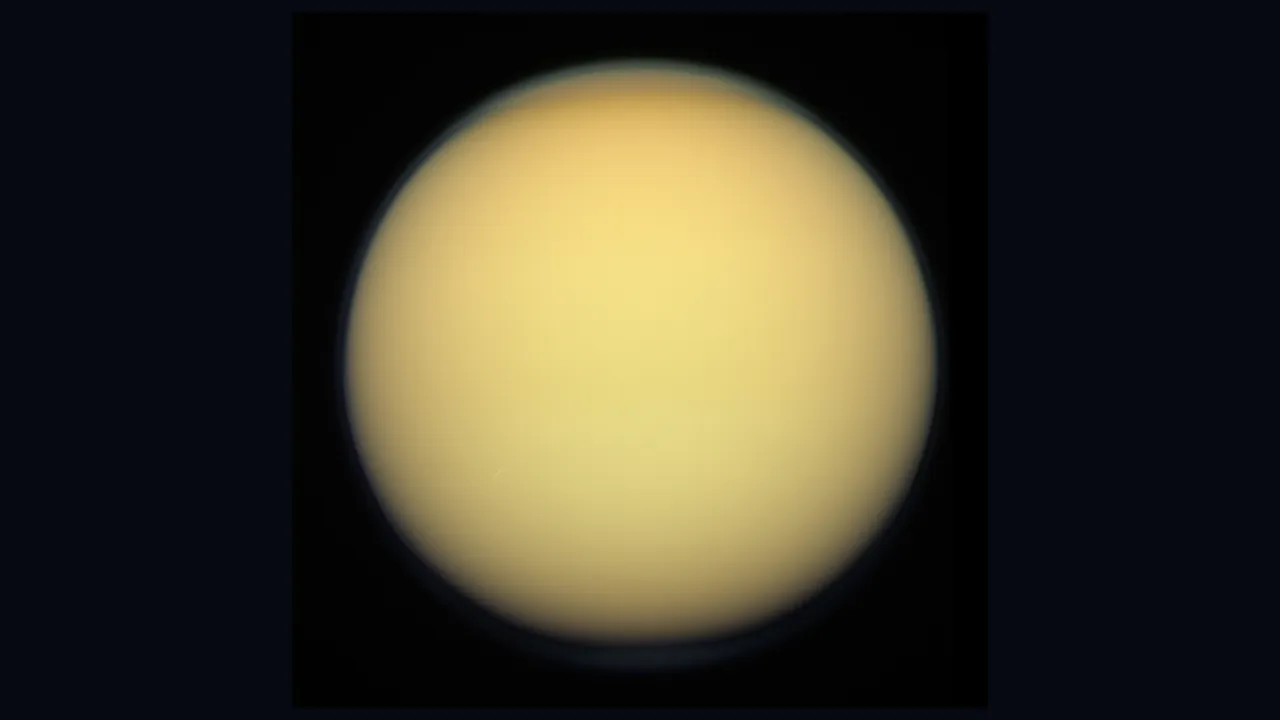
Cruising around Saturn every sixteen days, Titan is the second-largest moon in our Solar System. At 3,200 miles wide, it is even wider than the planet Mercury and wears a thick, soupy blanket of air!
2
Slow-Motion Weather
At minus 290 degrees Fahrenheit, liquid methane acts on Titan just like water acts on Earth! Clouds form, giant raindrops float down six times slower than Earth rain, and winding rivers carve into icy hills.
3
Touchdown on an Alien Shore
In 2005, the Huygens lander parachuted through Titan's orange fog and snapped photos of rounded ice cobbles—the farthest landing from Earth ever!
1. Which spacecraft lander parachuted onto Titan's surface in 2005?
2. What gas makes up most of Titan's thick atmosphere, just like Earth's?
🤯 Mind-Blowing Fact • Grade 3
Titan's largest northern sea, Kraken Mare, is over 1,000 feet deep in places and covers more area than the Caspian Sea on Earth!
✨ Word Sparks (Grade 3 Glossary)
Tap 🔊 to hear
Tholins
Golden organic haze particles formed by sunlight in methane.
Radar
Radio waves bounced off surfaces to map hidden ground.
Hydrocarbon
A molecule built out of hydrogen and carbon atoms.
🪝
How did radar beams pierce Titan's orange smog to reveal a giant sea bigger than Lake Superior?
1
Hidden Behind Smoggy Curtains
When Voyager 1 flew past Titan in 1980, cameras saw only a smooth orange tennis ball! Sunlight breaks methane apart high in Titan's nitrogen sky, creating organic smog particles called that hide the ground from ordinary telescopes.
2
Mapping Kraken Mare
NASA's Cassini orbiter bounced waves straight through that haze and uncovered a breathtaking landscape near Titan's north pole. Kraken Mare, Titan's largest sea of liquid methane and ethane, stretches wider than all five North American Great Lakes combined!
3
Dunes of Hydrocarbon Sand
Near Titan's dry equator, wind sculpts dark dunes 300 feet tall—not from quartz sand, but from tiny grains of organic soot that settled out of the orange sky.
4
Dragonfly Takes Flight
Because Titan combines dense air with low gravity, flying is easy! NASA is sending Dragonfly, a car-sized eight-rotor drone, to hop across Titan's dunes and search for building blocks of life.
1. How did NASA's Cassini spacecraft see through Titan's thick orange haze?
2. What kind of robotic explorer is NASA's upcoming Dragonfly mission to Titan?
🤯 Mind-Blowing Fact • Grade 4
Standing on Titan's surface feels about the same air pressure on your ears as diving 15 feet underwater in a swimming pool on Earth!
✨ Word Sparks (Grade 4 Glossary)
Tap 🔊 to hear
Triple point
Temperature and pressure where gas, liquid, and solid coexist.
Cryovolcano
An icy volcano that erupts water slush and gases.
Prebiotic
Chemical ingredients that form before living cells exist.
🪝
How can one moon host hydrocarbon seas on top AND a salty liquid water ocean underneath?
1
A Triple-Point Methane Cycle
On Earth, surface temperatures sit near water's , allowing ice, liquid water, and water vapor to power our hydrological cycle. Nearly ten times farther from the Sun, Titan's surface chills to minus 179 degrees Celsius (-290°F)—right near the triple point of methane! Under an atmospheric pressure 45 percent thicker than Earth's at sea level, methane evaporates from polar seas, condenses into convective storm clouds, and carves branching river channels across water-ice bedrock.
2
Two Oceans on One World
While liquid hydrocarbons slosh across Titan's northern basins like Kraken Mare and Ligeia Mare, Cassini measured Titan's crust flexing up and down by thirty feet during each elliptical orbit around Saturn. Only a deep, global ocean of liquid water mixed with ammonia about 35 to 50 miles beneath the icy crust could allow the surface shell to flex that dramatically!
3
Cryovolcanoes and Prebiotic Chemistry
Because ultraviolet sunlight continually destroys methane in the upper stratosphere, Titan's methane supply should vanish within tens of millions of years unless replenished from below—possibly through icy like Doom Mons. Meanwhile, complex carbon-nitrogen tholins drift down onto craters where temporary impact-melted liquid water once pooled.
4
A Frozen Early-Earth Laboratory
Planetary chemists view Titan as a natural time machine resembling primordial Earth before oxygen filled our skies, testing how rich organic molecules assemble across an entire world.
1. How did Cassini prove that a deep liquid-water ocean hides beneath Titan's icy crust?
2. How does Titan's surface atmospheric pressure compare to Earth's at sea level?
🤯 Mind-Blowing Fact • Grade 5
Titan alone contains more than 96 percent of all the mass orbiting Saturn—outweighing Saturn's famous rings and other 145 moons combined by over twenty-five times!
✨ Word Sparks (Grade 5 Glossary)
Tap 🔊 to hear
Anti-greenhouse
Cooling effect when high haze blocks incoming warm sunlight.
Bathymetry
Measuring the underwater depth and floor of seas.
Spectrometry
Identifying exact chemicals by measuring their atoms or light.
🪝
What happens when ultraviolet starlight turns an entire moon's atmosphere into an organic chemistry factory?
1
Huygens's Moon Unveiled
Discovered on March 25, 1655, by Dutch astronomer Christiaan Huygens—and shown to possess a methane atmosphere by Gerard Kuiper's spectroscopic work in 1944—Titan spans 5,150 kilometers in diameter with a bulk density of 1.88 grams per cubic centimeter. Accounting for over ninety-six percent of all mass orbiting Saturn (including the rings!), Titan is the sole satellite in our Solar System sustaining a dense, multi-layered atmosphere.
2
Photochemistry and the Anti-Greenhouse Balance
Titan's 1.45-bar atmosphere comprises roughly 94.2 percent molecular nitrogen, 5.65 percent methane, and trace hydrogen. High in the ionosphere, solar ultraviolet photons and Saturnian magnetospheric electrons cleave nitrogen and methane bonds, synthesizing complex nitriles, benzene rings, and polymeric tholin aerosols. While methane acts as a warming greenhouse gas below, high-altitude orange haze reflects incoming sunlight in a cooling ' effect,' stabilizing surface temperatures at 93.7 kelvins.
3
Bathymetry of Polar Hydrocarbon Seas
Cassini's radar altimeter sounded right through ultra-clear liquid ethane-methane mixtures in Ligeia Mare and Kraken Mare, measuring depths exceeding 160 to 300 meters and revealing drowned river valleys (rias) plus mysterious transient bright features nicknamed 'Magic Islands' caused by nitrogen bubbles or floating porous organic solids.
4
Subsurface Ammonia-Water Ocean
Gravity-field harmonics and Schumann-like extremely low-frequency radio resonances recorded by the Huygens probe confirm an internal ocean 55 to 80 kilometers below the water-ice shell, kept liquid at cold temperatures by dissolved ammonium sulfate or ammonia.
5
Rotorcraft Exploration at Selk Crater
Targeting impact-melt deposits around Selk Crater in the 2030s, NASA's nuclear-powered octocopter Dragonfly will drill icy regolith and analyze samples via mass —probing whether tholins mixed with transient liquid water forged amino acids and nucleobases.