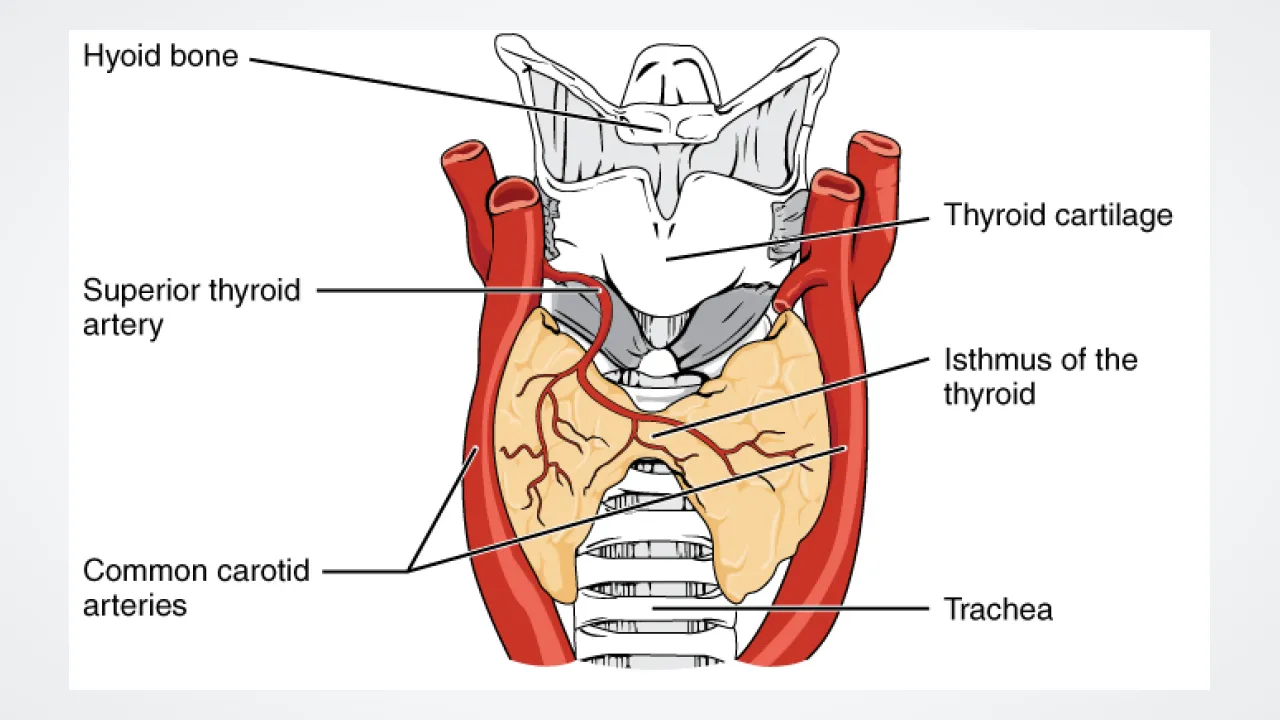
1. What animal or insect is the thyroid gland in your neck shaped like?
2. What main job do thyroid chemical messages do inside your body?
🤯 Mind-Blowing Fact • Grade 2
Your thyroid gland is the only organ in your entire body that collects iodine to build hormones!
✨ Word Sparks (Grade 2 Glossary)
Tap 🔊 to hear
Iodine
Natural mineral the thyroid uses for hormones
Windpipe
Tube carrying air from throat to lungs
Energy
Power your cells make from healthy food
🪝
Why do table salt boxes at the grocery store often say 'iodized' right on the front label?
1
Wings Around Your Windpipe
Tucked just below your voice box, two soft thyroid wings hug the front of your breathing tube. Even though this gland is only two inches wide, it works like the gas pedal for your whole body!
2
Powered by Iodine
To build its special hormones, your thyroid needs a natural ocean mineral called . Foods like seaweed, fish, dairy milk, eggs, and iodized table salt give your thyroid all the iodine building blocks it needs.
3
Keeping Everything Balanced
When thyroid hormones travel through your blood, they steady your heartbeat, warm your hands, sharpen your thinking, and help growing bones lengthen right on schedule.
1. Which special mineral from seafood, milk, and iodized salt does your thyroid need to build hormones?
2. Where in your body is the butterfly-shaped thyroid gland located?
🤯 Mind-Blowing Fact • Grade 3
Unlike most glands that make hormones only a few minutes before using them, your thyroid stores up to a two-month backup supply inside tiny gel-filled spheres!
✨ Word Sparks (Grade 3 Glossary)
Tap 🔊 to hear
Metabolism
How fast cells turn food into energy
Pituitary Gland
Pea-sized brain gland directing other body glands
Trachea
Scientific name for your ringed breathing windpipe
🪝
How does one tiny gland in your neck set the speed of your heart, digestion, body warmth, and growth all at once?
1
Master of Metabolism
Scientists use the word for all the chemical reactions that turn food and oxygen into usable fuel inside your cells. Sitting like a bowtie across your , the thyroid gland acts as your body's master metabolism pace-setter.
2
Counting Iodine Atoms: T3 and T4
Inside the thyroid, microscopic round bubbles store two main hormones named T3 and T4. Those numbers simply count how many iodine atoms are attached—three atoms on T3 and four atoms on T4! Once released into your bloodstream, cells snip one iodine off T4 to switch on super-active T3.
3
Teamwork With the Brain
How does your thyroid know whether to speed up or slow down? Two partners in your brain—the hypothalamus and the —taste hormone levels in your blood. Whenever levels dip, the pituitary sends Thyroid-Stimulating Hormone to ask for more!
4
Just-Right Goldilocks Speed
Too little thyroid hormone makes a person feel chilly and tired, while too much makes the heart race. Thankfully, doctors can check levels with a tiny blood test.
1. What do the numbers 3 and 4 stand for in the thyroid hormones T3 and T4?
2. Which pea-sized gland at the base of the brain tells the thyroid when to release more hormones?
🤯 Mind-Blowing Fact • Grade 4
In frogs and salamanders, a surge of this exact same thyroid hormone is what triggers a swimming tadpole to transform into a hopping adult frog!
✨ Word Sparks (Grade 4 Glossary)
Tap 🔊 to hear
Follicle
Tiny sphere storing thyroid hormone building blocks
Thyroxine
Full scientific name for four-iodine T4 hormone
Calcitonin
Thyroid hormone helping store calcium inside bones
🪝
How does a feedback loop between your brain and neck work just like a home heating system on a winter morning?
1
Follicles and Colloid Storage
Peer inside the thyroid's two lobes—linked across the trachea by a narrow bridge called the isthmus—and you will see millions of hollow spheres called . Follicular cells actively pump trace iodide ions out of passing blood and attach them to a large protein inside sticky central colloid gel, crafting (T4) and triiodothyronine (T3).
2
Negative Feedback Precision
Endocrinologists call the communication line between brain and neck the hypothalamic-pituitary-thyroid axis. When blood T3 and T4 dip slightly—for instance during cold weather or growth spurts—the hypothalamus signals the pituitary to secrete Thyroid-Stimulating Hormone (TSH). Rising T3 and T4 then signal the brain to ease off TSH, forming a self-balancing negative feedback loop.
3
Revving Cellular Powerhouses
Unlike many hormones that knock on the outside of cells, lipid-soluble T3 slips straight inside target cells and binds receptors right on the DNA inside the nucleus! That switch tells cells to build more mitochondria and sodium-potassium pumps, boosting oxygen use and gentle body heat.
4
Bonus Helper: Calcitonin
Tucked between thyroid sit specialized parafollicular C-cells that make a totally separate hormone called , which helps deposit extra blood calcium safely into growing bones while working opposite four tiny parathyroid glands nestled right on the thyroid's back surface.
1. Where inside a target cell does active T3 thyroid hormone attach to flip on energy genes?
2. What bonus hormone do thyroid C-cells make to help strengthen growing bones?
🤯 Mind-Blowing Fact • Grade 5
Follicular thyroid cells run microscopic molecular pumps so powerful they concentrate dietary iodide up to forty times higher inside the gland than in your bloodstream!
✨ Word Sparks (Grade 5 Glossary)
Tap 🔊 to hear
Thyroglobulin
Large protein scaffold holding stored thyroid hormones
Basal Metabolic Rate
Baseline energy burned while resting comfortably
Deiodinase
Enzyme converting T4 prohormone into active T3
🪝
How did adding a pinch of ocean element to ordinary table salt in 1924 become one of history's greatest public-health triumphs?
1
Anatomical Architecture and Iodide Trapping
Weighing merely twenty to thirty grams in adults, the bilobed thyroid gland drapes across the anterior trachea just inferior to the laryngeal thyroid cartilage—its Greek name thyreoeides meaning shield-shaped. Despite its modest mass, the thyroid receives one of the richest blood supplies per gram of any organ. Basolateral sodium-iodide symporters on follicular cells concentrate dietary iodide up to forty times higher than surrounding plasma.
2
Organification and Peripheral Deiodination
Inside the follicular lumen, thyroid peroxidase enzymes oxidize iodide and attach it to tyrosine amino acids along scaffolding, yielding roughly eighty percent tetraiodothyronine (thyroxine, T4) and twenty percent triiodothyronine (T3). Once secreted into blood bound to carrier proteins, target tissues use selenium-dependent enzymes to strip one outer-ring iodine from T4, converting the long-lived prohormone into potent T3 right where cells need it.
3
Nuclear Transcription and Basal Metabolic Rate
Unbound T3 crosses cell membranes via specific transporters and binds thyroid hormone receptors anchored to DNA response elements inside the nucleus. This transcriptional program upregulates mitochondrial respiratory enzymes, beta-adrenergic heart receptors, and Na+/K+-ATPase pumps—governing , thermogenesis, childhood skeletal ossification, and central nervous system myelination.
4
Hypothyroidism, Hyperthyroidism, and Homeostasis
Tight negative feedback along the hypothalamic-pituitary-thyroid (HPT) axis keeps free hormone concentrations remarkably steady. If thyroid output lags (hypothyroidism), pituitary TSH climbs to stimulate follicular growth; if output surges (hyperthyroidism), TSH drops near zero. Meanwhile, interstitial parafollicular C-cells monitor ionized calcium and secrete calcitonin to temper bone resorption.
5
Solving the Goiter Belt Mystery
Glaciated inland regions like the Swiss Alps and North America's Great Lakes once lacked soil iodine, causing widespread thyroid enlargement called goiter and childhood developmental delays. After Swiss surgeon Theodor Kocher won the 1909 Nobel Prize for illuminating thyroid physiology and American researcher David Marine proved iodine prevented goiter in Ohio schoolchildren, iodized salt debuted in 1924—protecting billions of brains worldwide.