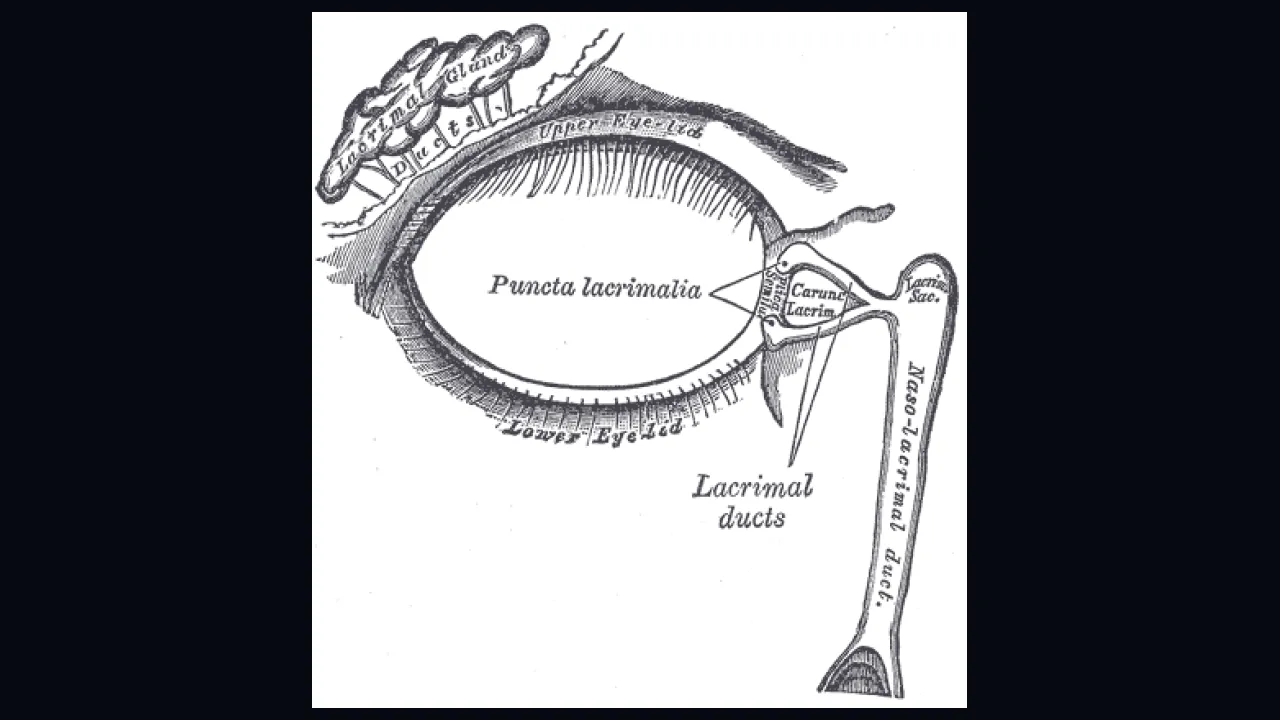
1. Where do your tear ducts carry used tears after every blink?
2. Do your eyes only make tears when you feel sad?
🤯 Mind-Blowing Fact • Grade 2
Humans are the ONLY known animals on Earth whose eyes overflow with emotional tears from big feelings like sadness, relief, or joy!
✨ Word Sparks (Grade 2 Glossary)
Tap 🔊 to hear
gland
Body part making helpful fluids like tears
overflow
To spill over when a drain fills
pinhole
A super tiny round dot opening
🪝
Have you ever spotted the tiny secret drain dot on the inner corner of your eyelid?
1
Faucet Above, Drain Below
Think of each eye like a sparkling clean bathroom sink! Tucked above the outer corner of each eye sits a tear acting like a gentle faucet, while near your nose sit tiny tear ducts acting like sink drains.
2
Spot the Little Dot
Look closely in a mirror at the pink inner corner of your lower eyelid (without touching it!). You can spot a tiny opening that sips up used tears every time you blink.
3
Overflowing the Sink
Chopping onions or watching a touching movie turns the tear faucet on full blast! Because the narrow drain tubes cannot keep up, tears spill over your cheeks and trickle into your nose.
1. In the bathroom sink comparison, what acts like the faucet and what acts like the drain?
2. Why can you sometimes taste salty tears in the back of your throat after crying?
🤯 Mind-Blowing Fact • Grade 3
In 1921, scientist Alexander Fleming discovered 'lysozyme'—his first natural germ-fighter before penicillin—by watching a single drop of liquid dissolve bacteria on a lab dish!
✨ Word Sparks (Grade 3 Glossary)
Tap 🔊 to hear
lacrimal
Relating to tears and tear-carrying tubes
punctum
Tiny pinhole tear drain on eyelid corner
lysozyme
Natural tear enzyme that breaks apart bacteria
🪝
How do three kinds of tears—everyday, reflex, and emotional—keep your eyes healthy and germ-free?
1
More Than Just Salty Water
Watch a slow-motion video of a blink and admire your system—science's fancy name for tear makers and tear ducts! Far from plain saltwater, every tear is a three-layer shield of mucus, water, and natural oil that keeps tears from drying up between blinks.
2
Three Recipes of Tears
Your eyes actually brew three different tear types! Basal tears coat and feed your cornea all day; reflex tears gush out to wash away campfire smoke or onion fumes; and emotional tears flow when you feel sad, proud, or laugh until you cry!
3
Pumping Through the Puncta
Each eyelid's inner corner holds a tiny opening called a . Blinking squeezes a small tear sac beside your nose like a rubber bulb, sucking used tears down the nasolacrimal duct into your nasal cavity.
4
Germ-Busting Superpower
Tears even carry a natural germ-fighting protein called that pops invading bacteria before they can bother your eyes!
1. Which type of tear rushes out to wash away chopped-onion fumes or dusty wind?
2. Why does your tear film include a thin outer layer of natural oil?
🤯 Mind-Blowing Fact • Grade 4
A tiny one-way tissue flap at the bottom of your tear duct—called the Valve of Hasner—stops air from whistling up out of your eyelids whenever you blow your nose!
✨ Word Sparks (Grade 4 Glossary)
Tap 🔊 to hear
canaliculi
Tiny channels linking eyelid puncta to sac
evaporate
Turn from liquid water into invisible vapor
valve
One-way flap keeping flow moving forward
🪝
Why do cold winter winds make healthy eyes water even when nothing sad happened?
1
Anatomy of the Lacrimal Plumbing
Trace a single teardrop's journey and you will discover miniature hydraulic engineering! Secreted by the almond-shaped lacrimal gland tucked beneath the outer brow bone, fresh tears sweep medially across your cornea with every fifteen-per-minute blink. At the inner eyelid margin, upper and lower openings called lacrimal puncta sip the fluid into slender tubes, pooling it inside the lacrimal sac before guiding it down the eighteen-millimeter nasolacrimal duct beneath the inferior nasal concha!
2
How Blinking Drives the Lacrimal Pump
Gravity alone doesn't drain your tears—your eyelid muscle powers a vacuum pump! Each time your orbicularis oculi muscle blinks shut, it gently compresses and releases the lacrimal sac, creating negative suction that draws used tears inward while a tiny one-way flap at the bottom—the of Hasner—keeps nose air from blowing backward into your eyes when you sneeze!
3
Winter Wind and Newborn Tear Ducts
Step into brisk winter wind and two things happen at once: cold air your tear film faster—triggering reflex tear gushes—while chill temperatures slightly narrow your puncta drains, causing harmless watery cheeks! Many newborns also have a thin membrane still covering the of Hasner at birth that opens naturally during infancy.
4
Why Chopping Onions Triggers Reflex Tears
Sliced onion cells release a harmless drifting gas that mixes with eye moisture, prompting corneal nerves to order an immediate reflex rinse!
1. What important job does the Valve of Hasner do at the bottom of your nasolacrimal duct?
2. How does blinking actively pump used tears into the tear ducts?
🤯 Mind-Blowing Fact • Grade 5
In zero-gravity spaceflight aboard the International Space Station, overflowing tears cannot roll down an astronaut's cheek—they collect into a shimmering clear water dome until wiped away with a towel!
✨ Word Sparks (Grade 5 Glossary)
Tap 🔊 to hear
meibomian
Eyelid rim glands making tear-sealing oils
mucin
Slippery protein helping tears spread smoothly
immunoglobulin
Protective antibody protein guarding body surfaces
🪝
Why do dried basal, reflex, and emotional tears form completely different crystal snowflakes under a microscope?
1
Tri-Layered Precision of the Precorneal Tear Film
Measuring barely three to seven micrometers thick, the precorneal tear film serves as the eye's true primary optical surface—smoothing microscopic corneal irregularities to fractions of a wavelength! Three specialized gland teams construct it: tarsal glands line the eyelid rims to secrete an outer lipid seal; lacrimal glands supply the central aqueous layer rich in oxygen, electrolytes, (IgA), lactoferrin, and antibacterial lysozyme; and conjunctival goblet cells lay down an inner carpet so water clings evenly across hydrophobic epithelium.
2
Neural Reflex Arcs Behind Different Tears
Although all tears drain through the same 0.3-millimeter puncta, canaliculi, lacrimal sac, and bony nasolacrimal canal into the inferior nasal meatus, different neural circuits trigger their production. Irritant reflex tears travel an afferent path along the ophthalmic trigeminal nerve (CN V1) to the brainstem's superior salivatory nucleus, returning parasympathetic secretomotor commands via the facial nerve (CN VII) and pterygopalatine ganglion. Emotional tears additionally recruit higher limbic hubs—including the amygdala and hypothalamus—during intense empathy, grief, or relief.
3
Biochemistry and Crystal Art of Tears
In the 1980s, biochemist William Frey discovered that emotional tears contain noticeably higher concentrations of protein-based hormones—including prolactin, adrenocorticotropic hormone, and natural stress-relieving leucine-enkephalin—than onion-triggered reflex tears! Photographers imaging dried teardrops under microscopes even see distinct salt-and-protein 'ferning' crystal patterns shaped by drying speed and chemistry.
4
Why Newborns Cry Without Visible Tears
During a baby's first two to four weeks of life, lacrimal glands produce just enough basal moisture to protect the corneas; full reflex and emotional tear volume develops only after postnatal autonomic innervation matures!
5
Punctal Plugs and Spaceflight Tears
For patients with dry eyes, ophthalmologists can insert biocompatible sub-millimeter silicone 'punctal plugs' into the tear ducts to conserve natural moisture—while astronauts in microgravity discover that without gravity, extra tears never roll down cheeks, instead forming a wobbly clear bubble over the eye!