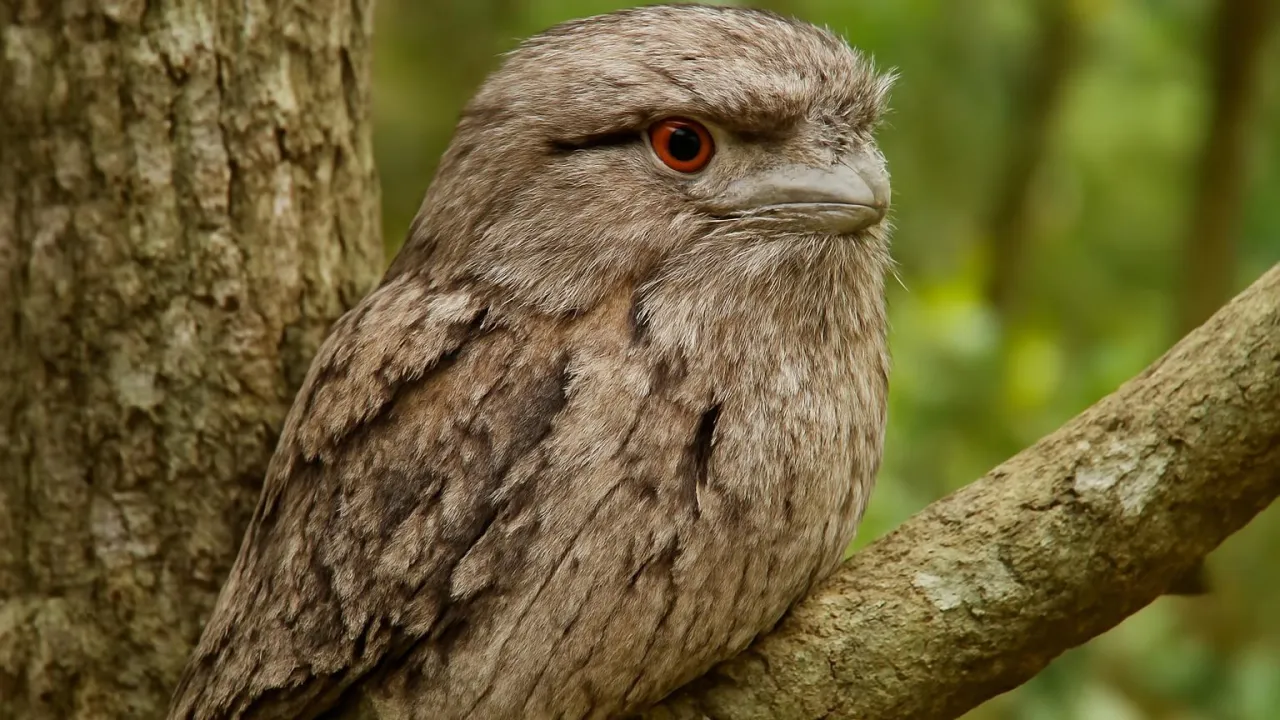
1. What does the tawny frogmouth look like when it rests?
2. When does the tawny frogmouth hunt for food?
🤯 Mind-Blowing Fact • Grade 2
Tawny frogmouths can stay perfectly still for hours to avoid being seen!
✨ Word Sparks (Grade 2 Glossary)
Tap 🔊 to hear
predator
An animal that hunts other animals for food
feathers
Soft parts that cover a bird’s body
prey
Animals that are hunted and eaten by others
🪝
Have you ever seen a bird that looks like a tree branch?
1
Amazing Camouflage Skills
The tawny frogmouth has that look like tree bark. It sits very still on branches to hide from . Its coloring helps it blend perfectly in forests and woodlands.
2
Nighttime Hunter
This bird hunts mostly at night when many insects and small animals are active. It uses its large eyes to see in the dark and flies silently to catch . Its diet includes moths, beetles, and small reptiles.
3
Unique Wide Beak
The tawny frogmouth has a very wide beak that opens like a frog’s mouth. This helps it catch insects easily while flying. The beak also has bristles that help sense nearby in the dark.
1. What helps the tawny frogmouth hide from predators?
2. What does the tawny frogmouth eat at night?
🤯 Mind-Blowing Fact • Grade 3
Tawny frogmouths can freeze motionless for hours, fooling even expert predators.
✨ Word Sparks (Grade 3 Glossary)
Tap 🔊 to hear
camouflage
Colors or patterns that help animals hide
nocturnal
Active during the night and resting by day
adaptation
A body part or behavior that helps survival
🪝
Did you know that the tawny frogmouth uses camouflage to survive at night?
1
Camouflage and Adaptation
The tawny frogmouth has feathers that mimic tree bark, which helps it avoid predators. This is an important for survival in forests and woodlands. When it stays still, it becomes almost invisible to predators and prey.
2
Nocturnal Hunting
Being means the tawny frogmouth is active at night and sleeps during the day. It hunts insects and small animals using its excellent night vision. Its silent flight helps it sneak up on prey without being noticed.
3
Unique Beak and Feeding
Its wide, frog-like beak opens very wide to catch flying insects easily. The bristles around the beak act like sensors to detect prey in the dark. This beak shape is a special for catching food at night.
4
Habitat and Role
Tawny frogmouths live in Australian forests and woodlands, where they play a role as insect predators. They help control insect populations, which benefits the ecosystem. Their presence supports a balanced food web.
1. Why do tawny frogmouths have feathers like tree bark?
2. What does nocturnal mean for the tawny frogmouth?
🤯 Mind-Blowing Fact • Grade 4
Tawny frogmouths’ camouflage is so perfect that even expert bird watchers can miss seeing them!
✨ Word Sparks (Grade 4 Glossary)
Tap 🔊 to hear
ecosystem
A community of living things and their home
predator
An animal that hunts others for food
adaptation
A change that helps an animal survive better
🪝
How does the tawny frogmouth’s camouflage affect its survival in forests?
1
Camouflage and Survival
The tawny frogmouth’s bark-like feathers provide excellent camouflage, allowing it to avoid by blending seamlessly with tree branches. This cause-and-effect relationship between its appearance and survival helps it remain undetected during the day. When threatened, it freezes to enhance this effect. This stillness makes it almost invisible to both predators and prey.
2
Ecosystem Role
As a nocturnal , the tawny frogmouth helps control insect populations, which benefits forest by maintaining a balanced food web. Its diet includes moths, beetles, and small reptiles, showing its role as both predator and prey. This balance supports healthy plant growth and biodiversity, which is vital for ecosystem health.
3
Geographic Distribution
This bird is native to Australia and Tasmania, inhabiting forests, woodlands, and suburban areas. Its ability to adapt to different environments allows it to thrive in diverse habitats. Human activity can impact its habitat, but it often coexists near people due to its excellent camouflage and adaptability.
4
Unique Physical Features
The tawny frogmouth’s wide, frog-like beak is an that helps it catch prey efficiently during silent night flights. Its bristles sense nearby insects, enhancing hunting success. These physical traits evolved to meet the challenges of nocturnal life and improve feeding efficiency.
1. Why does the tawny frogmouth freeze still on branches?
2. How does the tawny frogmouth help its ecosystem?
🤯 Mind-Blowing Fact • Grade 5
Tawny frogmouths can remain motionless for hours, fooling predators and humans alike with perfect bark camouflage.
✨ Word Sparks (Grade 5 Glossary)
Tap 🔊 to hear
cryptic coloration
Colors that help animals blend into backgrounds
plumage
The feathers covering a bird’s body
nocturnal
Active during the night, resting in the day
🪝
What makes the tawny frogmouth a remarkable example of evolutionary adaptation in birds?
1
Taxonomy and Scientific Context
The tawny frogmouth (Podargus strigoides) belongs to the family Podargidae, which is closely related to nightjars. Unlike owls, it is not a raptor but shares habits. Its taxonomic classification highlights unique evolutionary traits among Australian birds. Understanding its place in bird taxonomy helps scientists study its behavior and ecology.
2
Physiological Adaptations
This bird’s exhibits with mottled patterns that mimic tree bark, providing camouflage against predators. Its wide, flattened beak is lined with sensory bristles that detect prey movements in low light. Additionally, its large eyes enhance night vision for effective hunting. These adaptations allow it to thrive in dark forest environments.
3
Ecological Role and Conservation
Tawny frogmouths contribute significantly to insect population control within their ecosystems, maintaining balanced food webs. Although not currently endangered, habitat loss and urbanization pose threats to their populations. Conservation efforts focus on preserving woodland habitats and reducing pesticide use to protect their food sources and homes.
4
Behavioral and Habitat Adaptations
These birds inhabit diverse environments across Australia and Tasmania, including forests, woodlands, and suburban areas. Their behavioral adaptation of freezing motionless during the day reduces predation risk. They are primarily solitary and use vocalizations for territory defense and mating. Their ability to adapt behaviorally helps them survive in changing environments.
5
Quantitative Comparisons
Measuring between 35 and 50 centimeters in length, tawny frogmouths weigh approximately 300 to 500 grams. They fly silently at speeds up to 25 miles per hour, which aids in stealth hunting. Their wide gape allows them to capture prey up to 5 centimeters in size, demonstrating specialized feeding mechanics. These measurements highlight their efficiency as predators.