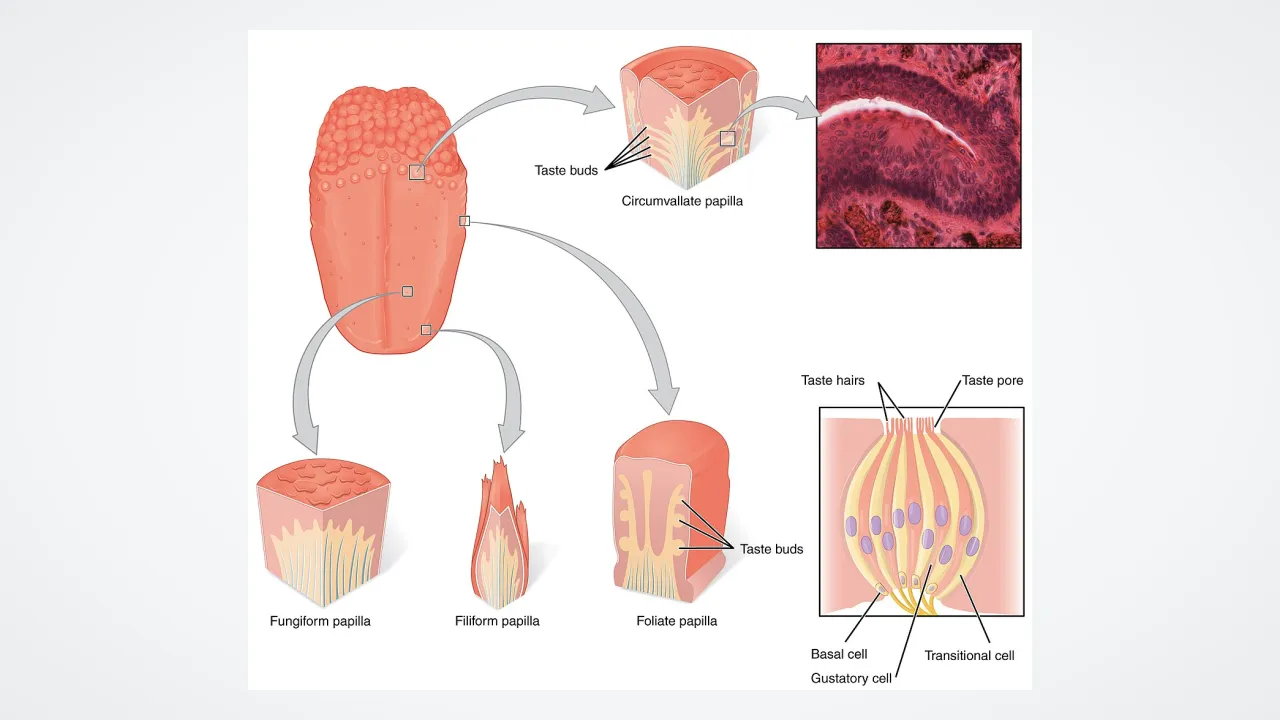
1. Are the pink bumps you see on your tongue the actual taste buds?
2. How often do your taste bud cells replace themselves?
🤯 Mind-Blowing Fact • Grade 2
Kids usually have even more active taste buds than adults, including extras on the roof of the mouth and inside the cheeks!
✨ Word Sparks (Grade 2 Glossary)
Tap 🔊 to hear
papillae
small bumps covering the surface of your tongue
dissolve
melt and mix evenly into a liquid
bitter
a sharp strong taste like unsweetened cocoa
🪝
What are the five basic tastes your tongue can spot at lunchtime?
1
Tiny Onion-Shaped Clusters
Crunch into a crisp apple or salty pretzel! Across your tongue sit thousands of little bumps called . Tucked inside their sides are up to ten thousand microscopic taste buds shaped like tiny onions.
2
Five Helpful Clues
Watery saliva food chemicals so they can slip into tiny taste pores. Your taste buds test for five main tastes: sweet honey, salty chips, sour lemons, dark cocoa, and savory tomato soup.
3
Keeping Your Body Safe
Sweet and savory tastes tell your brain that food has helpful energy and protein. Strong sour or tastes warn you before you swallow spoiled milk!
1. What helps dissolve dry food so taste buds can sense it?
2. Why is sensing bitter or sour tastes helpful for survival?
🤯 Mind-Blowing Fact • Grade 3
Most of the tiny pointed bumps covering the center of your tongue—called filiform papillae—have zero taste buds at all and instead grip food like a cat's rough tongue!
Is it really true that different parts of your tongue only taste sweet or bitter?
1
Inside a Microscopic Taste Bud
Pop a juicy berry into your mouth and let flavor burst! Hidden inside the mushroom-shaped and ridge-shaped papillae on your tongue sit roughly five thousand to ten thousand taste buds. Each bud bundles fifty to one hundred slender receptor cells together like segments of an orange.
2
Taste Hairs at the Pore
At the top of every taste bud opens a tiny doorway called a . Microscopic bristles called poke through that pore into your saliva, catching dissolved sugars, salts, acids, and amino acids.
3
Meet Umami, the Fifth Taste
Alongside sweet, salty, sour, and bitter, scientists recognize a fifth primary taste named , a Japanese word meaning pleasant savory flavor. Foods rich in protein building blocks—like aged cheese, mushrooms, and broth—ring the umami bell.
4
Busting the Tongue Map Myth
Old posters claimed only your tongue tip tasted sweet and only the back tasted bitter. Modern science proved that myth wrong: every region with taste buds can detect all five primary tastes!
1. What did scientists discover about the old 'tongue map' chart?
2. Which foods strongly trigger your umami taste receptors?
🤯 Mind-Blowing Fact • Grade 4
Catfish are the undisputed taste champions of the animal kingdom, sporting over 100,000 taste buds across their whiskers, fins, and entire outer skin!
✨ Word Sparks (Grade 4 Glossary)
Tap 🔊 to hear
gustatory
scientific term relating to the sense of taste
fungiform
mushroom-shaped tongue bumps holding front taste buds
supertaster
person born with extra-dense tongue taste buds
🪝
Why are humans naturally ‘supertasters’ to some bitter vegetables while others barely notice them?
1
Architecture of Papillae and Buds
Swirl a spoonful of tangy yogurt across your tongue, and thousands of chemical detectors spring into action! Human taste buds reside primarily inside three types of tongue papillae: mushroom-shaped papillae near the front, folded foliate papillae along the sides, and dome-shaped circumvallate papillae arranged in a V at the back. Additional buds dot your soft palate and epiglottis.
2
Ion Channels Versus Lock-and-Key Receptors
Inside each bud, fifty to one hundred cells use two clever strategies to read food chemistry. Salty sodium ions and sour hydrogen ions flow directly through microscopic ion channels in cell membranes. Meanwhile, sweet sugars, savory glutamates, and bitter compounds snap into specialized G-protein-coupled receptors like keys turning molecular locks.
3
Why Bitter Has Twenty-Five Locks
While one main receptor pair detects sweetness and another detects umami, humans carry roughly twenty-five different bitter receptor genes! In nature, many plant toxins taste bitter, so evolution equipped our tongues with wide-ranging chemical alarms. People born with extra-dense papillae—called —experience broccoli, kale, and grapefruit far more intensely.
4
Constant Stem-Cell Renewal
Because chewing, hot soup, and crunchy crusts batter the mouth daily, basal stem cells at the bottom of every taste bud divide tirelessly, minting fresh receptor cells every ten to fourteen days.
1. Why do humans have around 25 different receptor types just for bitter tastes?
2. Why might two classmates taste the exact same piece of raw broccoli differently?
🤯 Mind-Blowing Fact • Grade 5
Spicy chili peppers contain capsaicin, which tricks pain-and-heat nerve endings next to your taste buds into firing the exact same signal triggered by temperatures above 109°F (43°C)!
✨ Word Sparks (Grade 5 Glossary)
Tap 🔊 to hear
transduction
converting chemical or physical clues into nerve signals
tastant
any dissolved chemical that stimulates taste receptor cells
cranial nerves
twelve nerve pairs emerging directly from the brain
🪝
How do fifty microscopic cells huddled inside one taste bud translate salt crystals and complex sugars into instant brain signals?
1
Sensory Micro-Organs of the Oral Cavity
Bite into a slice of ripe pineapple, and within a tenth of a second your brain registers bright sweetness balanced by zesty tartness. That rapid chemical analysis happens inside roughly five thousand to ten thousand caliculi gustatorii—taste buds—embedded within fungiform, foliate, and circumvallate papillae as well as the soft palate and pharynx. Measuring just fifty micrometers wide, each bud clusters fifty to one hundred spindle-shaped cells beneath a tiny taste pore.
2
Two Molecular Pathways of Transduction
Microvilli projecting through the taste pore convert dissolved into electrical signals via two distinct biochemical mechanisms. Simple electrolytes act directly on ion channels: sodium ions enter salty-sensing cells through epithelial sodium channels, while sour acids send protons rushing through specialized proton channels called OTOP1. Complex organic molecules—sugars, savory L-glutamate, and bitter alkaloids—bind instead to T1R and T2R G-protein-coupled receptors, triggering intracellular calcium waves.
3
Three Cranial Nerves to the Gustatory Cortex
Depolarized taste cells release chemical messengers such as ATP onto sensory nerve endings coiled around their bases. Depending on where a bud sits, signals race along three —the facial nerve (VII), glossopharyngeal nerve (IX), and vagus nerve (X)—through the brainstem and thalamus to the primary gustatory cortex inside the insula.
4
Why Spicy Chili Is Not a Taste
Surprisingly, fiery chili heat and cool peppermint tingle are not detected by taste receptor cells at all! Instead, capsaicin and menthol activate temperature-sensing trigeminal nerve endings alongside the buds, weaving touch and thermal thrills together with retronasal aroma into multisensory flavor.
5
Kikunae Ikeda and the Discovery of Umami
For centuries, Western textbooks listed only four primary tastes. In 1908, Japanese chemist Kikunae Ikeda isolated glutamate crystals from kombu seaweed broth and proposed umami as a fifth fundamental taste—a hypothesis vindicated nearly a century later when molecular biologists identified dedicated T1R1/T1R3 umami receptors on human taste buds.