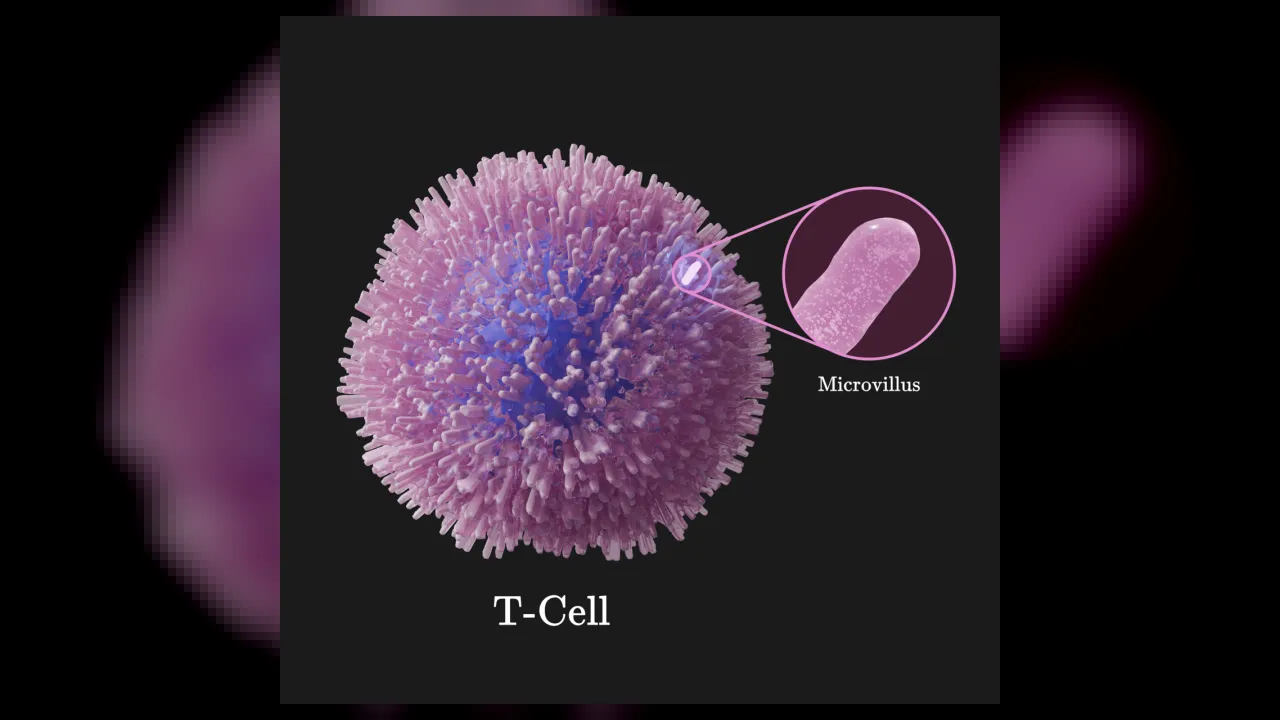
1. Where do young T-cells go to finish their special training?
2. How do T-cells tell your own healthy cells apart from sneaky germs?
🤯 Mind-Blowing Fact • Grade 2
Fewer than five out of every hundred young T-cells pass all the tough safety tests inside your thymus school!
✨ Word Sparks (Grade 2 Glossary)
Tap 🔊 to hear
Bone Marrow
Soft center of bones making blood cells
Helper T-Cell
Coach cell that guides the immune team
Memory Cell
Defender that remembers germs for many years
🪝
How can your body find a tiny virus when it hides inside one of your own cells?
1
Born in Bones, Trained in Chest
Zoom inside your spongy and watch tiny white blood cells begin their journey. Future T-cells travel up to the thymus gland behind your breastbone, where they learn to protect you without bothering healthy tissues.
2
Different Jobs on the Team
Graduated T-cells split into helpful roles across your blood and lymph nodes. act like coaches that cheer on other immune cells, while defender T-cells clear out cells where viruses are hiding.
3
Remembering Past Germs
Best of all, memory T-cells stay on patrol for years after a cold ends. If the same germ ever comes back, they recognize it right away!
1. What job do helper T-cells do during an illness?
2. Why are memory T-cells so helpful after you recover from a sickness?
🤯 Mind-Blowing Fact • Grade 3
Your thymus gland is largest when you are a kid and slowly shrinks into adulthood after stocking your body with a lifetime supply of T-cells!
✨ Word Sparks (Grade 3 Glossary)
Tap 🔊 to hear
Receptor
Surface sensor shaped to match one signal
Cytokine
Chemical message immune cells send each other
Regulatory T-Cell
Peacemaker cell that calms the immune team
🪝
Why does your immune system run one of the strictest schools in nature before letting T-cells patrol your blood?
1
Graduation at Thymus Academy
Picture millions of microscopic cadets marching from bone marrow into the thymus gland behind your sternum. Inside this training ground, every young T-cell builds a uniquely shaped surface sensor called a . Cadets only graduate if they can read body signals clearly while promising never to target your own healthy organs.
2
Reading Molecular Windows
Viruses are tricky because they slip inside cells where floating antibodies cannot reach them. Thankfully, your cells display tiny samples of whatever is inside them on special surface holders. Patrolling T-cells brush against those holders like inspectors checking store windows.
3
Helpers, Defenders, and Peacemakers
Once a match is found, T-cells divide into a focused squad. Helper T-cells release chemical messengers called to wake up B-cells and macrophages, while cytotoxic T-cells shut down virus-filled cells before new viruses escape.
4
Calming Down When Healthy
Another group called blows the final whistle once the germs are gone. They calm the immune response so your body can rest and save energy.
1. How do T-cells spot a virus that is hiding deep inside a body cell?
2. Which type of T-cell tells the immune system to calm down once germs are cleared?
🤯 Mind-Blowing Fact • Grade 4
By shuffling gene segments like puzzle pieces, human T-cells can generate more than a hundred million different receptor shapes!
✨ Word Sparks (Grade 4 Glossary)
Tap 🔊 to hear
Thymocyte
Young developing T-cell inside the thymus gland
MHC Molecule
Surface tray displaying protein clues to T-cells
Cytotoxic T-Cell
Defender cell that shuts down infected cells
🪝
How can your body craft billions of T-cells able to recognize a brand-new virus it has never met before?
1
Shuffling Genetic Puzzle Pieces
Long before you ever sniffle from a cold, stem cells in your bone marrow send immature to the thymus gland. There, each developing cell shuffles small segments of DNA like a deck of cards to build a one-of-a-kind T-cell receptor. Across your whole body, this genetic shuffling creates millions of distinct receptor shapes ready for almost any future microbe.
2
Two-Step Thymic Testing
Having so many random sensors requires careful quality control. First, positive selection checks that a can interact with Major Histocompatibility Complex—or MHC—molecules, the display trays on your cells. Second, negative selection weeds out any cell that latches too tightly onto your own healthy proteins, preventing friendly fire.
3
Coordinated Squads in Action
Graduated T-cells circulate through blood and lymph nodes awaiting messenger dendritic cells. When a match locks in, CD4 helper T-cells secrete cytokines that supercharge antibody-making B-cells and hungry macrophages. Meanwhile, CD8 pinpoint virus-hijacked cells and deliver precise molecular signals that dismantle the viral factory cleanly.
4
Vaccines and Long-Term Memory
After victory, most temporary fighters retire, leaving behind long-lived memory T-cells that patrol quietly for decades. Childhood vaccines safely train these same memory squads ahead of time so real viral or bacterial infections get stopped in record speed.
1. Why does the thymus remove young T-cells that stick strongly to the body's own healthy proteins?
2. How do CD4 helper T-cells and CD8 cytotoxic T-cells divide the work during a viral infection?
🤯 Mind-Blowing Fact • Grade 5
Until 1961, nobody knew what the thymus gland actually did—discovering that it trains T-cells transformed modern medicine and vaccine science!
✨ Word Sparks (Grade 5 Glossary)
Tap 🔊 to hear
Immunological Synapse
Close molecular docking zone between immune cells
Clonal Expansion
Rapid copying of one matched immune cell
Peptide Antigen
Short protein fragment signaling a foreign microbe
🪝
What happens inside the microscopic handshake between a T-cell and an infected cell that decides the fate of an illness in seconds?
1
Architects of Cell-Mediated Immunity
Measuring barely seven to ten micrometers across—roughly the width of a single red blood cell—T lymphocytes command the cell-mediated branch of adaptive immunity. Originating from hematopoietic stem cells in bone marrow, progenitor cells migrate to the bilobed thymus in the anterior chest, where they undergo V(D)J genetic recombination to assemble unique T-cell receptors capable of distinguishing billions of peptide shapes.
2
Central Tolerance and the Two-Percent Rule
Inside the thymic cortex and medulla, thymocytes face a rigorous two-stage audition. Positive selection confirms they can bind self-MHC molecules, while negative selection eliminates self-reactive clones that could trigger autoimmune conditions. Remarkably, roughly ninety-eight percent of candidate cells fail this audition and are recycled cleanly, ensuring only safe, discerning defenders enter circulation.
3
The Immunological Synapse
Naive T-cells cannot recognize free-floating pathogens; instead, they read linear cradled in MHC grooves. When a dendritic cell presents a matching viral fragment inside a lymph node, the two cells form a tight molecular interface called an . Co-stimulatory signals confirm genuine danger, triggering that produces thousands of identical daughter T-cells within days.
4
Specialized Lineages and Precision Clearance
Activated CD4+ helper T-cells differentiate into tailored subsets that release interleukins and interferons, guiding B-cell antibody class switching and macrophage activation. Simultaneously, CD8+ cytotoxic T-cells scan MHC Class I trays found on nearly every nucleated cell, instructing compromised cells to undergo orderly self-recycling before hidden viruses can replicate.
5
From Mystery Organ to Modern Immunotherapy
Until immunologist Jacques Miller demonstrated the thymus's essential immune function in 1961, scientists dismissed the organ as an evolutionary leftover. Later, Rolf Zinkernagel and Peter Doherty won the 1996 Nobel Prize for uncovering MHC restriction, paving the way for modern CAR-T cell therapies that engineer a patient's own T-cells to recognize stubborn illnesses.