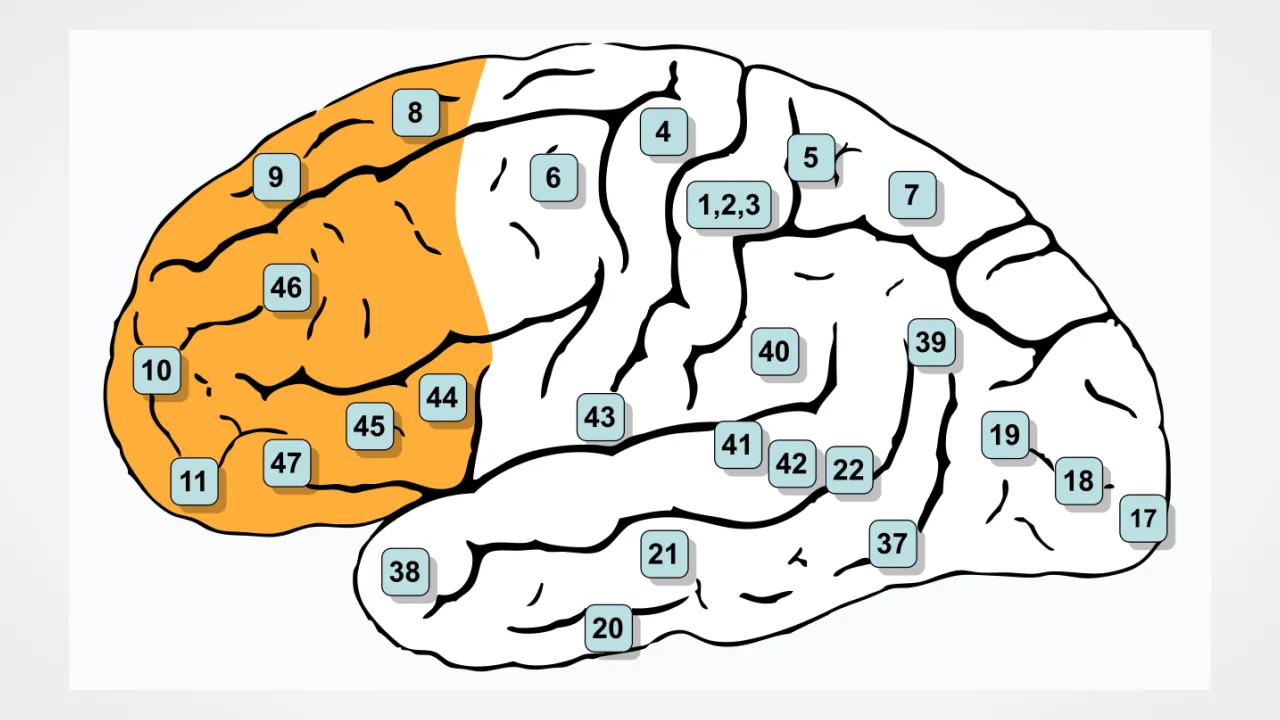
2. Which everyday superpower comes from your prefrontal cortex?
🤯 Mind-Blowing Fact • Grade 2
Compared to body size, humans have a much larger prefrontal cortex than dogs, cats, or any other animal on Earth!
✨ Word Sparks (Grade 2 Glossary)
Tap 🔊 to hear
impulse
sudden urge to act without thinking
working memory
mental notepad holding facts for moments
distraction
something pulling attention away from tasks
🪝
How do you hold three clues in your head at once while solving a mystery puzzle?
1
Air-Traffic Controller of Thought
Picture a busy airport tower guiding dozens of planes safely onto runways without bumping! Right behind your forehead, your prefrontal cortex acts like that air-traffic controller for all your thoughts, feelings, and goals.
2
Mental Scratchpad and Self-Control
When you add two numbers in your head without paper, you use '' right inside your prefrontal cortex! It also helps you ignore noisy and choose patient teamwork over impulsive outbursts.
3
Under Construction Until 25
Vision and movement zones finish wiring early in childhood, yet your prefrontal cortex keeps upgrading into adulthood—meaning kids' brains are built to learn!
1. What mental tool in your prefrontal cortex lets you hold a phone number or math step in mind for a few seconds?
2. About what age does the human prefrontal cortex finally finish maturing?
🤯 Mind-Blowing Fact • Grade 3
Brain scans of jazz musicians improvising brand-new melodies on the spot show parts of their prefrontal cortex temporarily quieting down so creative ideas flow freely without self-doubt!
✨ Word Sparks (Grade 3 Glossary)
Tap 🔊 to hear
executive function
mental skills for planning, focus, self-control
flexibility
switching smoothly to new ideas or rules
empathy
understanding how another person feels inside
🪝
Why can you travel ten years into the future inside your imagination—something almost no other creature can do?
1
Mental Time Travel
Close your eyes and imagine building a treehouse next summer or becoming an astronaut one day! Scientists call this ability 'mental time travel,' and its command hub sits right behind your forehead in the prefrontal cortex—covering nearly a third of your entire cerebral cortex.
2
Three Executive Superpowers
Psychologists group the prefrontal cortex's main jobs under '.' First is working memory—juggling facts in mind. Second is inhibitory control—resisting temptations and pausing knee-jerk reactions. Third is cognitive —switching strategies smoothly when rules change mid-game!
3
Calming the Alarm Bell
Deep in your brain sits an emotional alarm called the amygdala. When a loud shadow startles you, then you realize it's just your coat on a chair, your prefrontal cortex sends calming messages downward: 'Stand down, we're safe!'
4
Sleep Fuels Your Captain
Skipping a good night's sleep tires out your prefrontal cortex first, which is why tired brains feel crankier and more easily distracted!
1. Which skill shows 'cognitive flexibility' in your prefrontal cortex?
2. Why do people often feel extra grumpy or forgetful when they don't get enough sleep?
🤯 Mind-Blowing Fact • Grade 4
In Walter Mischel's famous 'Marshmallow Test,' kids used clever prefrontal cortex tricks—like singing songs or imagining the marshmallow was just a fluffy white cloud—to wait patiently for a double treat!
✨ Word Sparks (Grade 4 Glossary)
Tap 🔊 to hear
dorsolateral
upper outer side region handling logic
orbitofrontal
prefrontal zone right above eye sockets
pruning
trimming unused synapses to sharpen brain circuits
🪝
How did an 1848 railroad accident in Vermont give doctors their very first clue about what the front of the brain actually does?
1
The Surprising Case of Phineas Gage
In 1848, a polite, organized railroad foreman named Phineas Gage survived a freak workplace accident that injured his frontal lobes while sparing his motor, speech, and memory centers. Amazingly, Gage could still walk, talk, and calculate wages—yet friends noticed he suddenly struggled with patience, planning ahead, and social judgment! For the first time in medical history, scientists realized the prefrontal cortex shapes personality, self-control, and wise decision-making.
2
Specialized Zones Behind Your Brow
Modern functional MRI scanners map distinct neighborhoods inside the prefrontal cortex. Up on the outer sides, the prefrontal cortex handles logical reasoning, math problem-solving, and working memory. Down near the midline and behind the eyes, the ventromedial and zones weigh rewards, read social cues, feel empathy for friends, and regulate emotions.
3
Back-to-Front Brain Remodeling
Longitudinal MRI studies at the National Institutes of Health revealed that human brains mature from back to front! Sensory and visual zones at the back finish and insulating wires with myelin early, while long-range cables linking the prefrontal cortex to emotional centers finish wiring around age twenty-five.
4
Training Your Brain's CEO
Mindfulness breathing, learning musical instruments, strategy games, and outdoor exercise physically thicken prefrontal gray matter and strengthen focus!
1. What big scientific lesson did 19th-century doctors learn from railroad foreman Phineas Gage?
2. In what direction does the human cerebral cortex mature from childhood to young adulthood?
🤯 Mind-Blowing Fact • Grade 5
Neuroscientist Patricia Goldman-Rakic proved that prefrontal working-memory circuits follow an inverted-U 'Goldilocks curve' for dopamine—explaining why calm curiosity makes you think sharpest while panic temporarily blanks your mind!
✨ Word Sparks (Grade 5 Glossary)
Tap 🔊 to hear
theory of mind
understanding others hold different thoughts and feelings
dopamine
chemical messenger tuning focus, motivation, reward
pyramidal neuron
triangle-bodied cortex cell sending long signals
🪝
How do persistent reverberating loops of prefrontal neurons hold an abstract idea alive in your mind after every sensory clue has vanished?
1
Granular Association Pinnacle of Primates
Occupying roughly twenty-nine percent of total human neocortical surface area—more than double the proportion found in chimpanzees and triple that of cats—the prefrontal cortex (Brodmann areas 8–12 and 44–47) represents the evolutionary pinnacle of multimodal association cortex. Unlike primary motor cortex packed with giant Betz cells, prefrontal cortex features a prominent fourth 'granular' input layer (layer IV) richly wired with reciprocal long-range white-matter fasciculi connecting virtually every sensory system, limbic emotion center, thalamic mediodorsal nucleus, and basal ganglia loop.
2
Persistent Firing and Working Memory
Beginning in the 1970s, neurophysiologists Joaquin Fuster and Patricia Goldman-Rakic uncovered the cellular secret of working memory inside the dorsolateral prefrontal cortex (dlPFC). Whereas visual cortex neurons stop firing the instant a picture disappears from a screen, recurrent excitatory microcircuits of Layer III in the dlPFC keep firing continuously across delay periods via NMDA glutamate receptors! This 'mental sketchpad' requires a delicate 'Goldilocks' chemical balance of and norepinephrine: too little leaves focus sluggish during fatigue, while extreme stress floods receptors and temporarily takes top-down reasoning offline.
3
Functional Triads: Logic, Value, and Empathy
Three interconnected hubs divide executive labor: the dorsolateral prefrontal cortex orchestrates rule-based reasoning, task switching, and cognitive control; the orbitofrontal cortex (OFC) dynamically updates reward value and consequences; and the ventromedial/medial prefrontal cortex (vmPFC/mPFC) anchors ''—modeling other people's perspectives—while sending inhibitory projections via the uncinate fasciculus to calm amygdala threat reactivity.
4
Protracted Synaptic Pruning and Myelination
Across adolescence and early adulthood, glial oligodendrocytes wrap prefrontal axons in high-speed myelin while microglia prune redundant dendritic spines—trading raw childhood plasticity for streamlined, integrated adult executive networks around age twenty-five.
5
Architect of Human Culture
Every scientific hypothesis, symphony blueprint, constitutional law, and act of compassionate restraint begins inside these reverberating frontal circuits.