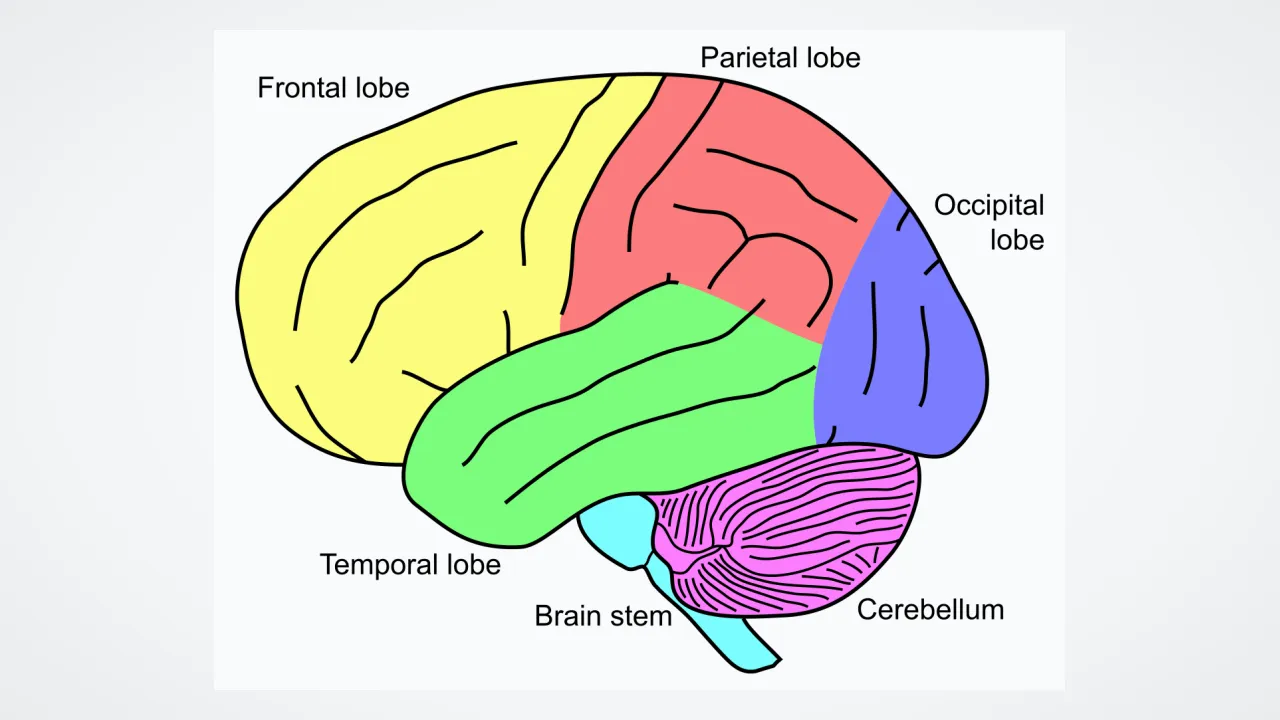
1. What does the Latin word 'cerebellum' mean in English?
2. Which everyday activity needs big help from your cerebellum?
🤯 Mind-Blowing Fact • Grade 2
Inside the cerebellum, white nerve pathways branch out like twigs and leaves—so early scientists named that pattern the 'Tree of Life'!
✨ Word Sparks (Grade 2 Glossary)
Tap 🔊 to hear
coordination
muscles working together smoothly on time
posture
how you hold your body upright
muscle memory
practiced movements stored inside your cerebellum
🪝
Why does learning to ride a bicycle feel wobbly on Monday yet smooth as magic by Saturday?
1
Coach of Your Muscles
Watch a gymnast flip across a narrow beam and stick the landing! Your big cerebrum decides to jump, yet your fist-sized cerebellum tucked at the back of your skull coaches every muscle so you land smoothly.
2
Building Muscle Memory
Muscles don't actually have memories inside them—that '' lives right inside your cerebellum! Whether you practice piano scales, handwriting, or basketball dribbles, your cerebellum fine-tunes the timing.
3
Tiny Space, Billions of Cells
Tightly pleated folds let this small region pack almost four out of every five neurons in your entire brain!
1. Where is 'muscle memory' for riding bikes or playing instruments actually stored?
2. What pretty shape do the branching white pathways inside your cerebellum look like?
🤯 Mind-Blowing Fact • Grade 3
Unlike your cerebrum's crisscross wiring, each half of your cerebellum controls the exact SAME side of your body—right cerebellum for right hand!
✨ Word Sparks (Grade 3 Glossary)
Tap 🔊 to hear
folia
thin leaf-like folds of cerebellum bark
inner ear
fluid-filled balance sensors inside your ear
reflex
instant automatic body response without waiting
🪝
How can a brain part taking up just one-tenth of your skull hold nearly eighty percent of your brain's neurons?
1
Tightly Pleated Like an Accordion
Fold a paper fan into dozens of super-thin pleats and see how compact it becomes! Sitting beneath the back of your cerebrum, the cerebellum folds its outer bark into hundreds of narrow horizontal leaves called . Packed inside those ultra-thin pleats are roughly 69 billion tiny granule cells—about four times more neurons than your whole cerebral cortex!
2
Split-Second Error Checker
Think of your cerebellum as a real-time autopilot inspector. First, it receives a copy of the movement plan your frontal lobe wants to make. Simultaneously, nerves in your , joints, and muscles report what your body is actually doing.
3
Instant Fixes
If your foot slips an inch on wet grass, your cerebellum spots the mismatch in milliseconds and fires corrective signals before you even realize you slipped!
4
Keeping Your Eyes Steady
Nod your head while reading this sentence—your cerebellum's eye-tracking circuits counter-steer your eyeballs so the words never blur!
1. How does your cerebellum catch a stumble on uneven ground so fast?
2. Which side of your body does the right half of your cerebellum coordinate?
🤯 Mind-Blowing Fact • Grade 4
Your cerebellum is the reason you cannot tickle yourself—it predicts your own finger movements and cancels out the surprise tickle alarm!
✨ Word Sparks (Grade 4 Glossary)
Tap 🔊 to hear
Purkinje cell
fan-shaped master neuron inside the cerebellum
granule cell
tiniest, most numerous neuron in brain
proprioception
body sense knowing limb positions blindfolded
🪝
What do catching a curving baseball, playing fast violin notes, and timing a punchline in conversation all have in common?
1
Fan-Shaped Purkinje Masterpieces
Peer through a microscope into the cerebellar cortex and you meet one of nature's most breathtaking cells: the Purkinje neuron! Shaped like a flat sea-fan coral, a single spreads a lush branching tree that receives messages from up to 200,000 tiny granule-cell fibers at once—more inputs than almost any other neuron in the human body.
2
Predictive Forward Models
Imagine trying to catch a fast baseball if you had to wait a tenth of a second for eye signals to travel through slow conscious thought—the ball would already pass your glove! Neuroscientists discovered the cerebellum builds predictive 'forward models.' Using past practice, it predicts exactly where your arm and the ball will be milliseconds ahead of time, coordinating dozens of shoulder, elbow, and finger muscles seamlessly.
3
Why You Cannot Tickle Yourself
Ever wondered why tickling your own ribs barely feels ticklish? When your fingers move, your cerebellum predicts the exact touch sensation ahead of time and tells your sensory cortex, 'False alarm—that's just us!'
4
Beyond Muscles: Sharpening Thought
Modern brain imaging reveals cerebellar loops also connect to language and thinking centers, helping smooth out mental timing, focus, and rapid word retrieval.
1. Why doesn't it tickle when you try to tickle your own foot or ribs?
2. What makes Purkinje neurons inside the cerebellum look so distinctive under a microscope?
🤯 Mind-Blowing Fact • Grade 5
If you unfolded every tiny accordion pleat of your fist-sized cerebellum, it would form a narrow ribbon over three and a half feet (more than one meter) long from top to bottom!
Why did evolution wire a uniform crystalline microcircuit of 69 billion neurons beneath the back of your brain—and how does it smooth both motion and thought?
1
Crystalline Architecture in the Posterior Cranial Fossa
Nestled within the posterior cranial fossa beneath a tough dural shelf called the tentorium cerebelli, the human cerebellum comprises two lateral hemispheres flanking a midline ridge termed the vermis ('worm'). When neuroscientist Suzana Herculano-Houzel developed isotropic fractionator cell-counting in the 2000s, textbooks needed an immediate rewrite: although the cerebellum occupies barely ten percent of total brain volume (~150 grams), its tightly pleated folia house roughly 69 billion of the human brain's 86 billion total neurons! Inside slices shines the —branching myelinated tracts linking three pairs of cerebellar peduncles (superior, middle, and inferior) directly to the midbrain, pons, and medulla.
2
Marr-Albus Motor Learning Circuitry
Unlike the cerebral cortex, whose six layers vary across visual, motor, and frontal regions, the three-layered cerebellar cortex repeats a single geometric circuit everywhere with crystal precision. Mossy fibers deliver sensory context and pontine motor copies to billions of tiny excitatory granule cells, whose T-shaped parallel fibers thread orthogonally through the flat dendritic fans of inhibitory GABAergic Purkinje cells. Meanwhile, each Purkinje cell is wrapped by a single powerful '' rising from the inferior olive—acting as a teaching signal whenever a movement error occurs and adjusting synaptic weights via long-term depression.
3
Three Functional Divisions
Evolutionarily, three zones divide labor: the ancient vestibulocerebellum (flocculonodular lobe) governs inner-ear equilibrium and the vestibulo-ocular reflex; the spinocerebellum (vermis and intermediate zone) fine-tunes axial posture and limb trajectory via proprioceptive feedback; and the massive lateral cerebrocerebellum plans skilled multi-joint sequences like typing, surgery, or musical virtuosity.
4
Ipsilateral Loops and Clinical Clues
Because cerebellar outputs cross to the opposite red nucleus and thalamus before descending motor tracts cross back again in the brainstem, cerebellar pathways stay doubly crossed—meaning each hemisphere governs (same-side) coordination, where disruption causes overshooting reach (dysmetria) rather than paralysis.
5
Universal Timing and Cognitive Dysmetria
Through reciprocal loops reaching the prefrontal cortex, neuroscientists led by Jeremy Schmahmann revealed that the identical error-prediction algorithm smoothing an athlete's jump also calibrates rapid attention shifts, verbal fluency, and cognitive precision.