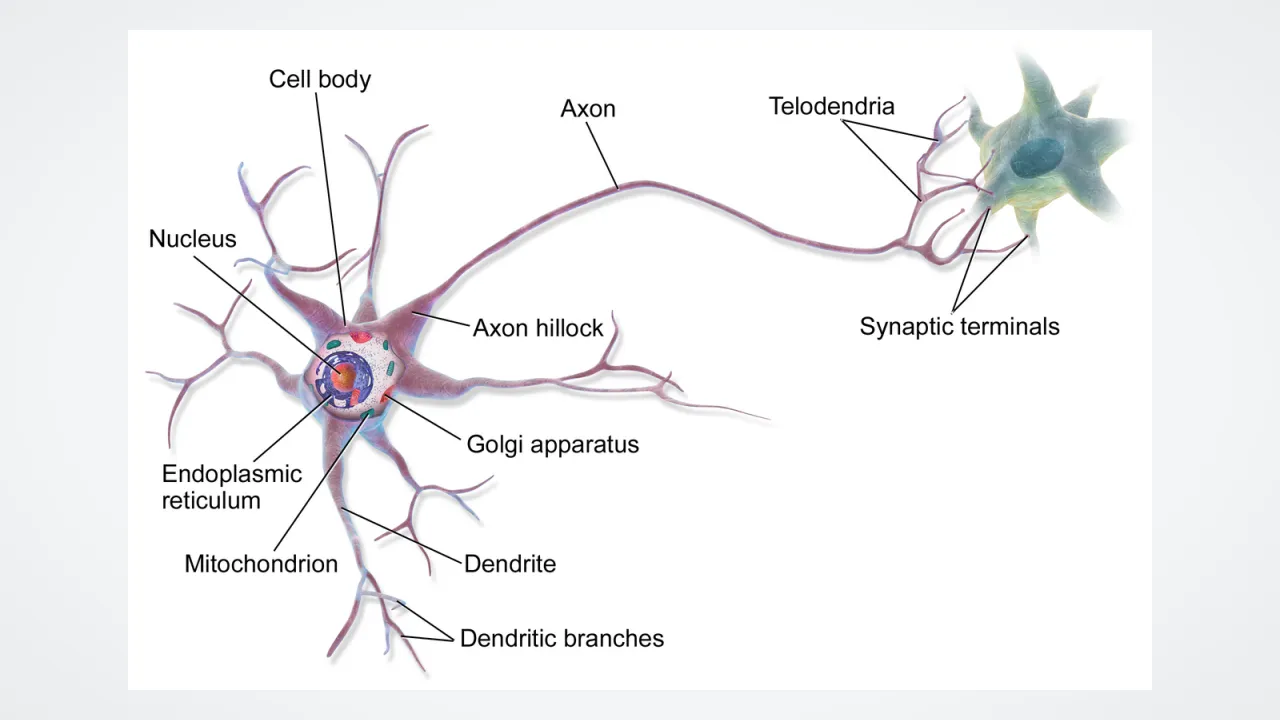
1. What do the short twig-like branches on a neuron do?
2. About how many neurons live inside your brain?
🤯 Mind-Blowing Fact • Grade 2
Even though your eighty-six billion brain neurons fire millions of sparks every second, your whole brain uses only enough electricity to light one small fridge bulb!
✨ Word Sparks (Grade 2 Glossary)
Tap 🔊 to hear
dendrite
A branch on a neuron catching messages
axon
A long fiber sending signals outward
microscopic
Too tiny to see without a microscope
🪝
How can one microscopic cell stretch from your lower back all the way to your big toe?
1
Built Like a Tiny Tree
Picture a glowing tree with leafy branches at the top and one long root at the bottom! That is a neuron, the special messenger cell of your brain and nerves. Every memory you keep and every song you hum travels across teams of neurons.
2
Three Smart Parts
Bushy branches called listen for incoming signals. The round cell body decides what to do next, and then a long tail fiber called an shoots a tiny electrical pulse forward.
3
Short and Super Long
Brain neurons are teensy, yet a single leg neuron's tail can stretch three feet from your spine right down to your wiggle toes!
1. Which part of a neuron acts like a long tail shooting signals outward?
2. How much electrical power does your busy brain use at once?
🤯 Mind-Blowing Fact • Grade 3
In a blue whale or a tall giraffe, a single motor neuron's axon can stretch more than ten to fifty feet without breaking!
✨ Word Sparks (Grade 3 Glossary)
Tap 🔊 to hear
soma
The main body center of a neuron
sensory
Carrying sight, sound, smell, or touch clues
interneuron
A brain neuron connecting sensory and motor cells
🪝
How do three kinds of neurons team up when you smell warm cookies and reach for one?
1
Living Wires Inside You
Sniff the sweet scent of warm chocolate chip cookies and smile! In less than a blink, microscopic nerve cells called neurons turned scent molecules into thoughts and hand movements. Unlike round skin or blood cells, neurons grow branching shapes built specifically to carry fast information.
2
Dendrites, Soma, and Axon
Most neurons share three main zones. Feathery dendrites gather incoming clues and funnel them into the , or cell body, which houses the cell's DNA nucleus. When the signal grows strong enough, an electrical wave zips down the slender axon toward waiting neighbors.
3
Three Specialist Jobs
Your body relies on three neuron specialists working like a relay team. neurons carry sights, sounds, smells, and touches inward; inside your brain and spinal cord think things over; and motor neurons command your muscles to move.
4
Growing New Connections
Every time you practice piano chords or multiplication facts, the same neuron pathways fire again and again, weaving stronger connections that make learning stick!
1. Which type of neuron carries commands from your brain out to your muscles so you can reach for a cookie?
2. What happens to your neuron pathways when you practice a new skill like playing music?
🤯 Mind-Blowing Fact • Grade 4
A single Purkinje neuron in your cerebellum can sprout up to two hundred thousand dendritic connections, looking just like a giant sea fan coral!
✨ Word Sparks (Grade 4 Glossary)
Tap 🔊 to hear
ion
A tiny atom carrying an electric charge
membrane
The thin outer skin around a cell
glia
Helper cells that feed and protect neurons
🪝
How does a soft cell made mostly of salty water generate crisp electrical sparks?
1
Bioelectricity Without Copper Wires
Open up a flashlight and you will find copper wires carrying electrons from a battery. Your body has no copper wires, yet your neurons flash millions of crisp electrical pulses every second! Instead of metal, neurons generate bioelectricity using charged mineral particles—especially sodium and potassium —dissolved right inside your body's natural salty fluids.
2
Firing an Action Potential
While resting, tiny molecular pumps in a neuron's outer push sodium outside, storing potential energy like water held behind a dam. When bushy dendrites collect enough incoming signals at the soma, microscopic protein gates suddenly snap open at the start of the axon. Positively charged sodium ions rush inward in a domino-like wave called an action potential, racing all the way to the axon terminals!
3
Glial Support Crew
Neurons never work solo. Billions of partner cells called feed them nutrients, tidy up leftover , guard against germs, and wrap axons in fast insulating coats so signals never fizzle out.
4
Built to Last a Lifetime
Unlike skin cells that flake away weekly, most of your brain neurons stay with you from childhood into old age—rewiring their dendritic branches as you master new languages, sports, and ideas.
1. Instead of copper wires, what do neurons use to create electrical action potentials?
2. What vital job do glial cells perform in the nervous system?
🤯 Mind-Blowing Fact • Grade 5
In 1952, biophysicists Alan Hodgkin and Andrew Huxley decoded how all human neurons fire electrical spikes by studying giant axons inside squids—fibers nearly one millimeter thick!
✨ Word Sparks (Grade 5 Glossary)
Tap 🔊 to hear
millivolt
One thousandth of a volt of electricity
threshold
The exact tipping point starting an event
neuroplasticity
The brain's lifelong ability to rewire connections
🪝
How did silver-stained sketches by a nineteenth-century artist-scientist reveal that your mind is built from eighty-six billion individual cells?
1
Santiago Ramón y Cajal and the Neuron Doctrine
Peer through a nineteenth-century microscope at ordinary brain tissue and all you see is a pale, tangled blur. Most Victorian scientists assumed the nervous system was one continuous fused web. Then, in the late 1880s, Spanish neuroscientist and talented artist Santiago Ramón y Cajal applied Camillo Golgi's silver-chromate stain, which darkened just one percent of cells in jet-black silhouette. Cajal's breathtaking ink drawings proved the 'Neuron Doctrine': the nervous system is composed of discrete, independent cells communicating across microscopic junctions.
2
Resting Voltage and Ion Pumps
Every neuron operates as a miniature rechargeable battery. Embedded throughout its lipid membrane, sodium-potassium ATPase pumps tirelessly export three positively charged sodium ions for every two potassium ions brought inside. That unequal trade maintains a resting membrane potential near minus seventy , holding the cell's interior slightly negative relative to surrounding fluid.
3
All-or-None Action Potentials
Branching dendrites sum thousands of excitatory and inhibitory inputs across the soma toward a trigger zone called the axon hillock. If voltage crosses a near minus fifty-five , voltage-gated sodium channels snap open in microseconds, flipping the membrane positive in an 'all-or-none' spike—the action potential. Potassium channels immediately open behind it to reset the charge, propelling an unweakened electrical wave down the axon at speeds up to 120 meters per second.
4
A Menagerie of Shapes and Neuroplasticity
Evolution sculpted neurons to match their tasks: pyramid-shaped cortical cells weave complex thoughts, coral-like Purkinje cells fine-tune balance, and pseudounipolar sensory neurons speed touch signals past their cell bodies. Even in adulthood, hippocampal circuits birth fresh neurons—neurogenesis—while dendritic spines continually remodel through .
5
Counting Every Brain Cell
For decades, textbooks guessed humans had a round hundred billion brain neurons. In 2009, Brazilian neuroscientist Suzana Herculano-Houzel invented an ingenious cell-counting method and pinned down the real human average: roughly eighty-six billion neurons paired with about eighty-five billion glial allies!