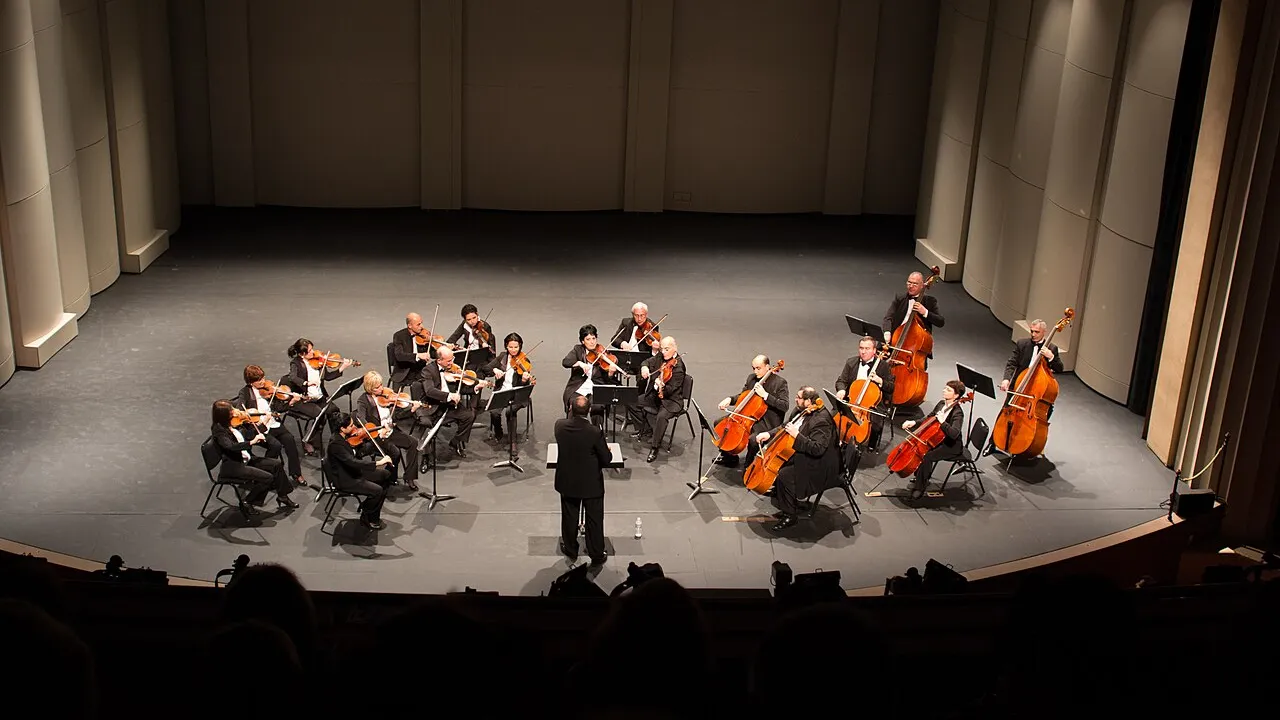
🏢 WorkplaceAcoustic concert halls, rehearsal studios, recording stages, and community amphitheaters
⚡ Everyday Impact SparkUnites dozens of instruments in split-second harmony to stir emotions and bring stories to life through sound
🤯 Mind-Blowing Fact • Grade 1
A full symphony orchestra can have up to one hundred musicians playing on stage at the exact same time!
✨ Word Sparks (Grade 1 Glossary)
Tap 🔊 to hear
orchestra
a large team of musicians playing instruments together
baton
the thin stick a music leader waves
harmony
different musical notes sounding sweet at once
🪝
How can eighty players sound like one giant voice?
1
Hush Before the First Note
Hush! The big concert hall grows quiet. A leader lifts a thin white stick. Then violins, flutes, and drums play together! A symphony musician makes big music with a team.
2
Tools of the Stage
Each player holds a special instrument. Some slide horsehair bows across shiny strings. Others blow warm air into brass horns. Everyone reads black notes on paper.
3
Practice Makes Harmony
Playing together takes lots of practice. Musicians listen closely to their neighbors. Their music fills the room with joy!
1. What does the music leader wave to guide the players?
2. How do symphony musicians know which notes to play?
🤯 Mind-Blowing Fact • Grade 2
Violin bows are strung with about 150 to 200 real horsehairs rubbed with sticky pine tree resin called rosin!
✨ Word Sparks (Grade 2 Glossary)
Tap 🔊 to hear
conductor
the leader who guides an orchestra's speed
percussion
instruments like drums played by striking or shaking
rehearse
to practice music carefully before a real show
🪝
Why does an oboe play one clear note before every symphony concert begins?
1
Tuning Up Together
Before the curtain rises, one oboe plays a steady, clear note. Soon, dozens of violins, cellos, flutes, and trumpets match that exact pitch! A symphony musician works inside a huge musical team called an orchestra.
2
Four Families of Sound
An orchestra has four main instrument families: strings, woodwinds, brass, and . Musicians watch the 's baton for the beat and read sheet music on stands. Even one tiny mistake in timing can stand out, so every player counts silently.
3
Sharing Stories Without Words
Musicians for hours to blend their sounds smoothly. On concert night, they perform classical masterpieces, movie scores, and holiday favorites that make audiences smile and cheer.
1. Which instrument plays the clear note that helps the whole orchestra tune up?
2. Which of these is one of the four main instrument families in an orchestra?
🤯 Mind-Blowing Fact • Grade 3
To keep auditions 100 percent fair, modern symphony orchestras ask candidates to play behind a curtain on a carpeted walkway so judges only hear the music!
✨ Word Sparks (Grade 3 Glossary)
Tap 🔊 to hear
tempo
the exact speed at which music moves
timpani
large copper kettle drums tuned to specific notes
acoustics
how sound waves bounce and travel inside rooms
🪝
How do ninety musicians stay perfectly synchronized when sound takes time to cross a wide stage?
1
Eyes on the Baton, Ears Wide Open
Warm stage lights glow off polished brass horns and carved wooden cellos. When the conductor's baton drops, ninety symphony musicians breathe together and launch into a thunderous opening chord! Playing in a professional orchestra combines athletic finger speed with deep artistic expression.
2
Life Inside the Rehearsal Hall
Long before Friday night's concert, musicians spend mornings in group rehearsals and afternoons practicing tricky passages alone. Woodwind players hand-carve thin bamboo reeds for their clarinets and bassoons, while percussionists switch swiftly between drums, chimes, and cymbals.
3
Teamwork Measured in Milliseconds
Because sound travels slower than light, brass players in the back row must watch the conductor's gestures rather than waiting to hear the front-row violins. Musicians pencil tiny bowings and breathing marks onto their sheet music so every section phrases melodies identically.
4
Music for the Whole Community
Beyond concert halls, symphony musicians record thrilling film soundtracks, visit elementary schools for youth concerts, and perform free outdoor summer shows in city parks.
1. Why must back-row brass players rely on watching the conductor's baton?
2. What do clarinet, oboe, and bassoon players often carve by hand before rehearsals?
🤯 Mind-Blowing Fact • Grade 4
During a lively two-hour symphony performance, a lead violinist's bow arm moves back and forth thousands of times—burning as much energy as a brisk three-mile jog!
✨ Word Sparks (Grade 4 Glossary)
Tap 🔊 to hear
concertmaster
the lead violinist who helps guide the orchestra
dynamics
changes between loud and soft volumes in music
ensemble
a group of performers working together as one
🪝
What connects physics, teamwork, and centuries of history every time an orchestra plays a single chord?
1
Precision Physics in Motion
Step onto the stage of a symphony hall just as the oboist sounds an A note vibrating at exactly 440 cycles per second. Within moments, violinists twist wooden pegs, trombonists adjust brass slides, and timpanists press foot pedals until nearly one hundred instruments lock into pure acoustic alignment. A symphony musician blends musical artistry with remarkable physical discipline.
2
Sections, Principals, and the Concertmaster
Every orchestra is organized like an intricate team so dozens of players can move as one. Strings sit closest to the audience because their wooden bodies project softer sound waves than booming trumpets or tubas at the rear. Each instrument group has a section leader called a principal, while the lead first violinist—known as the —coordinates bow movements and helps unify the .
3
Preparing a New Program Every Week
Unlike a theater cast that repeats one show for months, professional orchestras often prepare an entirely new two-hour program every single week. Musicians decode Italian tempo terms like allegro and adagio, master shifting rhythms, and balance so a delicate flute solo floats clearly above sixty string players.
4
Cultural Bridges Across Generations
Symphony musicians preserve masterworks by composers from Mozart to Florence Price while premiering bold new pieces written today. Through hospital visits, school workshops, and film-score sessions, they enrich public life and inspire young learners everywhere.
1. Why are violinists and other string players seated at the front of the stage?
2. What is the role of the concertmaster in a symphony orchestra?
🤯 Mind-Blowing Fact • Grade 5
If you uncoiled all the curved brass tubing of a single modern double French horn, it would stretch over 20 feet long—longer than a full-grown giraffe is tall!
✨ Word Sparks (Grade 5 Glossary)
Tap 🔊 to hear
intonation
playing musical pitches with exact, true accuracy
conservatory
a specialized college dedicated to musical training
articulation
how individual musical notes are shaped or connected
🪝
How does a symphony musician translate centuries-old ink marks on paper into living sound waves that fill a 2,500-seat hall without a single microphone?
1
Unamplified Acoustic Engineering
Imagine projecting a whisper-quiet melody across 2,500 seats without a single electronic speaker or amplifier. When a symphony musician draws a rosined bow across a cello string or shapes an airstream through a French horn's twelve feet of coiled brass tubing, pure physics takes over. Vibrating columns of air and resonant spruce soundboards send complex sound waves rebounding off angled ceiling canopies engineered to carry crisp music to the highest balcony.
2
Mastery Forged Over Ten Thousand Hours
Earning a chair in a major symphony orchestra is one of the most selective achievements in the performing arts. Candidates spend years training at music conservatories, mastering breath control, micro-, and complex polyrhythms before competing in blind auditions behind opaque screens. Once hired, musicians maintain peak neuromuscular coordination—executing sixteen notes per second while adjusting pitch by tiny fractions of a hertz to keep chords ringing purely.
3
Decoding the Musical Architecture
A symphonic score functions like a multidimensional blueprint. While the conductor shapes the overarching interpretation from a master score containing twenty or more staves, each musician reads an individual part packed with key changes, , and measure rests. Percussionists may count seventy silent measures before striking a single cymbal crash at the exact microsecond required by the composer's climax.
4
Versatility From Beethoven to Blockbusters
Modern orchestral careers span far more than 18th- and 19th-century European symphonies. Within a single month, an ensemble might perform compositions by Dvorak and Duke Ellington, sight-read intricate studio soundtracks for video games and motion pictures with a click track in their headphones, and collaborate with youth orchestras in underserved neighborhoods.
5
Stewards of Shared Human Emotion
Ultimately, symphony musicians serve as living bridges between composers of every era and communities today, proving that disciplined cooperation among diverse voices can create breathtaking harmony no soloist could ever achieve alone.