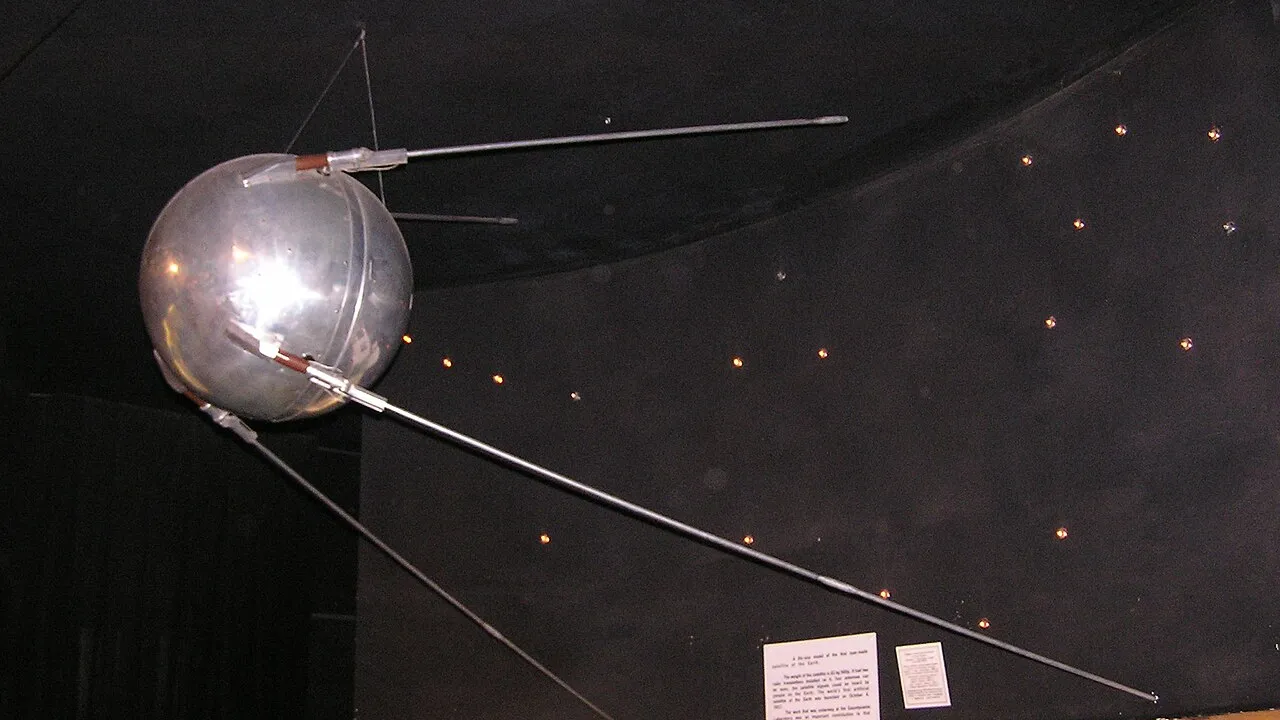
1. About how big was the round metal body of Sputnik 1?
2. What sound did Sputnik 1 send down to radios all around the world?
🤯 Mind-Blowing Fact • Grade 2
People watching the night sky in 1957 were often actually spotting Sputnik's giant empty rocket booster tumbling brightly behind the tiny satellite!
✨ Word Sparks (Grade 2 Glossary)
Tap 🔊 to hear
glint
flash bright reflected sunlight cleanly
transmitter
electronic device sending out radio signals
twilight
soft glowing sky right after sunset
🪝
How did a simple metal ball with no cameras change human history overnight?
1
Liftoff into History
Imagine stepping into your backyard at in October 1957 and spotting a brand-new moving point of light gliding across the stars! Soviet rocket engineers led by Sergei Korolev had just launched Sputnik 1 into orbit.
2
96 Minutes Around the Globe
Weighing 184 pounds and polished shiny so sunlight would off its round aluminum shell, Sputnik 1 whipped completely around Earth every 96 minutes at 18,000 miles per hour!
3
Batteries and Shooting Stars
Inside, silver-zinc batteries powered a radio that beeped for 21 days. Three months after launch, Sputnik 1 dipped into thick air and burned up harmlessly—inspiring countries everywhere to build space programs!
1. Why did engineers polish Sputnik 1's aluminum shell until it shone like a mirror?
2. How long did it take Sputnik 1 to zoom once all the way around Earth?
🤯 Mind-Blowing Fact • Grade 3
Within less than a year of Sputnik 1's surprise launch, the United States launched its own first satellite—Explorer 1—and founded NASA in 1958!
✨ Word Sparks (Grade 3 Glossary)
Tap 🔊 to hear
elliptical
oval-shaped orbit rather than exact circle
nitrogen
common safe gas filling Earth's air
pressurized
filled tightly with gas inside
🪝
What secret science clues were hidden inside Sputnik 1's simple 'beep-beep' radio signal?
1
Simpler, Lighter, First!
Originally, Chief Designer Sergei Korolev planned a heavy laboratory satellite packed with complex sensors. When construction ran behind schedule in 1957, his team swiftly built 'Elementary Satellite 1'—a sleek 23-inch aluminum sphere sealed tightly with gas inside.
2
Secret Science in the Beeps
Those famous 'beep-beep' pulses weren't just for show! Had a tiny space rock punctured Sputnik's shell and leaked out the gas, OR had temperatures inside swung too hot or cold, automatic switches would have changed the length and pause of every beep!
3
Measuring the Upper Sky
By tracking how gradually Sputnik 1's orbit slowed down from 584 miles high, physicists calculated the density of Earth's ultra-thin upper atmosphere for the very first time.
4
Sparking NASA and Modern Satellites
Before burning up on January 4, 1958 after 1,440 orbits, Sputnik 1 sparked the creation of NASA and paved the way for weather, GPS, and internet satellites!
1. How would scientists have known if a tiny meteoroid had poked a hole in Sputnik 1's metal shell?
2. What did scientists measure by watching how Sputnik 1's orbit slowly dropped lower each week?
🤯 Mind-Blowing Fact • Grade 4
Studying the rising and falling Doppler pitch of Sputnik 1's radio beeps directly inspired American scientists to invent the world's first satellite navigation system—the ancestor of the GPS in every phone!
✨ Word Sparks (Grade 4 Glossary)
Tap 🔊 to hear
ionosphere
electrically charged upper layer of air
Doppler effect
wave pitch shift from moving source
megahertz
millions of radio wave cycles per second
🪝
How did two young physicists listening to Sputnik 1's radio pitch shift invent satellite navigation right from their office?
1
International Geophysical Year Triumph
Scientists worldwide designated 1957–1958 the International Geophysical Year, challenging nations to launch scientific satellites to study Earth from above. Lifting off from Baikonur on October 4, 1957 atop Sergei Korolev's two-stage R-7 Semyorka booster, the 83.6-kilogram PS-1—Prosteyshiy Sputnik—injected into an orbit inclined 65 degrees to the equator, sweeping over nearly every inhabited continent!
2
Amateur Frequencies and Ionosphere Clues
Instead of encrypted military channels, engineers set Sputnik's dual 1-watt vacuum-tube transmitters to 20.005 and 40.002 —right where schools and amateur ham radio enthusiasts worldwide could listen in! Comparing how Earth's charged bent those two frequencies revealed electron densities high above weather balloons.
3
Inventing Satellite Navigation via Doppler Shift
At Johns Hopkins Applied Physics Laboratory in Maryland, physicists William Guier and George Weiffenbach listened to Sputnik's pitch slide higher as it approached and lower as it receded—the ! Plotting that frequency curve pinned down Sputnik's exact orbit from a single ground station.
4
From Sputnik to GPS
Their research director Frank McClure soon asked the brilliant reverse question: if you already know a satellite's exact orbit overhead, could measuring its radio Doppler shift pinpoint a submarine, ship, or hiker anywhere on Earth? That flash of insight birthed the U.S. Navy's Transit navigation system and directly inspired modern GPS!
1. How did listening to the Doppler pitch shift of Sputnik 1's radio signal lead to modern GPS navigation?
2. Why did Sputnik's designers broadcast on 20 and 40 megahertz instead of secret frequencies?
🤯 Mind-Blowing Fact • Grade 5
By orbiting freely over dozens of countries without objection in October 1957, Sputnik 1 quietly established the international space-law rule still used today: unlike national airspace, outer space belongs to no single country and is open to peaceful orbit by all!
✨ Word Sparks (Grade 5 Glossary)
Tap 🔊 to hear
cosmic velocity
speed needed to stay in orbit
thermosphere
thin sun-heated upper atmospheric layer
telemetry
remote measurement data radioed from craft
🪝
How did an 83.6-kilogram pressurized sphere transform global science education, aerospace engineering, and orbital law in 92 days?
1
Korolev's R-7 Booster and Orbital Velocity
Reaching stable Earth orbit requires accelerating horizontally past first —roughly 7.9 kilometers per second—so a craft's free-fall curvature matches Earth's spherical surface. On October 4, 1957, Chief Designer Sergei Korolev's OKB-1 bureau achieved that milestone using the R-7 Semyorka, whose four strap-on liquid-oxygen/kerosene boosters and central core fired twenty rocket chambers simultaneously to place the 580-millimeter AMG6T aluminum-magnesium sphere of Sputnik 1 into a 215-by-939-kilometer orbit.
2
Thermal Regulation and Telemetry Encoding
Designed by Mikhail Tikhonravov's team, Sputnik 1 featured a 1-millimeter heat-shield shell polished to high solar reflectivity, hermetically sealed with dry nitrogen at 1.3 atmospheres. An internal thermostatically switched fan circulated nitrogen whenever cabin temperatures rose past 36 degrees Celsius or fell below 20 degrees Celsius, cooling the vacuum-tube D-200 radio transmitter. Barometric and thermal relays modulated pulse durations around 0.3 seconds, confirming zero micrometeoroid hull penetrations across 326 orbits of active transmission.
3
Thermospheric Drag and Ionospheric Faraday Rotation
Tracking Sputnik 1 across 1,440 revolutions—nearly 70 million kilometers—before atmospheric reentry on January 4, 1958 yielded landmark geophysical discoveries. Perigee drag deceleration proved thermospheric density above 200 kilometers was markedly higher and more solar-sensitive than extrapolated balloon models, while Faraday polarization rotation and dual-band refraction across 20.005 and 40.002 MHz mapped total electron content through the upper F-layer ionosphere.
4
Catalyzing Global STEM and Space Law
Beyond physics, Sputnik 1 triggered an unprecedented transformation in science and mathematics education, propelled the 1958 creation of NASA and DARPA—whose computer networks later birthed the internet—and established the customary international legal principle of peaceful overflight in outer space.
5
Gateway to the Cosmos
Within twelve years of Sputnik 1's 1-watt vacuum-tube pulses, spacecraft had photographed the Moon's far side, skimmed Venus and Mars, and landed humans at Tranquility Base—all descending from one gleaming 58-centimeter sphere.