🌌 COSMOS
🔭 NASA Great Observatories & JPL/Caltech • Cryogenic Infrared Telescope
VA Science SOL 1.6, 4.5, 4.6 (Solar System, Stars & Space Exploration)
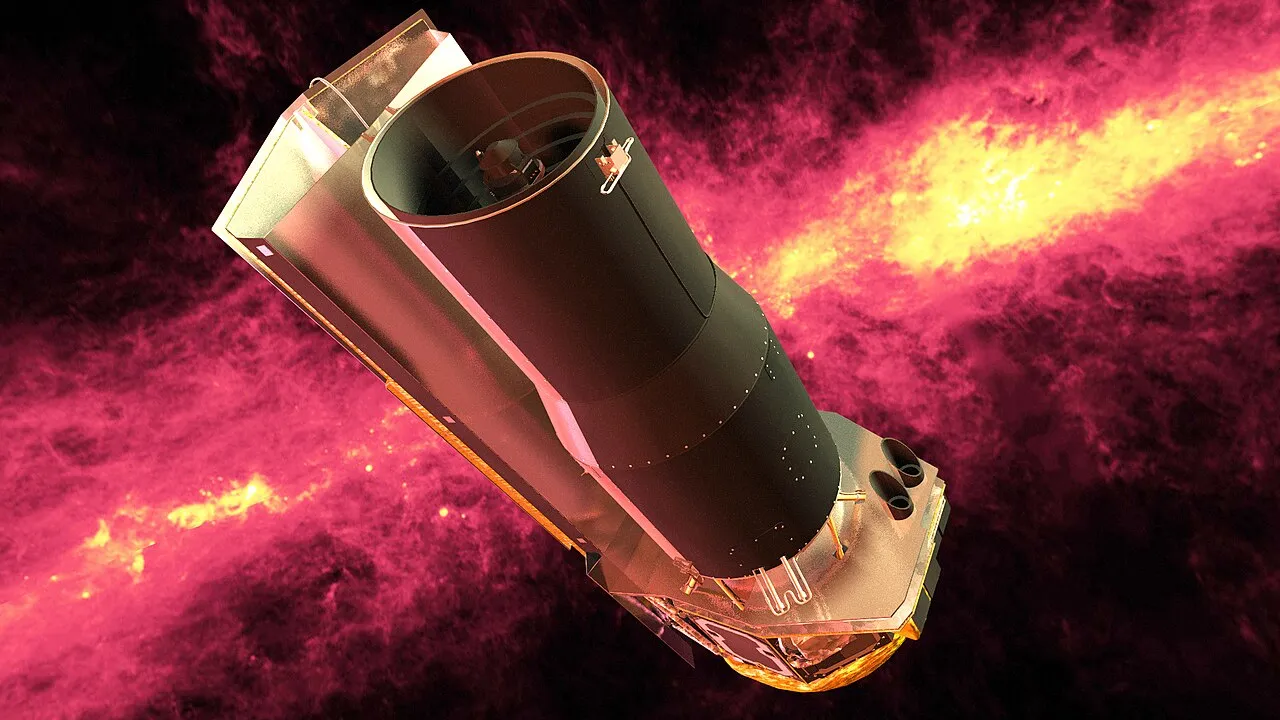
Spitzer Space Telescope
Peering Through Cosmic Dust With Cool Infrared Eyes
Grade 3 • Fluent • 135 words
🌌 Cosmic Location & DistanceEarth-Trailing Heliocentric Orbit • Drifted Over 158 Million Miles Behind Earth
🪐 Scale / Diameter14.6 ft (4.45 m) tall • 33.5 in (85 cm) beryllium mirror • 2,094 lbs (950 kg)
☄️ Composition & OrbitLiquid Helium Cryostat (5.5 Kelvin) & Solar Shield • Three Infrared Cameras
⚡ Cosmic SparkSaw straight through dark cosmic dust clouds to reveal baby stars and seven rocky TRAPPIST-1 worlds
🤯 Mind-Blowing Fact • Grade 1
Spitzer discovered a giant, whisper-thin ring of dust around Saturn so wide that three hundred Saturns could line up side by side across it!
✨ Word Sparks (Grade 1 Glossary)
Tap 🔊 to hear
infrared
Invisible heat light beyond red rainbow colors
nebula
Giant cloud of gas and dust in space
exoplanet
Planet orbiting a star outside our solar system
🪝
How can a telescope see baby stars hiding behind thick dark dust?
1
Seeing Warmth in the Dark
Peek-a-boo! Thick clouds of space dust hide newborn stars from normal eyes. Yet warm light shines right through!
2
Coldest Camera Around
If a heat camera gets warm, its own glow blurs the picture! So Spitzer floated far behind Earth to stay icy cold.
3
Seven Rocky Worlds
Before retiring in 2020, this cool eye found a hidden ring around Saturn and seven rocky planets circling one tiny star!
1. Why did the Spitzer telescope have to stay super cold?
2. What helps infrared light show us newborn stars that normal telescopes miss?
🤯 Mind-Blowing Fact • Grade 2
Spitzer was named after astronomer Lyman Spitzer Jr., who first suggested launching telescopes into space in 1946—eleven years before the very first satellite!
✨ Word Sparks (Grade 2 Glossary)
Tap 🔊 to hear
helium
Super-light gas cooled into liquid to chill instruments
beryllium
Lightweight, stiff metal staying steady in extreme cold
red dwarf
Small, cool star burning slowly for trillions of years
🪝
Why did NASA let this space telescope drift farther and farther behind Earth instead of circling our planet?
1
Trailing Behind Warm Earth
Planet Earth is warm—radiating lots of infrared heat into nearby space! Instead of orbiting warm Earth like Hubble, Spitzer launched in 2003 into a clever path around the Sun, trailing millions of miles behind Earth in deep, naturally chilly darkness.
2
Chilled Near Absolute Zero
Protected behind a shiny solar shield and cooled by a tank of super-cold liquid , its lightweight mirror chilled down to minus 450 degrees Fahrenheit!
3
Meet the TRAPPIST-1 Family
In 2017, staring for twenty days straight, Spitzer helped reveal seven Earth-sized planets orbiting star TRAPPIST-1—three inside the temperate water zone!
1. Why did trailing behind Earth in solar orbit help Spitzer work better?
2. How many Earth-sized planets did Spitzer help confirm around the nearby star TRAPPIST-1?
🤯 Mind-Blowing Fact • Grade 3
Spitzer discovered 'buckyballs'—soccer-ball-shaped cages made of sixty carbon atoms—floating naturally among dying stars in deep space!
✨ Word Sparks (Grade 3 Glossary)
Tap 🔊 to hear
cryogenic
Chilled down to ultra-freezing temperatures near absolute zero
wavelength
Distance between wave peaks determining a light's type
buckyball
Hollow sphere molecule built from sixty carbon atoms
🪝
How did Spitzer keep making huge discoveries for eleven more years AFTER its super-cold coolant ran completely dry?
1
Completing the Great Observatories
Joining Hubble (visible), Compton (gamma-ray), and Chandra (X-ray), Spitzer launched in August 2003 as the fourth member of NASA's Great Observatories family—built to unveil the cool, dusty infrared universe.
2
Cold Mission to Warm Mission
For five and a half years, evaporating liquid helium chilled Spitzer to just five degrees above absolute zero. When the helium tank finally ran empty in May 2009, its smart Earth-trailing orbit and shady solar panel kept the telescope passively cool at minus 388 degrees Fahrenheit—cold enough for two short- infrared cameras to start a bonus eleven-year 'Warm Mission'!
3
First Light Directly From Exoplanets
In 2005, Spitzer made history as the first telescope ever to capture actual light photons directly from planets orbiting distant stars, measuring alien wind and cloud temperatures!
4
Graceful Goodbye in 2020
Drifting 158 million miles behind Earth, tilting further to point its antenna home finally grew too risky—so NASA retired Spitzer in January 2020.
1. What happened when Spitzer's liquid helium coolant ran out in 2009?
2. What exoplanet first did Spitzer achieve in 2005?
🤯 Mind-Blowing Fact • Grade 4
Spitzer solved a 300-year-old astronomy mystery started in 1671: dark dust swept inward from Saturn's newly found Phoebe ring coats one side of moon Iapetus black while leaving the trailing side snowy white!
✨ Word Sparks (Grade 4 Glossary)
Tap 🔊 to hear
radiate
To send out heat or light waves into space
micrometer
Millionth of a meter, used to measure infrared waves
redshift
Stretching of distant starlight into longer redder wavelengths
🪝
Why was Spitzer's top half painted shiny silver while its bottom half facing away from the Sun was painted jet-black?
1
Clever Thermal Design Saves Tons of Mass
Earlier infrared satellites stuffed their entire telescope barrel inside a giant, heavy thermos of liquid helium. JPL and Caltech engineer Frank Low proposed a breakthrough for Spitzer: launch the 85-centimeter beryllium telescope at normal outdoor temperature inside an Earth-trailing solar orbit! Facing the Sun, shiny silver solar panels reflected heat away; facing dark deep space, the telescope shell was painted black—because black surfaces leftover warmth into space fastest! That passive cooling shrunk the helium tank tenfold, allowing launch on an affordable Delta II rocket.
2
Unmasking Saturn's Invisible Phoebe Ring
Cold dust barely reflects sunlight, making outer rings nearly invisible to optical cameras, yet even minus-315-degree dust glows gently at 24 in infrared! In 2009, Spitzer stunned planetary scientists by spotting the colossal Phoebe ring encircling Saturn millions of miles out—explaining why Saturn's moon Iapetus is mysteriously dark on one side and icy white on the other.
3
Mapping Galactic Bars and Distant Eras
Scanning 800,000 snapshots across our Milky Way's dusty disk, Spitzer proved our home galaxy has a much longer central stellar bar than previously thought and measured cosmic expansion alongside early galaxies whose starlight was stretched into infrared by the expanding universe.
4
Pathfinder for the James Webb Space Telescope
Spitzer pinpointed the richest exoplanet atmospheres—including the seven worlds of TRAPPIST-1—handing the James Webb Space Telescope its prime target list!
1. Why was the deep-space-facing side of Spitzer's telescope barrel painted black instead of white or silver?
2. How did Spitzer solve the 300-year-old puzzle of Saturn's two-toned moon Iapetus?
🤯 Mind-Blowing Fact • Grade 5
By watching tiny infrared brightness changes as hot gas giant HD 189733b turned in orbit 64 light-years away, Spitzer created the very first weather map of an exoplanet—spotting howling 5,400-mph winds!
✨ Word Sparks (Grade 5 Glossary)
Tap 🔊 to hear
cryostat
Insulated chamber maintaining ultra-cold temperatures near absolute zero
secondary eclipse
When an orbiting exoplanet passes directly behind its star
protoplanetary
Swirling disk of dust and gas forming young planets
🪝
How can astronomers build a weather map of an alien planet light-years away when the planet itself looks like no more than a single blended pixel?
1
Warm-Launch Cryogenics and Heliocentric Drift
Named by public contest after Lyman Spitzer Jr.—father of space telescopes—NASA's Space Infrared Telescope Facility launched from Cape Canaveral on August 25, 2003 into an Earth-trailing heliocentric orbit drifting roughly 0.1 astronomical units farther behind Earth annually. Combining radiative passive cooling in deep space with cold helium vapor boiled off a mere 360-liter superfluid helium chilled its ultra-lightweight 85-centimeter all-beryllium Ritchey-Chrétien optics to 5.5 Kelvin—slashing spacecraft mass from five tons in early concepts down to 950 kilograms!
2
Three Cryogenic Eyes Across 3 to 180 Micrometers
During its 5.5-year Cold Mission, the Infrared Array Camera (IRAC), Infrared Spectrograph (IRS), and Multiband Imaging Photometer (MIPS) penetrated opaque molecular clouds across wavelengths from 3.6 to 160 micrometers. IRS spectra cataloged polycyclic aromatic hydrocarbons, silicate crystals, water ice, and C60 fullerene buckyballs inside disks where new solar systems condense.
3
Secondary Eclipses and Exoplanet Weather Maps
Even though a distant star and its close-in 'hot Jupiter' blend into a single point of light, Spitzer pioneered secondary-eclipse photometry: measuring total infrared brightness right before and after the planet ducks behind its star! Subtracting the star's light isolated the planet's thermal spectrum—and tracking brightness shifts as tidally locked gas giant HD 189733b rotated produced humanity's very first alien weather map, revealing supersonic winds blowing its hottest spot thousands of miles eastward of noon!
4
TRAPPIST-1 and Cosmic Distance Ladders
Operating passively near 28.7 Kelvin throughout its Warm Mission (2009–2020), IRAC's 3.6- and 4.5-micrometer indium-antimonide arrays logged 500 continuous hours on ultracool dwarf TRAPPIST-1—measuring transit depths and gravitational tugs (transit-timing variations) to calculate the rocky densities of all seven worlds—while calibrating Cepheid variable stars to refine the Hubble constant.
5
Passing the Infrared Torch
When increasing communication angles past 1.7 astronomical units threatened battery drain during Earth downlinks on January 30, 2020, controllers commanded Spitzer into eternal sleep—having paved every scientific and cryogenic milestone for the James Webb Space Telescope.