🧬 HUMAN BODY
🧬 Columna Vertebralis • Axial Skeletal & Nervous Systems
VA Science & Health SOL 1.1, 3.1, 4.2, 5.1 (Cells, Organs & Body Systems)
Spine (Vertebrae)
Thirty-Three Stacked Ring Bones Built Like a Spring
Grade 5 • Advanced • 275 words
🩺 Body System & LocationCentral Back • Extending From Skull Base to Pelvis
🔬 Size / Cell Count33 vertebrae at birth (24 movable + sacrum + coccyx) • ~28 in (70 cm) in adults
⚙️ Core JobSupports upright posture, bends flexibly, and armors the spinal cord
⚡ Body SuperpowerSquishy gel discs make you up to half an inch taller every morning!
🤯 Mind-Blowing Fact • Grade 1
Humans and long-necked giraffes both have the exact same number of neck bones in their spines—seven!
✨ Word Sparks (Grade 1 Glossary)
Tap 🔊 to hear
Vertebrae
Small stacked ring bones building your spine
Discs
Soft cushion pads between your back bones
Spinal Cord
Main nerve cable protected inside your spine
🪝
How can your back stand up tall like a tree AND bend down to touch your toes?
1
A Tower of Bone Rings
Reach behind you and feel the little bumps down the middle of your back! Your spine is not one stiff stick. It is a tall stack of small ring bones called .
2
Squishy Jelly Pillows
Between the bone rings sit soft, squishy pads called . They bounce like tiny trampolines when you skip, hop, and jump!
3
Guarding Message Wires
All those stacked rings make a safe tunnel down the center. Inside runs your , carrying fast messages between your brain and toes!
1. Why can you bend and twist your back instead of walking like a stiff wooden plank?
2. How many neck vertebrae does a human have compared to a tall giraffe?
🤯 Mind-Blowing Fact • Grade 2
Gravity squeezes your spinal discs slightly all day long, so astronauts floating in space temporarily grow up to two inches taller!
✨ Word Sparks (Grade 2 Glossary)
Tap 🔊 to hear
Gravity
Invisible force pulling everything toward the ground
Curve
Smooth bend shaped like the letter S
Cushion
Soft pad that absorbs bumps and bounces
🪝
Did you know you wake up slightly taller every morning than when you went to bed last night?
1
Morning Height Surprise
Grab a ruler in the morning and measure your height! Between your stacked vertebrae sit twenty-three squishy filled with watery gel. All day long, gently squeezes a tiny bit of water out of those discs. Overnight while you lie flat asleep, they soak water right back up—making you up to half an inch taller by breakfast!
2
Built Like a Spring
Look at a spine from the side, and you will see gentle S-shaped instead of a straight pole. Those curves act like a coiled spring, absorbing shock whenever your feet hit the playground.
3
Bony Armor Tunnel
Each vertebra has a hole in the middle. Stacked together, those holes form a sturdy bony tunnel protecting your delicate spinal cord.
1. Why are you slightly taller right when you wake up in the morning?
2. How does the S-shaped curve of your spine help when you run and jump?
🤯 Mind-Blowing Fact • Grade 3
Doctors remember the 7 neck, 12 chest, and 5 lower-back movable vertebrae using meal times: breakfast at 7, lunch at 12, and dinner at 5!
✨ Word Sparks (Grade 3 Glossary)
Tap 🔊 to hear
Cervical
Seven upper vertebrae supporting your flexible neck
Lumbar
Five heavy-duty vertebrae in your lower back
Sacrum
Triangle bone formed from five fused vertebrae
🪝
Why are you born with thirty-three vertebrae, yet grown-ups usually count twenty-six?
1
Five Neighborhoods Down Your Back
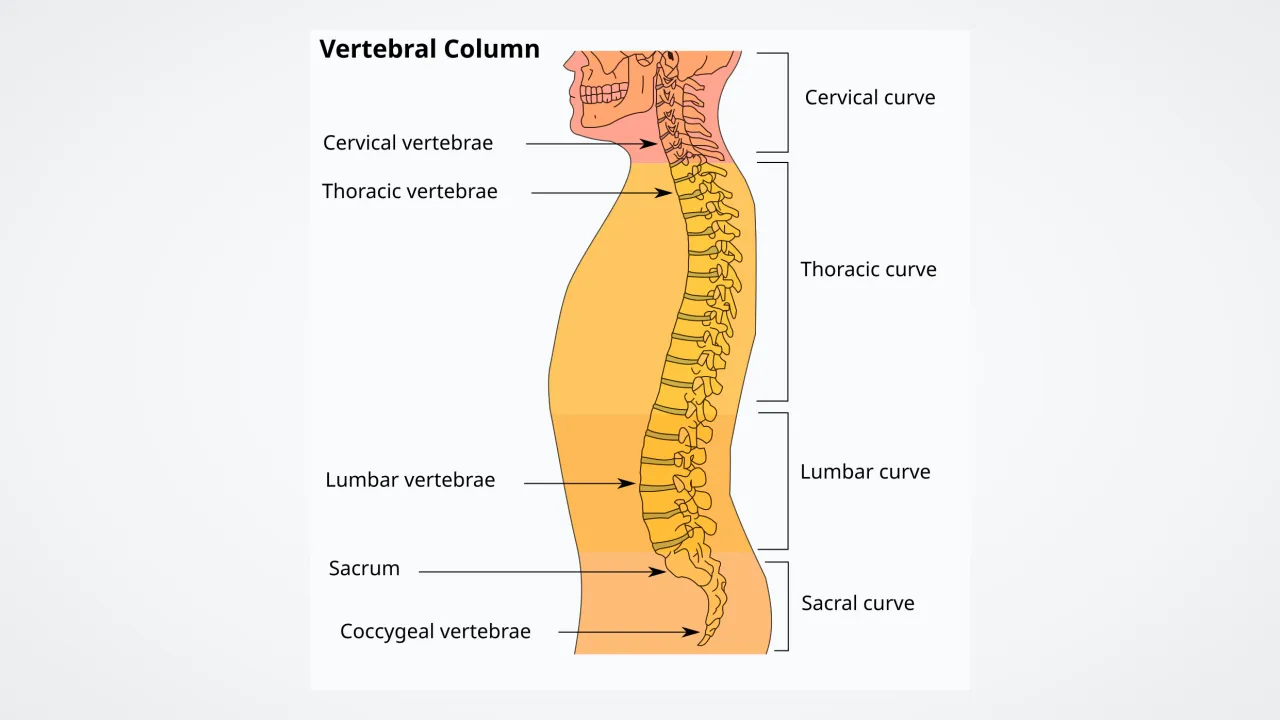
Run your fingers down a classroom skeleton's backbone and meet five distinct neighborhoods! At the top, 7 vertebrae hold up your head and let it nod and turn. Next come 12 thoracic vertebrae anchoring your twelve pairs of ribs. Below those sit 5 thick, sturdy vertebrae in your lower back that carry most of your upper-body weight.
2
Bones That Fuse Together
Where do the other nine vertebrae go? At the bottom of the spine, 5 sacral bones fuse together as you grow up into one strong triangle called the , linking your spine to your hip bones. Beneath that, 4 tiny tailbones fuse into the coccyx—turning 33 childhood bones into 26 adult pieces!
3
Jelly Donuts Between Bones
Each intervertebral disc works like a tough jelly donut: strong outer rings hold a squishy gel center so vertebrae never grind bone against bone.
4
Nerves Branching Out
Through side windows between every pair of vertebrae, thirty-one pairs of spinal nerves branch out from the spinal cord to move your arms, chest, and legs!
1. What clever mealtime trick helps doctors remember the 7 cervical, 12 thoracic, and 5 lumbar vertebrae?
2. Why are the five lumbar vertebrae in your lower back thicker and wider than your neck bones?
🤯 Mind-Blowing Fact • Grade 4
Engineers proved mathematically that a column with your spine's alternating curves can withstand ten times more compression than a completely straight rod of the exact same material!
✨ Word Sparks (Grade 4 Glossary)
Tap 🔊 to hear
Atlas
Topmost neck vertebra cradling the human skull
Axis
Second neck vertebra with a pivot peg
Thoracic
Twelve mid-back vertebrae anchoring the rib cage
🪝
How do the very top two bones of your spine team up so you can nod 'yes' and shake your head 'no'?
1
Atlas and Axis: The Yes-and-No Duo
Right beneath the base of your skull sit two uniquely sculpted cervical vertebrae that work like precision mechanical hinges! Named after the Greek titan who held up the sky, the first vertebra—C1, or the —has no solid block body at all; instead, its bony ring cradles the skull's curved rockers so you can nod 'yes.' Immediately below sits C2, the , sporting an upward tooth-like peg called the dens. The atlas pivots smoothly around that peg whenever you shake your head 'no'!
2
Anatomy of a Typical Vertebra
From C3 down to L5, each movable vertebra combines two main parts: a thick front drum of spongy bone (the vertebral body) for bearing weight, and a rear bony arch enclosing the vertebral foramen. Bony wings—transverse and spinous processes—jut outward as levers where deep back muscles and ligaments attach.
3
Annulus Fibrosus and Nucleus Pulposus
Every intervertebral disc is a marvel of fibrocartilage engineering. Concentric angled layers of tough collagen—the annulus fibrosus, built like radial tire plies—encase a hydrated proteoglycan gel core called the nucleus pulposus that distributes compression evenly in all directions.
4
How Babies Earn Their Curves
Newborns have a single C-shaped spinal curve! Lifting their heads builds the neck curve, and learning to stand and walk sculpts the lower-back lumbar curve—increasing shock resistance tenfold over a straight rod!
1. How do the atlas (C1) and axis (C2) split the job of moving your head?
2. How do babies develop the neck and lower-back curves of an adult S-shaped spine?
🤯 Mind-Blowing Fact • Grade 5
Because adult spinal discs have zero blood vessels inside them, walking, stretching, and sleeping actually pump nutrients in and wastes out like squeezing and releasing a sponge!
✨ Word Sparks (Grade 5 Glossary)
Tap 🔊 to hear
Lordosis
Natural inward curve of neck and lower-back
Notochord
Flexible embryonic rod forming disc gel centers
Lamellae
Angled concentric collagen rings around spinal discs
🪝
How do collagen tire-belts, osmotic gel cores, and four sinusoidal curves turn thirty-three vertebrae into a shock-absorbing suspension bridge for bipedal life?
1
Regional Architecture of the Vertebral Column
Measuring roughly 70 centimeters in adult height, the human vertebral column (columna vertebralis) balances two competing evolutionary demands: rigid axial load transmission for bipedalism and multi-axial flexibility for trunk motion, all while shielding the central nervous system's spinal cord. Its 33 developmental segments organize into 7 cervical (C1–C7), 12 rib-bearing thoracic (T1–T12), 5 massive lumbar (L1–L5), 5 fused sacral (S1–S5 forming the pelvic keystone), and 3 to 5 fused coccygeal vertebrae—vestiges of an ancestral vertebrate tail.
2
Primary Kyphoses and Secondary Lordoses
Viewed sagittally, the column exhibits four alternating curves: two primary posteriorly convex curves (thoracic and sacral kyphoses) retained from fetal development, and two secondary anteriorly convex curves (cervical and lumbar lordoses) acquired as infants lift their heads and toddlers walk upright. According to Euler's column-buckling mechanics (`R = N² + 1`, where `N` equals the number of curves), three movable curves boost axial load capacity tenfold (`3² + 1 = 10`) compared to a straight rod!
3
Hydrostatic Biomechanics of Intervertebral Discs
Accounting for 25 percent of movable spinal length, the 23 intervertebral discs lack direct blood vessels in adulthood, relying on diurnal movement to pump nutrients across cartilaginous endplates! Each disc pairs a central nucleus pulposus—remnant of the embryonic , rich in water-attracting aggrecan proteoglycans—with 15 to 25 concentric of type I collagen (the annulus fibrosus) alternating at 60-degree angles to resist torsion and convert vertical compression into safe radial tension.
4
Spinal Canal, Conus Medullaris, and Cauda Equina
Because the bony column outgrows the neural cord during childhood, the adult spinal cord actually terminates around vertebra L1–L2 at the conus medullaris, trailing a leash of lumbar and sacral nerve roots called the cauda equina ('horse's tail') through cerebrospinal fluid.
5
Ergonomics and Lifelong Spine Care
Core muscle strength, neutral posture when carrying backpacks, and regular physical movement nourish avascular discs and keep facet joints gliding smoothly for decades.