1. Why do recording studios have soft foam shapes on the walls?
2. What tool does a sound recording engineer place in front of a singer or guitar?
🤯 Mind-Blowing Fact • Grade 2
Thomas Edison invented the very first sound recorder—the tin-foil phonograph—in 1877, and the first test song he recorded was 'Mary Had a Little Lamb'!
✨ Word Sparks (Grade 2 Glossary)
Tap 🔊 to hear
fader
Sliding switch controlling a track's loudness
soundproof
Built to block outside noise completely
track
One single recorded layer of sound
🪝
Why do singers wear big padded headphones while recording a new song in a studio?
1
Inside the Control Room
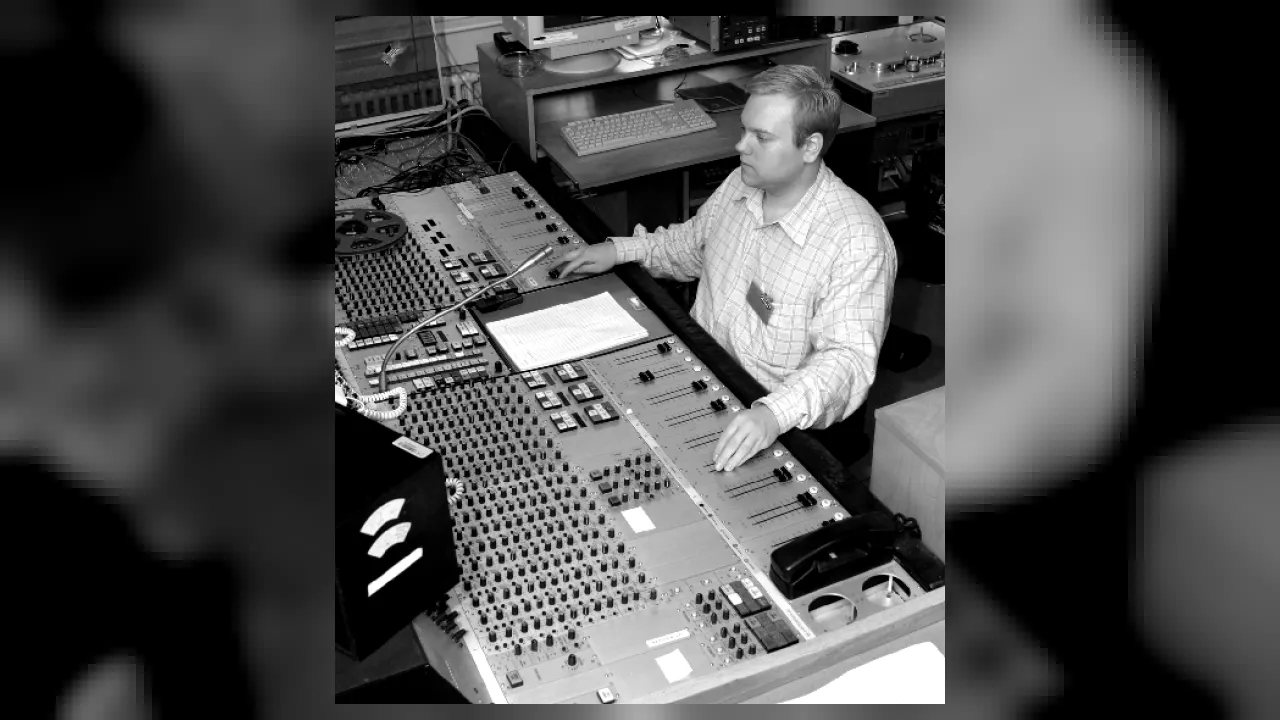
Imagine sitting in front of a giant mixing board covered with dozens of sliding controls called ! Through a thick window, the sound engineer waves thumbs-up to a violinist ready to record.
2
Recording One Track at a Time
Musicians wear closed headphones so they can hear the beat without that music leaking into their sensitive microphone! Recording drums, bass, piano, and vocals on separate lets the engineer adjust each part cleanly.
3
Fun Movie Sound Effects
Some engineers work on 'Foley' stages for movies and cartoons, flapping umbrellas to sound like dragon wings or snapping celery for dinosaur crunches!
1. Why do singers wear closed headphones in a recording booth?
2. What were the very first words Thomas Edison recorded on his 1877 phonograph?
🤯 Mind-Blowing Fact • Grade 3
That fuzzy gray cover over outdoor TV and movie microphones is nicknamed a 'windjammer' or 'fuzzy cat' because its soft fibers break up rushing wind noise!
✨ Word Sparks (Grade 3 Glossary)
Tap 🔊 to hear
vibration
Rapid back-and-forth movement creating sound waves
diaphragm
Thin membrane inside microphones sensing air waves
stereo
Sound spread naturally between left and right
🪝
How do invisible air vibrations turn into digital waveforms on a computer screen?
1
The Science of Sound Waves
Pluck a guitar string and watch it wiggle! Vibrating strings push tiny air molecules back and forth in waves. Inside a microphone, a thin plate called a vibrates in sync and turns those air waves into tiny electrical signals.
2
Tracking, Mixing, and Mastering
Recording a music album happens in three steps. First is 'tracking,' capturing clean performances with smart microphone placement. Second is 'mixing,' balancing volume, left-to-right space, and gentle room echo. Third is 'mastering,' polishing the final song for streaming and radio!
3
Boom Poles on Movie Sets
Location sound engineers work outdoors on windy film sets, holding fuzzy wind-shielded microphones overhead on long extendable 'boom poles' just inches above the camera's top frame.
4
Live Concert Sound
At basketball arenas and outdoor summer festivals, live audio engineers balance towering speaker arrays so music fans in the very back row hear every lyric clearly without painful feedback squeals.
1. What tiny part inside a microphone vibrates when sound waves hit it?
2. Why do outdoor sound engineers put fuzzy covers over boom microphones?
🤯 Mind-Blowing Fact • Grade 4
Guitarist and inventor Les Paul built some of the earliest multitrack tape machines in his garage in the late 1940s, allowing one musician to harmonize with themselves eight times on a single record!
✨ Word Sparks (Grade 4 Glossary)
Tap 🔊 to hear
acoustics
Science of how sound travels through spaces
Hertz
Unit measuring sound wave vibrations per second
decibel
Unit measuring how loud or quiet sound is
🪝
How do sound engineers sculpt low bass rumbles and high flute notes so instruments never clash?
1
Sculpting Frequencies Measured in Hertz
Close your eyes while listening to a movie soundtrack or your favorite band: how can you hear the deep bass guitar, crisp snare drum, acoustic piano, and lead singer all at once without muddy noise? Sound recording engineers master —the physics of sound waves—measuring musical pitch in vibrations per second, a scientific unit called (Hz).
2
Equalizers and Compressors
Inside a computer-based Digital Audio Workstation (DAW), engineers rely on two essential sculpting tools. An equalizer (EQ) boosts or trims specific frequency zones—carving warm space around 80 to 100 Hz for bass drums while brightening vocal clarity near 3,000 Hz. A dynamic compressor automatically softens sudden loud shouts while lifting quiet whispers so listeners never have to lunge for the volume dial.
3
Designing Rooms Without Echoes
Walk inside a professional recording studio and you will notice almost zero parallel concrete walls! Instead, angled wooden diffuser panels scatter sound waves smoothly across the room, while thick mineral-wool bass traps tucked into corners soak up booming low-frequency echoes.
4
Protecting Lifelong Hearing Health
Because healthy ears are every audio engineer's most valuable scientific instrument, smart professionals monitor studio speaker loudness carefully in (dB) and rest their ears regularly during long mixing sessions.
1. What unit measures how many times per second a sound wave vibrates (its pitch)?
2. How does an audio 'compressor' help a vocal recording?
🤯 Mind-Blowing Fact • Grade 5
Inside the world's quietest 'anechoic' acoustic test chambers—lined with deep fiberglass wedges—background sound drops below minus 20 decibels, quiet enough to hear air molecules bumping together!
✨ Word Sparks (Grade 5 Glossary)
Tap 🔊 to hear
transducer
Device converting energy between sound and electricity
cardioid
Heart-shaped microphone zone hearing mostly in front
reverberation
Warm lingering sound reflections inside large halls
🪝
How does analog-to-digital sampling turn continuous air pressure waves into lossless binary code and 3D spatial audio?
1
Transducers and Polar Pickup Patterns
Every great studio recording begins as invisible air-pressure waves long before reaching a computer chip. Sound recording engineers choose specific microphone —rugged moving-coil dynamics for loud snare drums, ultra-sensitive gold-sputtered condensers for vocals, or figure-eight aluminum ribbons for warm brass—based on acoustic physics and directional 'polar patterns.' A heart-shaped mic isolates the singer in front while rejecting drum spill behind it, whereas omnidirectional mics capture the natural acoustic bloom of an entire Virginia symphony hall.
2
Nyquist Sampling Theorem and Bit Depth
Converting continuous analog electrical voltage into binary numbers without losing shimmering cymbal overtones relies on the Nyquist-Shannon sampling theorem, which proves a digital converter must sample at least twice as fast as the highest audible human frequency (20,000 Hz). Professional studios record at 48,000 or 96,000 samples per second (48–96 kHz) with 24-bit resolution, capturing more than 16.7 million vertical amplitude steps and 144 decibels of noise-free dynamic range.
3
Phase Coherence and Spatial Immersive Mixing
When positioning a dozen microphones around a grand piano or jazz ensemble, engineers measure physical distances down to the inch using the '3-to-1 rule' so arriving sound waves reinforce rather than cancel one another out of phase. Modern object-based 3D formats like Dolby Atmos allow re-recording mixers to pan up to 128 independent audio objects—raindrops, helicopters, or string sections—across a 360-degree overhead speaker dome.
4
Archival Preservation and Sonic History
Inside the Library of Congress Packard Campus for Audio-Visual Conservation in Culpeper, Virginia, specialized preservation engineers use optical laser turntables to digitize fragile nineteenth-century wax cylinders, folk-song field tapes, and historic presidential radio broadcasts so America's recorded memory never fades.
5
Bridging Physics and Musical Empathy
Successful recording engineers blend electrical engineering, architectural acoustics, ear-training music theory, and calm studio encouragement—creating a relaxed creative space where musicians perform at their very best.