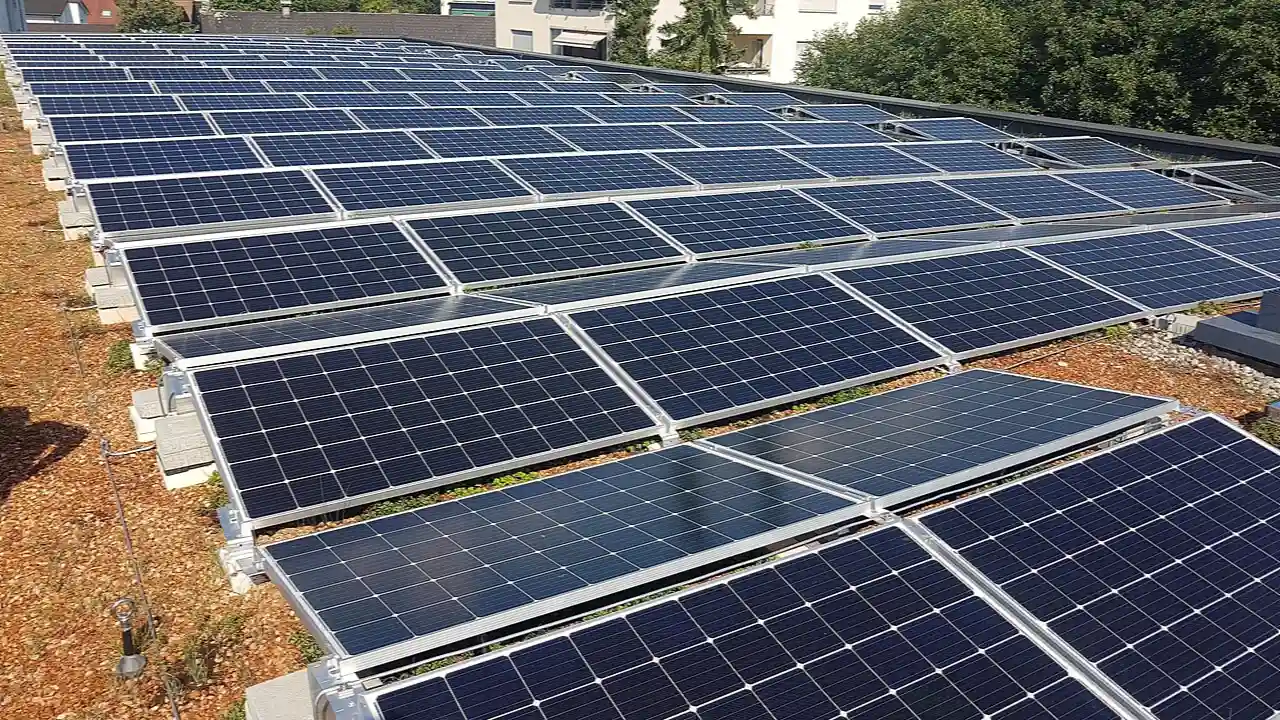
1. What natural source gives solar panels their energy?
2. How much noise does a rooftop solar panel make while creating electricity?
🤯 Mind-Blowing Fact • Grade 2
Space satellites and the International Space Station get 100 percent of their electricity from giant unfolding wings of solar panels!
✨ Word Sparks (Grade 2 Glossary)
Tap 🔊 to hear
compass
a tool showing north, south, east, and west
tempered glass
extra-tough safety glass built to resist hail
battery
a device that stores electricity for later use
🪝
Why do solar installers check tree shadows and compass directions before touching a single wrench?
1
Chasing the Best Sunshine
Before climbing a ladder, a solar installer studies the sky like a sun detective! In North America, roofs facing south catch the longest hours of bright sunshine from morning until late afternoon.
2
Racks, Panels, and Waterproof Seals
Wearing fall-safety harnesses, installers bolt sturdy aluminum rails onto roof rafters and seal every screw hole tightly so rain never leaks inside. Next, the crew lifts tempered-glass solar panels—tough enough to survive hailstones—and clicks the weatherproof wires together.
3
Saving Sunshine in Batteries
Many teams also connect home wall batteries so stored daytime sunshine keeps lamps glowing long after sunset!
1. In North America, which direction do installers usually face rooftop solar panels to catch the most sun?
2. How can a solar-powered home still run lights at night after the sun goes down?
🤯 Mind-Blowing Fact • Grade 3
On sunny afternoons when rooftop panels make extra electricity, smart electric meters can actually count backward and share surplus clean power with neighbors down the street!
✨ Word Sparks (Grade 3 Glossary)
Tap 🔊 to hear
silicon
crystal element from sand used in solar cells
inverter
a device changing DC solar electricity into AC
canopy
an overhead roof structure shading an outdoor area
🪝
What does a box called an "inverter" do on the wall of every solar-powered house or school?
1
Sand Turned Into Silicon
Believe it or not, the shining wafers inside a solar panel start out as ordinary quartz sand! Factories purify crystals that knock tiny electrons loose whenever light hits them, and a solar installer turns groups of those panels into a working power station.
2
Speaking the House's Language
Solar panels produce Direct Current (DC) electricity—the same steady flow inside a flashlight battery. Refrigerators and classroom smartboards, however, run on Alternating Current (AC). Installers mount a smart box called an to translate DC solar power into household AC power!
3
Drones and Shade Mapping
Modern crews fly small drones over roofs to measure exact angles and spot chimney shadows before building custom 3D layout maps.
4
Cool Parking Canopies
Installers also build solar canopies over school parking lots—shading cars from summer heat while powering classrooms inside!
1. Why does every home solar system need an inverter?
2. What abundant natural material provides the silicon used inside most solar cells?
🤯 Mind-Blowing Fact • Grade 4
Albert Einstein won his famous 1921 Nobel Prize in Physics not for relativity, but for explaining the photoelectric effect—the exact science behind how light knocks electrons loose in solar cells!
✨ Word Sparks (Grade 4 Glossary)
Tap 🔊 to hear
photovoltaic
turning light photons directly into electric voltage
agrivoltaics
sharing land for both farming and solar panels
conduit
protective metal or plastic tubing shielding electrical wires
🪝
How can sheep graze happily underneath a Virginia solar farm while panels overhead tilt like sunflowers?
1
Rooftops to Sunflower Trackers
Drive across rural counties in Virginia or the Southwest and you may spot rows of sleek (PV) panels slowly tilting from east at dawn to west at dusk—tracking the sun just like giant mechanical sunflowers! Meanwhile, flocks of sheep graze peacefully in the cool shade beneath the racks. Assembling both utility-scale solar fields and neighborhood roof arrays is the hands-on craft of the solar installer.
2
The Photovoltaic Effect
Discovered by nineteen-year-old French physicist Edmond Becquerel in 1839 and later explained by Albert Einstein, the effect occurs when light particles—photons—strike two specially treated silicon layers, nudging electrons across a circuit without burning fuel or boiling water.
3
Structural Math and Electrical Code
Every installation combines carpentry, roofing geometry, and strict National Electrical Code safety. Installers calculate wind-uplift forces and winter snow loads, bolt anodized aluminum flashing directly into structural rafters, run weatherproof metal , and wire rapid-shutdown switches so firefighters can de-energize a roof in one click.
4
Agrivoltaics and Resilient Microgrids
Pairing solar arrays with pollinator wildflowers, grazing sheep, or shade-loving crops—called —lets farmland harvest both food and clean watts at the exact same time!
1. Why are rapid-shutdown switches required by safety codes on rooftop solar installations?
2. What is agrivoltaics?
🤯 Mind-Blowing Fact • Grade 5
Launched in March 1958 as the first solar-powered spacecraft, the grapefruit-sized Vanguard I satellite transmitted signals for over six years and remains the oldest human-made object still orbiting Earth today!
✨ Word Sparks (Grade 5 Glossary)
Tap 🔊 to hear
p-n junction
paired silicon layers creating one-way electric flow
bifacial
double-sided solar panels capturing light front and back
microgrid
a local solar-and-battery network able to run independently
🪝
Why did solar electricity plunge over 99 percent in price from 1954 Bell Labs satellites to your school's roof today?
1
From Vanguard Satellite to Everyday Roofs
When Bell Laboratories unveiled the first practical silicon solar cell in 1954, producing a single watt of solar capacity cost nearly $300—so expensive that early panels were reserved almost exclusively for space missions like the 1958 Vanguard I satellite! Over seven decades, manufacturing breakthroughs and semiconductor scaling drove module prices down by more than 99 percent, turning solar photovoltaics into some of the most affordable electricity in history and empowering the modern solar installer.
2
P-N Junctions, String Sizing, and Microinverters
Inside each monocrystalline silicon cell, doping trace amounts of phosphorus (negative n-type) atop boron-doped silicon (positive p-type) creates an internal electric field called a . NABCEP-certified solar installers engineer series and parallel wiring strings carefully: because cold winter mornings actually boost open-circuit silicon voltage, technicians calculate record-low local temperatures so string voltage never exceeds inverter limits, or fit module-level microinverters so one shaded panel never drags down its neighbors.
3
Bifacial Modules and Lithium-Iron-Phosphate Storage
Modern commercial and utility crews increasingly mount panels—double-sided glass modules that harvest direct skyward sunlight on top plus reflected albedo light bouncing off white roofs or snow underneath—paired with fire-safe lithium-iron-phosphate (LFP) battery that keep community clinics and emergency shelters running during grid blackouts.
4
Tilt Geometry Across Seasons
To maximize annual kilowatt-hours, installers set fixed array tilt angles near a town's geographic latitude—around 37 to 38 degrees across central Virginia—balancing high June sun arcs against low December horizons.
5
Craftspeople of the Clean Transition
Uniting rooftop athleticism, structural engineering, and National Electrical Code mastery, solar installers transform ordinary roofs and fields into quiet, decentralized clean-power stations.