1. When do the smooth muscles inside your stomach and body tubes work?
2. What tiny skin reaction is caused by miniature smooth muscles pulling on your hairs?
🤯 Mind-Blowing Fact • Grade 2
Smooth muscle squeezes in your throat are strong enough that you could swallow a sip of water while doing a handstand—though it is much safer standing upright!
✨ Word Sparks (Grade 2 Glossary)
Tap 🔊 to hear
Involuntary
Working automatically without you choosing or thinking
Intestines
Long winding tubes absorbing nutrients from food
Blood Vessel
Flexible tube carrying blood through your body
🪝
Why is this muscle called 'smooth,' and how does it squeeze food along like toothpaste from a tube?
1
No Stripes Under the Lens
Remember how skeletal muscles have neat tiger stripes under a microscope? When scientists zoomed in on the muscles lining your stomach and , they saw smooth, tapered cells with zero stripes—so they named it smooth muscle!
2
Waves of Gentle Squeezes
Smooth muscles wrap around hollow tubes inside your body. After you swallow a bite of apple, rhythmic waves of smooth muscle squeezes push that bite down into your stomach and all through your winding .
3
Involuntary Champions
Because you cannot boss them around by wishing, doctors call smooth muscles —they steer , airways, and digestion automatically!
1. Why did scientists give 'smooth muscle' its name?
2. Where are sheets of smooth muscle mostly found inside your body?
🤯 Mind-Blowing Fact • Grade 3
Tiny smooth muscles inside your colored iris adjust your pupil width in less than half a second whenever you step from a dark movie theater into bright sunshine!
✨ Word Sparks (Grade 3 Glossary)
Tap 🔊 to hear
Peristalsis
Wave-like muscle squeezes moving food along tubes
Artery
Muscular blood vessel carrying blood from heart
Iris
Colored smooth-muscle ring controlling your eye pupil
🪝
How does smooth muscle direct traffic inside 60,000 miles of blood vessels without ever getting tired?
1
Slow, Steady, and Tireless
Try squeezing a rubber ball in your fist for three minutes—your forearm skeletal muscles start aching fast! Smooth muscle is engineered completely differently. Its football-shaped cells contract much more slowly, yet they can hold a steady squeeze for hours on end using just a tiny fraction of the energy.
2
Peristalsis: The Wave Machine
Along your digestive tract, two layers of smooth muscle team up: an inner ring squeezes the tube narrower while an outer lengthwise layer shortens it forward. Together they create , a traveling wave that moves meals nearly thirty feet from throat to finish.
3
Traffic Cops for Blood and Air
Rings of smooth muscle inside arteries widen during soccer games to send extra blood to your legs, or narrow in winter air to keep heat near your core. Similar rings adjust the width of breathing tubes inside your lungs.
4
Camera Lenses in Your Eyes
Inside each eye, delicate smooth muscles reshape your lens to focus from a book in your lap to clouds miles away!
1. What is the scientific name for the traveling wave of smooth muscle squeezes that moves food through your digestive tract?
2. How do artery smooth muscles help your leg muscles when you start running?
🤯 Mind-Blowing Fact • Grade 4
Thanks to its diagonal protein net, smooth muscle can hold steady tension using 300 times less energy than your arm or leg muscles!
✨ Word Sparks (Grade 4 Glossary)
Tap 🔊 to hear
Autonomic Nervous System
Brain network running automatic internal body jobs
Latch State
Smooth muscle's ability to hold tension cheaply
Gap Junctions
Tiny cell tunnels sharing electrical wave signals
🪝
How can smooth muscle stretch to eight times its resting length and 'latch' tight while burning almost zero fuel?
1
Crisscrossing Nets Instead of Stripes
Why doesn't smooth muscle show stripes under a microscope? Instead of lining up actin and myosin in rigid straight rows, each spindle-shaped, single-nucleus smooth muscle cell weaves its contractile filaments in diagonal crisscrossing nets anchored to 'dense bodies.' When myosin pulls, the entire cell twists and corkscrews shorter like a wrung-out sponge, allowing it to contract much farther than skeletal muscle ever could!
2
The Energy-Saving 'Latch State'
Artery walls and internal sphincters (ring valves) must maintain steady pressure every minute of your life. Smooth muscle achieves this feat with a biochemical superpower called the '': once contracted, myosin heads lock onto actin bridges and hold full tension while burning up to 300 times less ATP energy than skeletal muscle!
3
Two Control Styles: Group Waves vs. Solo Precision
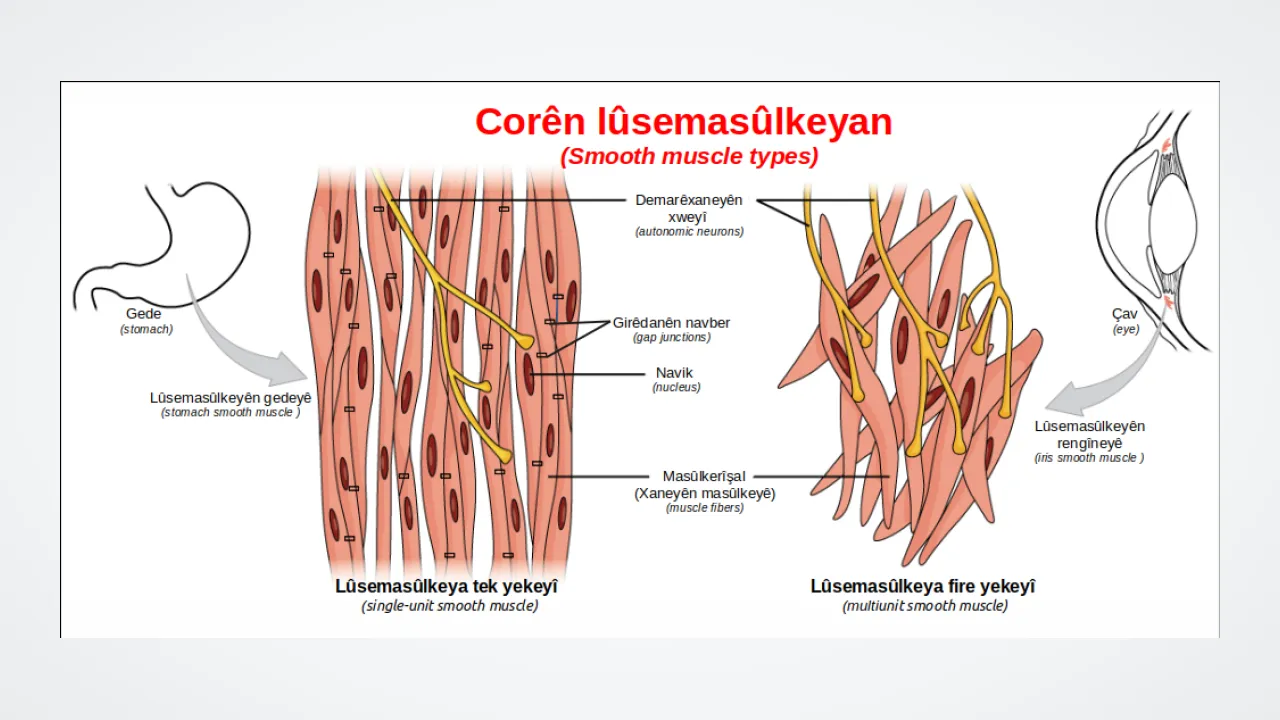
Your runs two flavors of smooth muscle. In 'single-unit' visceral smooth muscle (like intestines and the bladder), electrical link millions of cells so one ripple spreads seamlessly across the whole sheet. In 'multi-unit' smooth muscle (like your eye's ciliary focus muscle and arrector pili goosebump muscles), nerves wire individual cells separately for pinpoint control.
4
Super-Stretch Champions
Smooth muscle inside hollow organs like the stomach and urinary bladder smoothly relaxes as they fill—expanding dramatically without spiking internal pressure until it is time to empty.
1. Why can a smooth muscle cell shorten by a much greater percentage than a striped skeletal muscle fiber?
2. What special energy-saving trick lets artery smooth muscles maintain healthy blood pressure 24/7 without exhausting you?
🤯 Mind-Blowing Fact • Grade 5
The 1998 Nobel Prize in Medicine honored the surprising discovery that blood vessel linings puff out a tiny dissolved gas—nitric oxide—to tell smooth muscles to relax and widen arteries!
✨ Word Sparks (Grade 5 Glossary)
Tap 🔊 to hear
Calmodulin
Calcium-sensing messenger protein triggering smooth muscle squeeze
Fusiform
Tapered spindle shape wider in the middle
Nitric Oxide
Natural signaling gas telling artery muscles to relax
🪝
What molecular switch replaces troponin inside smooth muscle, and how did vascular smooth muscle research earn a Nobel Prize?
1
Cytoskeletal Architecture of Visceral Myocytes
Lining the walls of arteries, veins, bronchial airways, the gastrointestinal tract, urinary passages, and ocular irises, non-striated smooth muscle governs involuntary homeostasis across nearly every organ system. Individual myocytes are (spindle-shaped) cells measuring twenty to two hundred micrometers long with a single central nucleus, devoid of sarcomeric Z-discs; instead, cytoplasmic dense bodies and membrane plaques anchor obliquely oriented actin and myosin filaments alongside intermediate desmin networks.
2
Calmodulin-Driven Activation and the Latch Bridge
Unlike skeletal and cardiac muscle—which use troponin switches on thin filaments—smooth muscle lacks troponin altogether. When autonomic neurotransmitters, hormones, or mechanical stretch admit calcium ions through membrane caveolae, calcium binds a messenger protein called . This complex activates myosin light-chain kinase (MLCK), phosphorylating myosin heads to initiate cross-bridge cycling; subsequent dephosphorylation slows detachment into the ultra-economical 'latch state' that sustains tonic pressure at 1/300th the ATP expenditure.
3
Unitary Syncytia Versus Multi-Unit Precision
Physiologists divide smooth muscle into unitary (visceral) sheets—where connexin gap junctions propagate slow-wave pacemaker potentials instituted by interstitial cells of Cajal to drive gut peristalsis—and multi-unit bundles in the iris sphincter, ciliary body, and large airways, where discrete varicosities from sympathetic and parasympathetic nerves fine-tune pupil aperture and lens accommodation.
4
Stress-Relaxation Plasticity and Tissue Repair
Smooth muscle exhibits remarkable stress-relaxation, allowing hollow viscera to expand severalfold without sharp pressure spikes, and retains lifelong capacity to divide and synthesize elastin and collagen to repair blood vessel walls.
5
Nitric Oxide and the 1998 Nobel Prize
In 1998, pharmacologists Robert Furchgott, Louis Ignarro, and Ferid Murad shared the Nobel Prize in Physiology or Medicine for discovering that endothelial cells release a tiny gas molecule——to relax vascular smooth muscle and regulate human blood pressure.