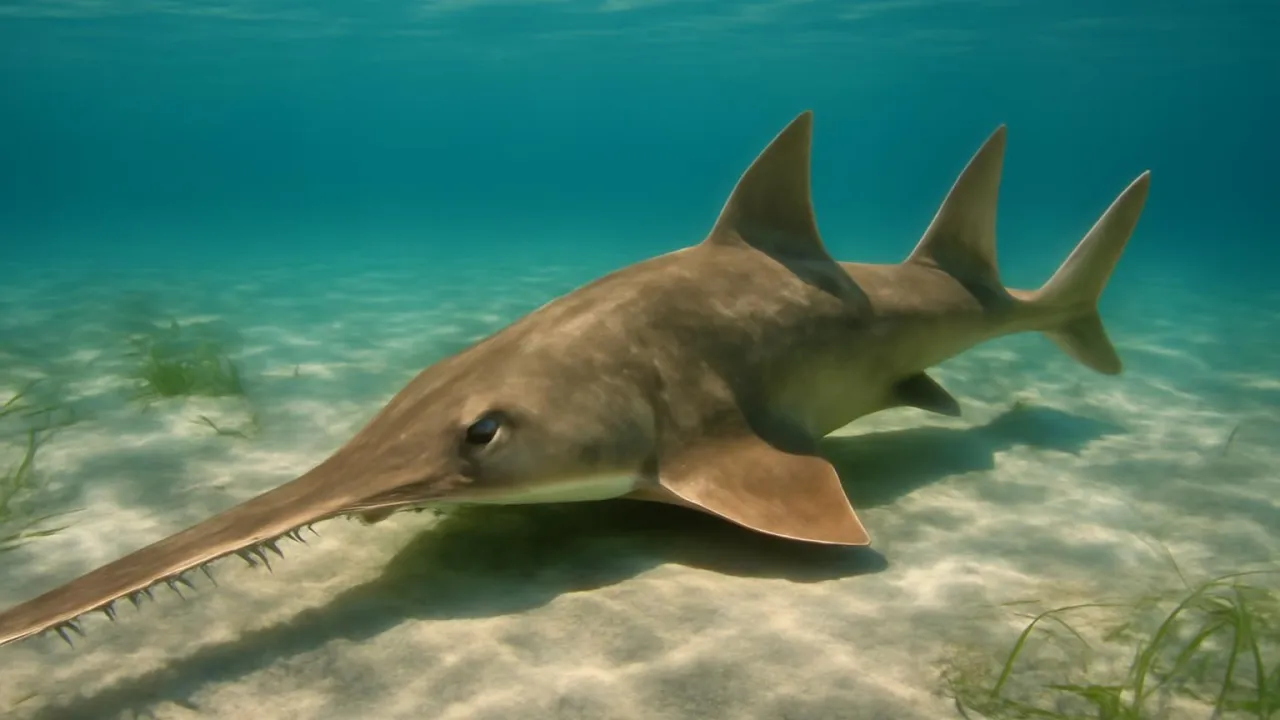
1. What does the smalltooth sawfish’s nose look like?
2. Where does the sawfish like to live?
🤯 Mind-Blowing Fact • Grade 2
The sawfish’s nose can have up to 20 sharp teeth on each side!
✨ Word Sparks (Grade 2 Glossary)
Tap 🔊 to hear
predator
An animal that hunts other animals for food.
coastal
Near the edge of the land by the sea.
stun
To hit hard and make someone unable to move.
🪝
Have you ever seen a fish with a nose shaped like a saw blade?
1
The Amazing Saw Nose
The smalltooth sawfish has a long nose that looks like a saw blade. It uses this nose to find and catch food. The nose has sharp teeth on the sides. It can swing its nose to hit small fish and crabs.
2
Where It Lives and Grows
This fish lives in warm waters and shallow bays. It hides in sandy or muddy bottoms to stay safe. Baby sawfish grow in these calm waters before swimming to deeper areas. They use the shallow water to avoid .
3
What It Eats and How
The smalltooth sawfish eats fish, crabs, and shrimp. It uses its saw nose to find food hidden in the sand. It can also hit prey with its nose to them. This helps the sawfish catch food easily.
The smalltooth sawfish’s saw nose can have up to 14 to 25 teeth on each side!
✨ Word Sparks (Grade 3 Glossary)
Tap 🔊 to hear
camouflage
Colors or shapes that help hide an animal.
prey
An animal that is hunted and eaten by another.
estuary
Where a river meets the sea with mixed water.
🪝
Did you know the smalltooth sawfish uses its saw nose as a special tool?
1
A Nose Like a Saw
The smalltooth sawfish has a long, flat nose edged with sharp teeth. This saw-like nose helps it find hidden in sand or mud. It can swing the nose side to side to stun fish or crustaceans nearby. This adaptation helps the sawfish catch food more easily.
2
Where It Lives and Hides
This sawfish lives in warm coastal waters and estuaries where rivers meet the sea. It often hides on sandy or muddy bottoms using to blend in. Camouflage helps protect it from predators while it waits for . The shallow water also provides safety for young sawfish.
3
What It Eats and How
The smalltooth sawfish eats fish, crabs, shrimp, and mollusks. It uses its saw nose to detect movements of buried in sand. When it finds food, it hits the prey with its nose to stun it before eating. This hunting method makes the sawfish a skilled predator.
4
Life Cycle and Growth
Baby sawfish grow in shallow nursery areas where they are safer from predators. As they grow, they move to deeper coastal waters. The sawfish can live for many years, growing up to 20 feet long. Their long life helps keep their population stable if protected.
1. How does camouflage help the smalltooth sawfish?
2. What does the sawfish do to stun its prey?
🤯 Mind-Blowing Fact • Grade 4
Smalltooth sawfish populations have declined by over 90% due to human impact!
✨ Word Sparks (Grade 4 Glossary)
Tap 🔊 to hear
symbiotic
A close relationship where both animals benefit.
endangered
At risk of disappearing forever from Earth.
nursery
A safe place where baby animals grow.
🪝
How does the smalltooth sawfish’s saw nose help it survive in coastal ecosystems?
1
Saw Nose Adaptation and Hunting
The smalltooth sawfish’s saw nose is a unique adaptation that helps it locate and capture prey hidden in sandy or muddy bottoms. By swinging its saw side to side, the fish can stun small fish and crustaceans, making them easier to catch. This hunting method increases its chances of survival in competitive coastal habitats. The saw’s sharp teeth also serve as a defense against predators.
2
Role in the Ecosystem
As a predator, the smalltooth sawfish plays an important role in controlling fish and crustacean populations. Its presence helps maintain a balanced food web in coastal and estuarine ecosystems. Moreover, the sawfish benefits from relationships with smaller fish that clean parasites from its skin. Human activities like fishing and habitat loss have negatively impacted its populations, making conservation efforts critical.
3
Geographic Distribution and Habitat
The smalltooth sawfish is found mainly in the warm coastal waters of the western Atlantic Ocean, from the southeastern United States to northern South America. It prefers shallow bays, estuaries, and river mouths where it can find abundant food and areas. These habitats provide shelter and protection for young sawfish, which are vulnerable to predators. Habitat degradation threatens these important areas.
4
Life Cycle and Conservation
Smalltooth sawfish have a slow growth rate and long lifespan, which makes population recovery slow. Females give birth to live young in shallow habitats, where juveniles grow safely. Because of overfishing and habitat loss, the smalltooth sawfish is listed as . Conservation programs focus on protecting habitats and limiting fishing to help this species survive.
1. What role does the smalltooth sawfish play in its ecosystem?
2. Why is the smalltooth sawfish endangered?
🤯 Mind-Blowing Fact • Grade 5
The smalltooth sawfish’s saw nose contains hundreds of electroreceptors to detect hidden prey!
✨ Word Sparks (Grade 5 Glossary)
Tap 🔊 to hear
rostrum
The long nose or snout of some fish.
ampullae of Lorenzini
Special sensors that detect electric signals underwater.
bycatch
Animals caught by mistake in fishing nets.
🪝
What makes the smalltooth sawfish’s saw nose a remarkable evolutionary adaptation in the family Pristidae?
1
Taxonomy and Scientific Classification
The smalltooth sawfish, scientifically named Pristis pectinata, belongs to the family Pristidae within the class Chondrichthyes. This family is characterized by elongated edged with sharp teeth, which are used for sensory detection and hunting. The species is one of five extant sawfish species worldwide, distinguished by the number and arrangement of teeth on its saw-like nose.
2
Physiological Mechanics of the Saw Nose
The sawfish’s contains electroreceptors called , which detect electrical signals from prey buried in sediment. Its saw-like nose has 14 to 25 teeth on each side, which are modified dermal denticles. The sawfish uses lateral swipes of its rostrum to stun or injure prey, facilitating capture. This specialized structure also aids in navigation and environmental sensing.
3
Habitat, Behavior, and Conservation Status
Smalltooth sawfish inhabit warm, shallow coastal waters, estuaries, and river mouths from the southeastern United States to northern South America. Juveniles utilize nursery habitats in shallow waters to avoid predators. Due to overfishing, habitat degradation, and , the species is classified as endangered by the IUCN. Conservation efforts include habitat protection, fishing regulations, and public education.
4
Ecological Role and Human Impact
As an apex predator, the smalltooth sawfish regulates prey populations such as fish and crustaceans, maintaining ecosystem balance. Its decline disrupts food webs and affects biodiversity. Human activities like coastal development and fishing nets increase mortality rates. Sustainable management and habitat restoration are essential to prevent extinction and preserve marine biodiversity.
5
Quantitative Comparisons and Interesting Facts
The smalltooth sawfish can reach lengths up to 20 feet (6 meters) and weigh over 500 pounds (227 kilograms). Its can measure up to 7 feet (2 meters) long, with teeth spaced evenly along each side. Sawfish can swim at speeds around 5 miles per hour (8 kilometers per hour) while hunting. Their slow reproductive rate and long lifespan require careful conservation planning.