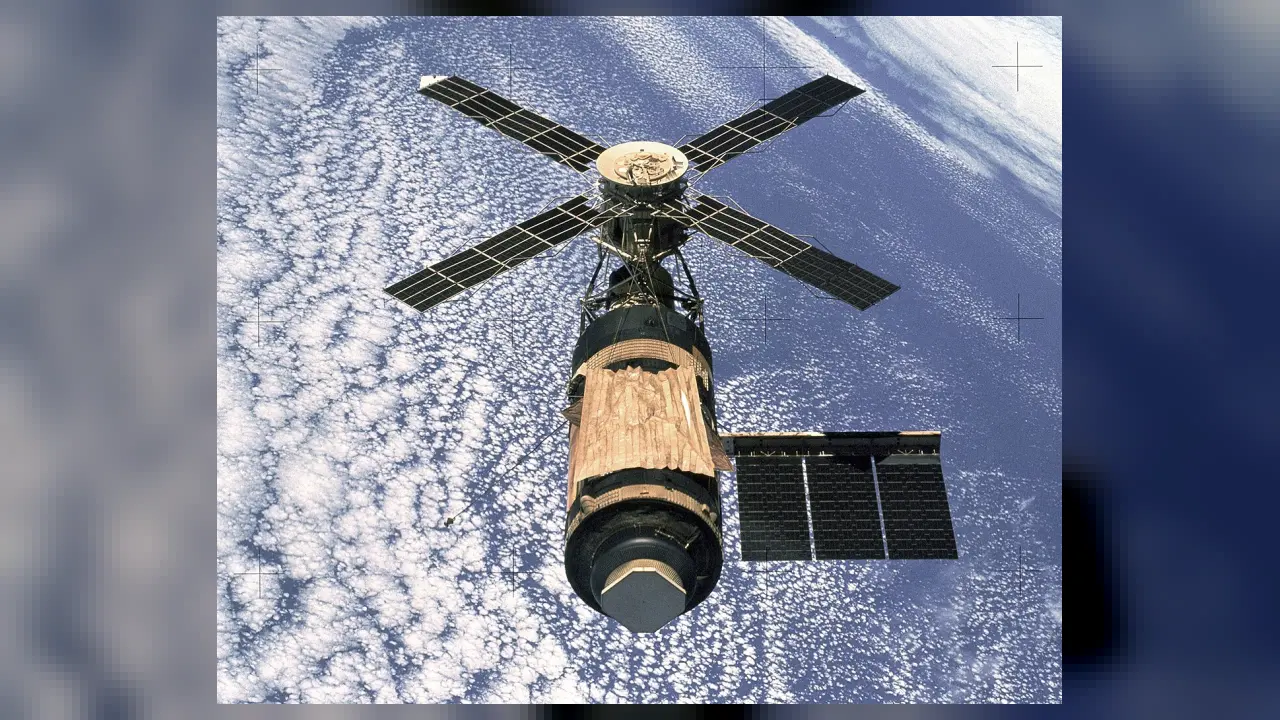
1. How did astronauts cool down Skylab after its heat shield ripped off during launch?
2. What leftover Apollo hardware did engineers turn into Skylab's roomy two-story home?
🤯 Mind-Blowing Fact • Grade 2
Skylab was so cavernous inside that astronauts played floating gymnastics and ran full circles around its ring of storage lockers like hamsters in a wheel!
✨ Word Sparks (Grade 2 Glossary)
Tap 🔊 to hear
windmill
Four crossed solar wings turning to catch sunlight
salvage
To rescue and repair something damaged
eruption
Sudden burst of hot gas from the Sun
🪝
How did a pair of long garden-style cable cutters save an entire seventy-seven-ton space station?
1
Trouble Sixty-Three Seconds Up
When the last Saturn V rocket roared skyward on May 14, 1973, rushing air tore away Skylab's sun shield and left solar wing! Worse yet, a metal scrap pinned the right solar wing shut, leaving the baking station almost powerless.
2
Parasol and Cable Cutters
Engineers worked around the clock for ten days. Commander Pete Conrad's crew pushed a folded gold sunshade out a small hatch to cool the cabin, then spacewalked outside with long-handled cutters to snip the metal strap—popping the jammed solar wing wide open!
3
Showers and Solar Telescopes
Three crews lived aboard for up to eighty-four days, taking curtain-wrapped space showers and photographing giant on the Sun!
1. Why couldn't Skylab's remaining big side solar wing open by itself at first?
2. What shaped array of four solar panels sat on top of Skylab's Sun telescope?
🤯 Mind-Blowing Fact • Grade 3
When pieces of Skylab fell safely across remote Western Australia in 1979, a small town playfully sent NASA a $400 ticket for littering—and a teenager found titanium tanks now displayed in their local museum!
✨ Word Sparks (Grade 3 Glossary)
Tap 🔊 to hear
wardroom
Shared dining and lounge room for a crew
coronal hole
Darker cooler region on the Sun streaming fast wind
atmosphere
Blanket of gases surrounding a planet
🪝
What happens when high school students design science experiments for astronauts living 270 miles above Earth?
1
Clever 'Dry Workshop' Design
Early NASA sketches imagined launching a rocket stage full of fuel and letting astronauts build walls inside the empty tank in orbit! Instead, engineers wisely outfitted an unused Saturn V third stage on the ground as a 'dry workshop'—creating a twenty-two-foot-wide, two-story home with a dining table, window, exercise bike, and collapsible shower.
2
Mr. Fix-It in Orbit
After launch vibrations ripped off its meteoroid shield, cabin heat hit 126 degrees Fahrenheit, threatening to spoil food and film. Skylab 2's orange-gold parasol and Skylab 3's twin-pole sunshade proved human crews can repair broken spacecraft right in orbit!
3
Student Spiders and Solar Storms
Massachusetts high schooler Judith Miles suggested sending garden spiders Arabella and Anita to test web-building without gravity! Meanwhile, eight solar telescopes caught and solar flares.
4
Fiery Return Over Australia
Strong solar storms puffed up Earth's upper sooner than expected, pulling uncrewed Skylab down over the Indian Ocean and Western Australia in July 1979.
1. Who came up with the famous Skylab experiment testing whether spiders could spin webs in weightlessness?
2. Why did Skylab fall back into Earth's atmosphere earlier than engineers originally predicted?
🤯 Mind-Blowing Fact • Grade 4
Astronauts wore special shoes with triangular metal cleats on the soles that clicked and locked into Skylab's open triangle-grid aluminum floors so they could stand still to eat or brush their teeth!
✨ Word Sparks (Grade 4 Glossary)
Tap 🔊 to hear
micrometeoroid
Sand-sized space dust grain zipping faster than bullets
ergonomics
Designing workspaces and schedules to fit human comfort
jetpack
Wearable thruster backpack steering an astronaut in weightlessness
🪝
Why did living inside a repurposed Moon-rocket tank give 1970s astronauts wider bedrooms than crews on the International Space Station?
1
Cavernous Volume of an S-IVB Tank
Because Space Shuttle cargo bays and Proton rockets were roughly fourteen feet wide, modern station modules on Mir and the International Space Station feel like long train cars. Skylab rode directly atop a two-stage Saturn V—inheriting the full twenty-two-foot diameter of its S-IVB liquid-hydrogen tank! Grid-metal floors divided 10,000 cubic feet into a lower living deck with private sleep compartments and an upper dome roomy enough to test nitrogen indoors without bumping walls!
2
Ten Days That Invented In-Space Repair
When aerodynamic loads ripped away the shield sixty-three seconds into the May 14, 1973 launch, NASA's Marshall and Johnson engineers led by 'Mr. Fix-It' Jack Kinzler improvised a spring-loaded aluminized-Mylar parasol pushed like a fishing rod through an eight-inch scientific airlock—dropping interior temperatures from a scorching 130 degrees to 75 degrees Fahrenheit before Pete Conrad and Joe Kerwin freed the jammed solar wing on a heart-pounding spacewalk.
3
Unveiling the Dynamic X-Ray Sun
Above Earth's X-ray-blocking air, Skylab's Apollo Telescope Mount captured over 150,000 solar images, proving coronal mass ejections hurl billions of tons of magnetized plasma across the solar system.
4
Human Factors and Ergonomics
Across 171 days logged by three three-man crews (Conrad's 28 days, Alan Bean's 59 days, and Gerald Carr's 84 days), Skylab rewrote astronaut scheduling, nutrition, bone-loss countermeasures, and spacewalk tool design.
1. Why were Skylab's rooms much wider from wall to wall than individual modules on the International Space Station?
2. How did astronauts deploy the first golden emergency parasol without opening the main hatch?
🤯 Mind-Blowing Fact • Grade 5
Skylab's Apollo Telescope Mount didn't use digital camera chips—astronauts had to spacewalk outside multiple times just to reload heavy canisters holding over 150,000 frames of special photographic film!
✨ Word Sparks (Grade 5 Glossary)
Tap 🔊 to hear
Max-Q
Point during rocket climb where rushing air pushes hardest
coronagraph
Telescope disk blocking bright Sun glare to reveal its corona
outgassing
Heated plastics releasing trapped chemical vapors into cabin air
🪝
How did leftover Apollo Moon hardware rescue NASA's post-lunar future and pioneer solar physics, Earth observation, and orbital repair all in one year?
1
Born From the Apollo Applications Program
As Apollo lunar landings wound down in the early 1970s, visionary engineers repurposed surplus flight hardware into America's first orbital research laboratory. Saturn V rocket SA-513—originally slated for a canceled Moon landing—boosted the 77-metric-ton Skylab cluster on May 14, 1973: an S-IVB stage converted into a two-story Orbital Workshop, an Airlock Module, a Multiple Docking Adapter, and the octagonal Apollo Telescope Mount (ATM) built from a Lunar Module ascent frame.
2
Aerodynamic Failure and Improvised Engineering
Sixty-three seconds after liftoff at , premature atmospheric entry under an improperly vented fairing tore away the thin aluminum micrometeoroid/thermal shield, severing Workshop Solar Wing 2 and wedging Solar Wing 1 beneath a scrap of structural channel. Starved to a fraction of normal power by the ATM's windmill panels alone and baking internally near 55 °C, Skylab faced total loss from polyurethane insulation—until ten days of furious crash engineering equipped Pete Conrad, Paul Weitz, and physician Joe Kerwin (Skylab 2) with a deployable parasol and twenty-five-foot aluminum pole cutters that resurrected the station.
3
Heliophysics Revolution Atop the ATM
Operating simultaneously across extreme ultraviolet, X-ray, and white-light channels stabilized by massive control-moment gyroscopes, the ATM photographed coronal holes as the source of high-speed solar wind streams, tracked giant coronal transients, and observed Comet Kohoutek unhindered by Earth's atmosphere.
4
Biomedical Baselines and Multispectral Earth Sensing
Across three escalating missions—28, 59, and 84 days—Joe Kerwin conducted humanity's first in-orbit medical exams, quantifying red-blood-cell shifts, calcium bone loss, and fluid redistribution toward the head, while the Earth Resources Experiment Package pioneered orbital crop, ocean-current, and ice mapping.
5
Reentry Legacy in Esperance
When heightened Solar Cycle 21 drag outpaced delays in the Space Shuttle program meant to reboost it, Skylab disintegrated on July 11, 1979 over the southeastern Indian Ocean and sparsely populated Esperance, Western Australia—leaving behind enduring lessons that shaped every space station since.