1. Why are skeletal muscles called 'voluntary' muscles?
2. How do your skeletal muscles help you when you feel cold outside?
🤯 Mind-Blowing Fact • Grade 2
Your fastest skeletal muscles control your eyelids, letting you blink up to five times in a single second!
✨ Word Sparks (Grade 2 Glossary)
Tap 🔊 to hear
Striped
Marked with neat bands of light and dark
Muscle Fiber
Long thin cell inside a skeletal muscle
Posture
How your body holds itself sitting or standing
🪝
Why do skeletal muscles have neat tiger-like stripes under a microscope?
1
Striped Cables of Power
Make a proud superhero pose and feel your upper arm firm up! Across your skeleton sit more than six hundred skeletal muscles. If you peeked at them under a powerful microscope, you would spot tidy light and dark stripes stacked in neat rows.
2
Teamwork in Pairs
Because a can only pull shorter like a tug-of-war team and never push backward, skeletal muscles work in friendly pairs. One muscle pulls a bone forward while its partner across the joint relaxes, then they trade jobs!
3
From Tiny Winks to Giant Leaps
Some skeletal muscles inside your eye socket are thin as ribbon, while huge thigh and hip muscles launch you off the ground!
1. Why must skeletal muscles arrange themselves in pairs on opposite sides of bones?
2. Which skeletal muscles are the quickest sprinters in your whole body?
🤯 Mind-Blowing Fact • Grade 3
The smallest skeletal muscle in your entire body—the stapedius inside your middle ear—is shorter than a grain of rice!
✨ Word Sparks (Grade 3 Glossary)
Tap 🔊 to hear
Striated
Patterned with microscopic stripes inside muscle cells
Slow-Twitch
Endurance muscle fibers built for steady all-day work
Fast-Twitch
Power muscle fibers built for quick bursts
🪝
How do microscopic sliding protein threads make a whole skeletal muscle shorten in a flash?
1
Bundles of Striped Fibers
Tap your fingers on the table: your brain just flashed an electrical message down spinal nerves at over two hundred miles per hour! Skeletal muscles make up nearly forty percent of an adult's weight. Scientists also call them '' muscles because overlapping protein threads inside every long muscle cell create crisp microscopic stripes.
2
Tiny Rowing Oars Inside
When a nerve signal arrives, billions of microscopic protein hooks grab onto thin neighbor threads and pull them inward like tiny rowboat oars. Millions of tiny pulls adding up all at once shorten the whole muscle belly and tug its tendon!
3
Marathon Fibers and Sprinter Fibers
Every skeletal muscle mixes two kinds of fibers. fibers sip oxygen steadily so your back and legs can stand or hike all afternoon without tiring. fibers fire with explosive power for high jumps and quick dashes.
4
Your Body's Furnace
Whenever muscles burn food fuel to move, they release warmth—generating up to eighty-five percent of your body's heat during active play!
1. Which type of skeletal muscle fiber helps you stand tall or hike for hours without getting tired quickly?
2. About how much of your body's heat comes from skeletal muscles during active exercise?
🤯 Mind-Blowing Fact • Grade 4
You have more than forty delicate skeletal muscles in your face that attach straight into skin instead of bone so you can grin, frown, raise an eyebrow, and laugh!
✨ Word Sparks (Grade 4 Glossary)
Tap 🔊 to hear
Sarcomere
Smallest repeating striped unit that makes muscle shorten
Motor Unit
One nerve and all muscle fibers it controls
Actin and Myosin
Partner protein threads sliding past each other
🪝
Why does a single skeletal muscle cell have hundreds of nuclei, and how does exercise make it stronger?
1
Giant Multinucleated Cylinders
Unlike tiny round skin or blood cells that hold one nucleus (or none at all), a single skeletal muscle fiber can stretch up to twelve inches long in your thigh! Because hundreds of embryonic starter cells fuse together to build such an enormous cylinder, one mature muscle fiber packs hundreds of control-center nuclei along its outer edge just to manage protein repairs.
2
Actin, Myosin, and Sarcomere Stripes
Inside each fiber sit thousands of repeating contractile units called —the source of skeletal muscle's famous stripes. When a motor nerve releases chemical messengers at the neuromuscular junction, stored calcium floods the cell, unlocking thick myosin filaments to ratchet along thin actin filaments powered by ATP energy molecules.
3
Smart Motor Unit Grading
How can the exact same arm muscles lift a delicate butterfly gently, then heave a heavy suitcase? Your nervous system divides each muscle into '.' Picking up a feather activates just a few motor units; lifting a heavy box recruits dozens more simultaneously!
4
Rest Builds Strength
Challenging play and sports create tiny microscopic tugs in muscle proteins. While you sleep and eat nutritious protein, helper satellite cells weave extra strands inside, making the fibers thicker and stronger.
1. How does your brain use the same arm muscle to lift both a light feather and a heavy backpack?
2. How are facial expression muscles unusual compared to most other skeletal muscles?
🤯 Mind-Blowing Fact • Grade 5
In 1954, two unrelated British scientists who happened to share the last name Huxley—Andrew Huxley and Hugh Huxley—published back-to-back papers in the exact same journal issue proving the sliding filament theory of muscle!
✨ Word Sparks (Grade 5 Glossary)
Tap 🔊 to hear
Sliding Filament Theory
Discovery showing actin and myosin slide without shrinking
Myoglobin
Red oxygen-holding protein inside endurance muscle cells
Myokines
Healthy messenger molecules released by active muscles
🪝
How did two independent research teams in 1954 solve the centuries-old mystery of how striped muscle fibers contract?
1
Syncytial Architecture of Striated Muscle
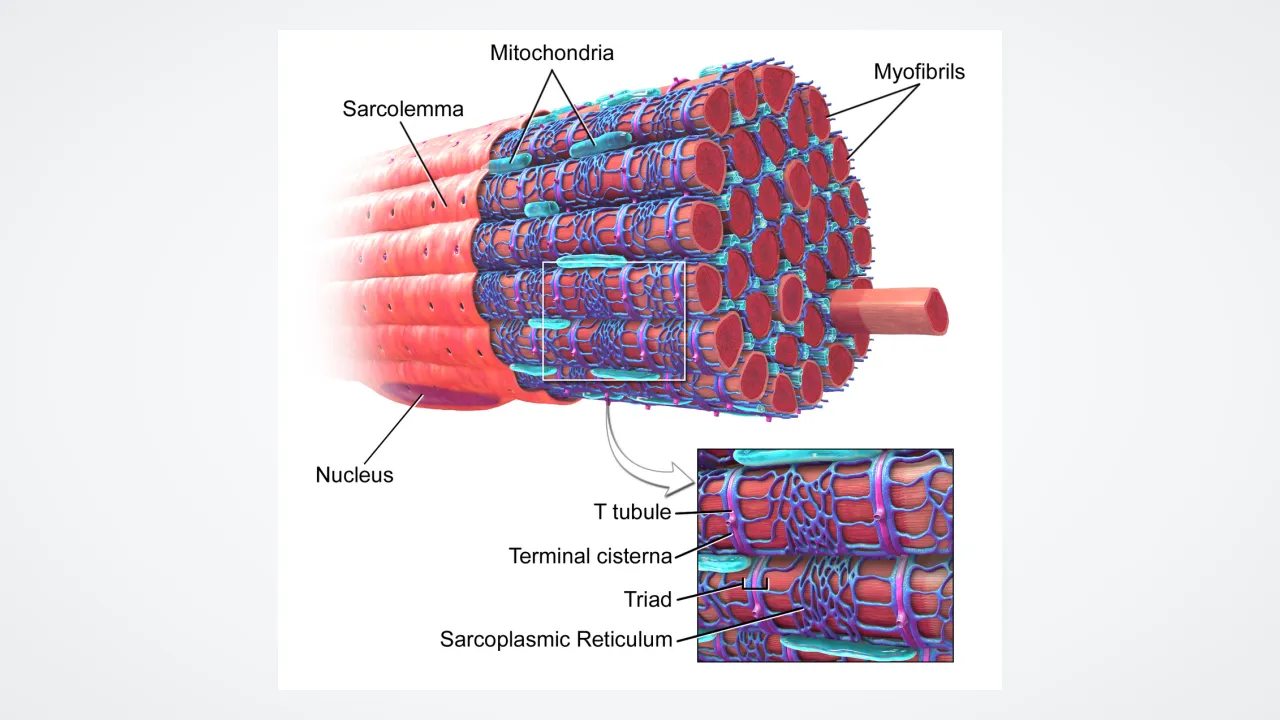
Accounting for roughly forty percent of human body mass across more than six hundred named organs, skeletal muscle represents a masterpiece of hierarchical bioengineering. Individual myofibers—multinucleated syncytia formed by fused developmental myoblasts—are bundled by endomysium, perimysium, and epimysium connective sheaths that merge seamlessly into force-transmitting tendons.
2
Excitation-Contraction Coupling
Every voluntary movement begins in the brain's primary motor cortex. Action potentials race down alpha motor neurons and trigger acetylcholine release across the neuromuscular junction. Electrical depolarization sweeps deep inside the muscle fiber via transverse T-tubules, prompting the sarcoplasmic reticulum to release calcium ions that bind troponin-tropomyosin complexes and expose binding sites along thin actin filaments.
3
The 1954 Sliding Filament Breakthrough
For centuries, scientists thought muscle proteins folded up like accordions. Then, in back-to-back 1954 Nature papers, Andrew Huxley with Rolf Niedergerke and Hugh Huxley with Jean Hanson independently unveiled the : neither thick myosin nor thin actin filaments shorten at all! Instead, ATP-driven myosin heads cycle cross-bridges to slide actin toward the center of each two-micrometer sarcomere, telescoping Z-discs closer together.
4
Metabolic Fiber Plasticity
Human skeletal muscles weave a mosaic of specialized fiber phenotypes tuned to diverse athletic demands. Type I slow-oxidative fibers gleam deep crimson with oxygen-binding , dense capillary networks, and abundant mitochondria that burn fatty acids aerobically for hours of posture control and marathon running. Conversely, Type IIa fast-oxidative-glycolytic and Type IIx fast-glycolytic fibers store rich glycogen reserves to generate rapid, high-force contractions for sprinting and jumping. Through regular physical training, quiescent stem cells called satellite cells fuse into stressed myofibers, adding fresh myonuclei that synthesize extra actin and myosin to drive muscular hypertrophy.
5
An Endocrine and Metabolic Powerhouse
Twenty-first-century physiology recognizes skeletal muscle as far more than a mechanical motor: it serves as the body's primary reservoir for post-meal blood glucose uptake and functions as a dynamic endocrine organ. Whenever contracting fibers work during active play or sport, they release hundreds of beneficial signaling peptides called —such as irisin and interleukin-6—directly into the bloodstream, promoting bone mineral density, anti-inflammatory immune balance, and even new neuron growth inside the brain's memory centers.