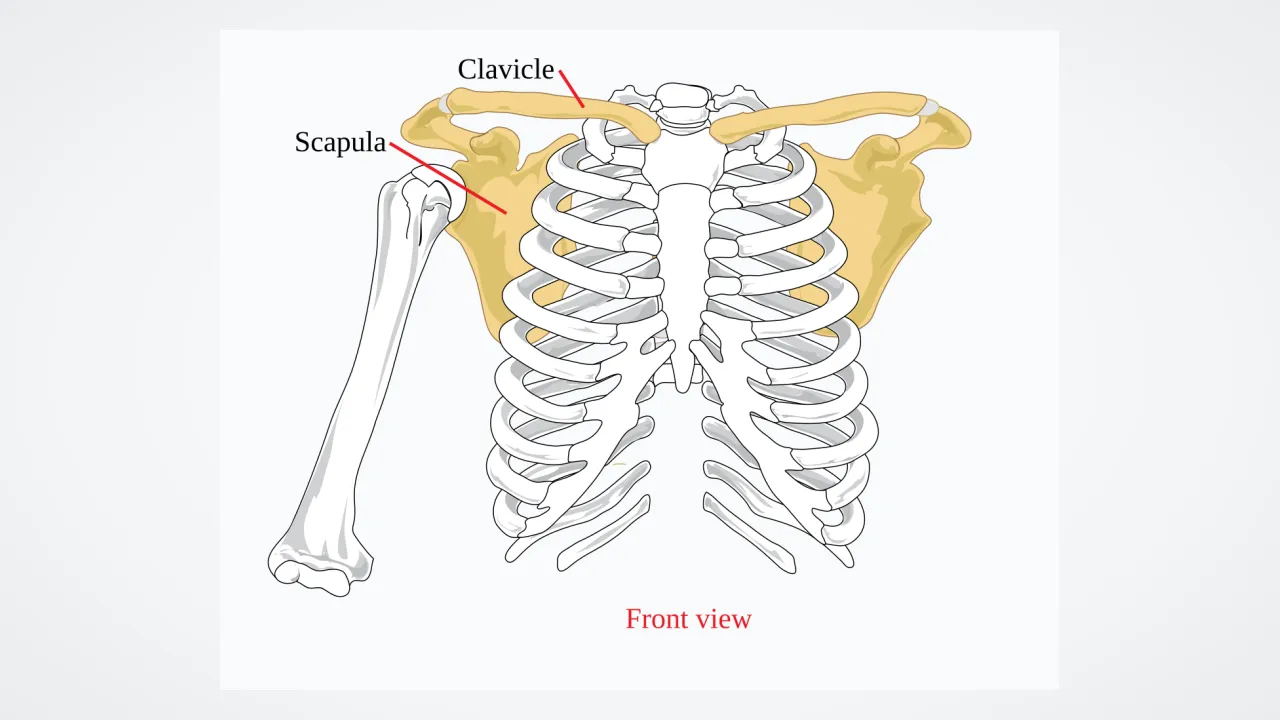
1. How do your shoulder blades move across the back of your rib cage when you wave overhead?
2. What tool did ancient people think the flat triangular scapula looked like?
🤯 Mind-Blowing Fact • Grade 2
Seventeen different muscles attach to each one of your shoulder blades—making thirty-four muscle connections across the pair!
✨ Word Sparks (Grade 2 Glossary)
Tap 🔊 to hear
Ridge
Raised bony ledge where strong muscles attach
Posture
How you hold your body standing or sitting
Shallow
Not very deep, like a small saucer
🪝
How can one flat triangle bone be paper-thin in the middle yet pull seventeen strong muscles at once?
1
Thin Center, Tough Edges!
Hold a museum shoulder blade up to a bright flashlight, and light shines right through its middle! Because muscles wrap deeply over both front and back faces, the flat center stays light and thin while the outer borders and raised are super thick and strong.
2
Seventeen Muscle Ropes
Count the muscles pulling on a single scapula and you reach seventeen! Some shrug your shoulders toward your ears, some pull them back for tall , and others spin your arm to pitch a baseball.
3
Golf Ball on a Tee
Its outer socket lets your arm swing in giant windmill circles—wider than any other joint in your body!
1. What happens if you shine a bright flashlight behind the thin center of a dry scapula bone?
2. How many different muscles attach to a SINGLE human scapula?
🤯 Mind-Blowing Fact • Grade 3
Four muscles growing off your shoulder blade form a snug muscular sleeve called the 'rotator cuff,' keeping your arm bone centered on its shallow saucer like a golf ball on a tee!
✨ Word Sparks (Grade 3 Glossary)
Tap 🔊 to hear
Acromion
High outer bony roof tip of shoulder
Glenoid
Shallow saucer socket on outer shoulder blade
Coracoid
Crow's-beak bony hook anchoring front arm muscles
🪝
Why does one bony hook on the front of your shoulder blade have a name that means 'like a crow's beak'?
1
Three Famous Bony Landmarks
Explore the bumps on a model scapula and discover three cool shapes! Running diagonally across the back is a high ledge called the spine of the scapula, ending at the flat outer roof of your shoulder—the —where your collarbone connects. Jutting forward under your collarbone curves a hooked finger of bone called the process, Greek for 'like a crow's beak,' anchoring chest and arm muscles!
2
The Glenoid Saucer
Unlike the deep 'vinegar cup' socket of your hip, the scapula's cavity is a shallow pear-shaped saucer—like a golf tee holding a much bigger golf ball! A soft cartilage rim called the labrum deepens the edge slightly without blocking freedom of motion.
3
The Rotator Cuff Hug
Because that saucer is so shallow, four special muscles growing right off the scapula—the rotator cuff—hug the arm's ball snug against the tee whenever you swim, climb, or throw!
4
Resting Over Ribs 2 Through 7
When your arms hang relaxed at your sides, each scapula rests neatly over ribs two through seven.
1. Why is the shoulder joint often compared to a golf ball resting on a golf tee?
2. What does 'coracoid' mean in Greek, describing the curved front hook of the scapula?
🤯 Mind-Blowing Fact • Grade 4
Out of the 180 degrees you lift your arm straight overhead, 120 degrees come from the ball-and-socket joint and a full 60 degrees come from your shoulder blade tilting upward!
✨ Word Sparks (Grade 4 Glossary)
Tap 🔊 to hear
Fossae
Shallow bone valleys housing thick muscle bellies
Serratus
Saw-toothed side rib muscle anchoring shoulder blade
Rhythm
Coordinated 2-to-1 movement of arm and scapula
🪝
Did you know that every time you raise your hand in class, your shoulder blade and upper arm dance in a precise 2-to-1 ratio?
1
Scapulohumeral Rhythm: The 2-to-1 Dance
Try raising your hand straight up to answer a question while a friend watches your upper back! You might assume all 180 degrees of motion happen inside the ball-and-socket joint, yet without your scapula gliding, your arm bone would bump into the bony acromion roof halfway up! Instead, physical therapists measure a smooth '2-to-1 scapulohumeral ': for every 2 degrees the humerus lifts in the socket, the scapula rotates 1 degree upward across the rib cage—contributing a full 60 degrees of your 180-degree reach!
2
Fossae Cradling the Rotator Cuff
Both faces of the triangular scapula are sculpted into shallow valleys called that house the four SITS rotator-cuff muscles: supraspinatus above the scapular spine, infraspinatus and teres minor below the spine on the back, and subscapularis filling the concave front face against the ribs.
3
Preventing 'Winged Scapula'
Saw-toothed muscles wrapping your side ribs—especially anterior, nicknamed the 'boxer's muscle'—hold the inner edge of your scapula flat against your rib cage whenever you push open a heavy door or do push-ups.
4
A 'False Joint' With Zero Ligaments
Anatomists call the sliding interface between subscapularis, anterior, and your back ribs the 'scapulothoracic articulation'—a remarkable bone-free muscular gliding plane cushioned by smooth bursae so every reach, throw, and climb feels effortless!
1. In the 2-to-1 'scapulohumeral rhythm' of raising your arm 180 degrees overhead, how many degrees come from the scapula rotating upward?
2. Which saw-toothed side muscle holds your shoulder blade flat against your ribs during push-ups?
🤯 Mind-Blowing Fact • Grade 5
Chimpanzees are far stronger than humans at pulling, yet a ten-year-old human can throw a baseball more than twice as fast as an adult chimp thanks to our sideways-facing scapular sockets!
How did shifting the scapula from the sides of the rib cage onto our flat upper back unlock the uniquely human superpower of high-speed overhand throwing?
1
Osteology of a Mobile Muscle Platform
Positioned posterolaterally across thoracic ribs 2 through 7, the scapula is a flat, triangular bone featuring three borders (superior, medial/vertebral, and thick lateral/axillary), three angles, and three projecting processes: the posterior spine culminating laterally in the flat acromion, and the anterior hook-like coracoid process. Remarkably, its translucent supraspinous and infraspinous plates consist almost entirely of thin cortical bone, whereas the lateral border forms a dense pillar resisting immense bending moments from seventeen attaching muscles!
2
Dynamic Centering of the Glenohumeral Joint
Because the pear-shaped glenoid fossa covers barely one-fourth to one-third of the spherical humeral head's surface area—even when deepened 50 percent by the fibrocartilaginous glenoid labrum—static ligaments alone cannot stabilize mid-range motion. Instead, the four rotator-cuff muscles (supraspinatus, infraspinatus, teres minor, and subscapularis) fire in millisecond feed-forward harmony, generating 'concavity-compression' that keeps the humeral head centered within 1 millimeter across the glenoid while the deltoid and pectoralis major generate power.
3
Force-Couple Kinetics and Scapulohumeral Rhythm
Full overhead elevation relies on a classic biomechanical force couple: the upper , lower trapezius, and serratus anterior pull on opposite corners of the scapula like hands turning a steering wheel! Together they rotate the glenoid cavity ~60 degrees upward (1:2 ratio with 120 degrees of glenohumeral ), maintaining optimal length-tension curves for the deltoid and preventing subacromial of the supraspinatus tendon.
4
Evolutionary Shift From Climbing to Throwing
In tree-climbing chimpanzees, cranially angled glenoid sockets and narrow chests favor overhead hanging. Roughly two million years ago in Homo erectus, the human scapula shifted dorsally onto a wider thorax with a laterally facing glenoid—allowing the torso, pectoralis major, and shoulder tendons to cock back like a catapult and hurl projectiles at over 90 miles per hour!
5
Sports Medicine and Posture
Strengthening scapular stabilizers balances desk-bound screen posture and safeguards overhead athletes—from swimmers and gymnasts to baseball pitchers.