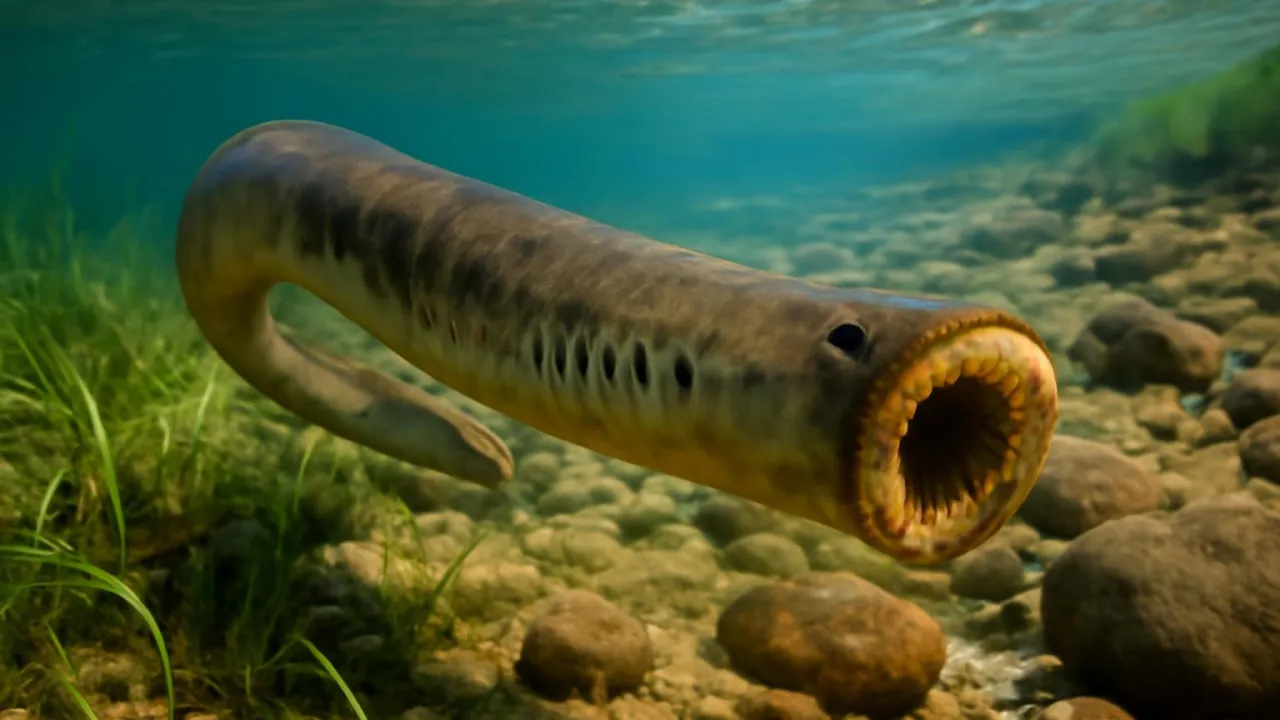
1. What does the sea lamprey use to stick to fish?
2. Where do sea lampreys live?
🤯 Mind-Blowing Fact • Grade 2
Sea lampreys can attach to fish using their suction-cup mouths and sharp teeth!
✨ Word Sparks (Grade 2 Glossary)
Tap 🔊 to hear
parasite
An animal that lives on another and takes food
spawn
To lay eggs in water to make baby fish
suction
A strong pull that sticks things tightly
🪝
Have you ever seen a fish that looks like a long, slim snake?
1
Appearance and Body
The sea lamprey has a long, slim body like a snake and no jaws. It has a round mouth filled with sharp teeth. Its skin is smooth and slimy, helping it swim fast. The eyes are small but help it see in dark water.
2
Where It Lives
Sea lampreys live in both saltwater oceans and freshwater rivers. They often travel far to in rivers. They hide under rocks and in mud during the day. They like cold water to stay healthy and strong.
3
How It Eats
This fish uses its mouth to latch onto other fish and drink their blood. It has sharp teeth to bite through skin. It is a because it feeds on other fish. This helps it survive but can harm the host fish.
2. What does the sea lamprey use to feed on other fish?
🤯 Mind-Blowing Fact • Grade 3
Sea lampreys use a suction mouth with teeth to feed on fish blood without jaws!
✨ Word Sparks (Grade 3 Glossary)
Tap 🔊 to hear
anadromous
Fish that live in ocean but spawn in rivers
parasite
An animal that feeds on another animal’s body
camouflage
Colors or shapes that help hide from predators
🪝
What makes the sea lamprey’s mouth so special for catching food?
1
Unique Body Features
The sea lamprey has no jaws but a round, suction-cup mouth with sharp teeth. Its long, slim body helps it swim quickly through water. It has smooth skin that helps it blend in and hide from predators. These features help it survive and catch prey.
2
Habitat and Life Cycle
Sea lampreys live in oceans and rivers, moving between them to spawn. They begin life as larvae buried in river mud, feeding on tiny particles. After several years, they change into adults and swim to the ocean. This life cycle helps them live in different places.
3
Feeding and Survival
Sea lampreys are that attach to fish using their suction mouths and teeth. They rasp through skin to drink blood and body fluids for nutrients. This feeding method helps them survive but can hurt the host fish. Their mouth is an important adaptation.
4
Ecological Role
Sea lampreys affect fish populations by feeding on them and sometimes harming fisheries. They are also food for bigger animals like birds and fish. Their presence changes how ecosystems work and shows how animals depend on each other. Humans study them to manage their impact.
Sea lampreys can latch onto fish with suction mouths and sharp teeth, affecting entire ecosystems!
✨ Word Sparks (Grade 4 Glossary)
Tap 🔊 to hear
anadromous
Fish that live in oceans but spawn in rivers
parasite
An animal that feeds on another animal’s body
symbiosis
Close living together of different species
🪝
How does the sea lamprey’s jawless mouth help it survive in oceans and rivers?
1
Physical Adaptations and Survival
The sea lamprey’s jawless, round mouth acts like a suction cup, allowing it to firmly attach to host fish and rasp through their skin with sharp teeth. This adaptation enables it to feed on blood and body fluids, which is essential for its survival. Its smooth, scaleless body helps it move swiftly through water and hide from predators. These physical traits are key to its parasitic lifestyle.
2
Life Cycle and Migration
Sea lampreys are fish that hatch in freshwater rivers and migrate to the ocean as adults. After spending years as larvae buried in river sediment, they transform and travel downstream to saltwater. This migration is crucial for reproduction and survival, showing cause and effect between habitat and life stages. Their ability to live in both fresh and saltwater habitats is a remarkable adaptation.
3
Ecosystem Roles and Impact
As , sea lampreys influence fish populations by feeding on them, sometimes causing declines in native species. This impact affects food webs and can disrupt commercial fisheries, leading to human management efforts. However, they also serve as prey for larger animals, contributing to biodiversity. Their presence highlights complex symbiotic relationships in aquatic ecosystems.
4
Geographic Distribution
Sea lampreys are found mainly in the North Atlantic Ocean’s coastal waters and connected freshwater rivers in Europe and North America. Their distribution depends on access to spawning rivers and suitable habitats. Human activities, such as dam building, can limit their migration and affect populations. Understanding their range helps in conservation and control efforts.
Sea lampreys have survived over 360 million years, revealing secrets of early vertebrate evolution!
✨ Word Sparks (Grade 5 Glossary)
Tap 🔊 to hear
Agnatha
A class of jawless fishes like lampreys
anticoagulant
A chemical that stops blood from clotting
invasive
An animal that harms new habitats it enters
🪝
What fascinating adaptations allow the sea lamprey to thrive as a jawless parasitic fish?
1
Taxonomy and Scientific Context
The sea lamprey, Petromyzon marinus, belongs to the class , which includes jawless fishes. Unlike bony fishes, lampreys lack jaws and paired fins but possess a cartilaginous skeleton. Their evolutionary lineage dates back over 360 million years, making them living fossils that provide insight into early vertebrate evolution. Understanding their taxonomy helps scientists study vertebrate origins.
2
Physiological Mechanics of Feeding
Sea lampreys use a specialized oral disc with keratinized teeth arranged in concentric circles to attach firmly to host fish. They secrete saliva to keep the host’s blood flowing while rasping through skin with a tongue-like structure. This feeding mechanism allows efficient extraction of nutrients but often weakens or kills the host. Their physiology is uniquely adapted for parasitism.
3
Conservation and Human Impact
While native in the North Atlantic, sea lampreys became in the Great Lakes, causing significant declines in native fish populations. Human efforts include barriers, chemical lampricides, and trapping to control their numbers. Conservation balances managing invasive populations and protecting native ecosystems. Their history highlights challenges in aquatic invasive species management.
4
Quantitative Comparisons and Habitat Range
Sea lampreys can grow up to 3 feet (90 cm) long and weigh about 2 pounds (0.9 kg). They inhabit cold coastal waters and migrate thousands of miles between spawning rivers and ocean feeding grounds. Their larvae live buried for up to seven years in sediment, filtering microscopic food. These quantitative traits reflect their complex life cycle and ecological adaptations.
5
Ecological Role and Evolutionary Significance
As parasites, sea lampreys regulate fish populations, influencing aquatic food webs and biodiversity. Their presence affects predator-prey dynamics and nutrient cycling in ecosystems. Evolutionarily, they represent a primitive vertebrate form, helping scientists understand vertebrate development and adaptation. Studying sea lampreys enriches knowledge of ecology and evolutionary biology.