🧬 HUMAN BODY
🧬 Hemostasis, Fibrin Clotting & Epidermal Regeneration • Integumentary System
VA Science & Health SOL 1.1, 3.1, 4.2, 5.1 (Cells, Organs & Body Systems)
Scabs & Wound Healing
Nature's Built-In Bandage and Skin Repair Crew
Grade 5 • Advanced • 264 words
🩺 Body System & LocationSkin & Circulatory System • Active across epidermis, dermis, and surface capillaries
🔬 Size / Cell CountPlatelets: 2–3 micrometers wide • 150,000–450,000 platelets in every tiny drop of blood
⚙️ Core JobWeaves a protective protein patch over scrapes while building brand-new skin underneath
⚡ Body SuperpowerSpinning microscopic protein threads into a natural waterproof shield within minutes
🤯 Mind-Blowing Fact • Grade 1
One tiny drop of blood holds hundreds of thousands of little platelets ready to patch a scrape in seconds!
✨ Word Sparks (Grade 1 Glossary)
Tap 🔊 to hear
Platelet
Tiny blood helper that plugs small scrapes
Scab
Dry protective crust over healing new skin
Shield
Protective cover keeping dirt and germs out
🪝
How does your knee build its very own cozy bandage right after a playground scrape?
1
Tiny Patch Helpers
Oops—you tripped on the sidewalk and got a little scrape! Right away, tiny cell bits called zoom to the spot and hold hands.
2
Weaving a Natural Shield
Sticky threads wrap across the like a microscopic spiderweb. As that patch dries on top, it forms a sturdy crust called a !
3
Brand-New Skin Below
Never pick a ! Underneath that safe little roof, busy skin cells build smooth, fresh skin until the scab falls off by itself.
1. Which tiny helpers zoom in first to plug a little playground scrape?
2. Why is it super smart to leave a scab alone instead of picking it?
🤯 Mind-Blowing Fact • Grade 2
Your outer skin layer replaces itself completely about once a month even when you don't have a single scrape!
✨ Word Sparks (Grade 2 Glossary)
Tap 🔊 to hear
Fibrin
Strong protein threads weaving a protective patch
Clot
Soft gel mesh sealing a tiny vessel
Epidermis
Outer layer of skin protecting your body
🪝
What secret construction project happens underneath a scab while you play, sleep, and go to school?
1
First Responders on the Scene
Whenever a bicycle tumble leaves a small scrape on your elbow, your body starts a four-star repair mission! Tiny blood vessels pinch narrower, and disk-shaped platelets rush over to stick together into a soft plug.
2
Spinning Fibrin Nets
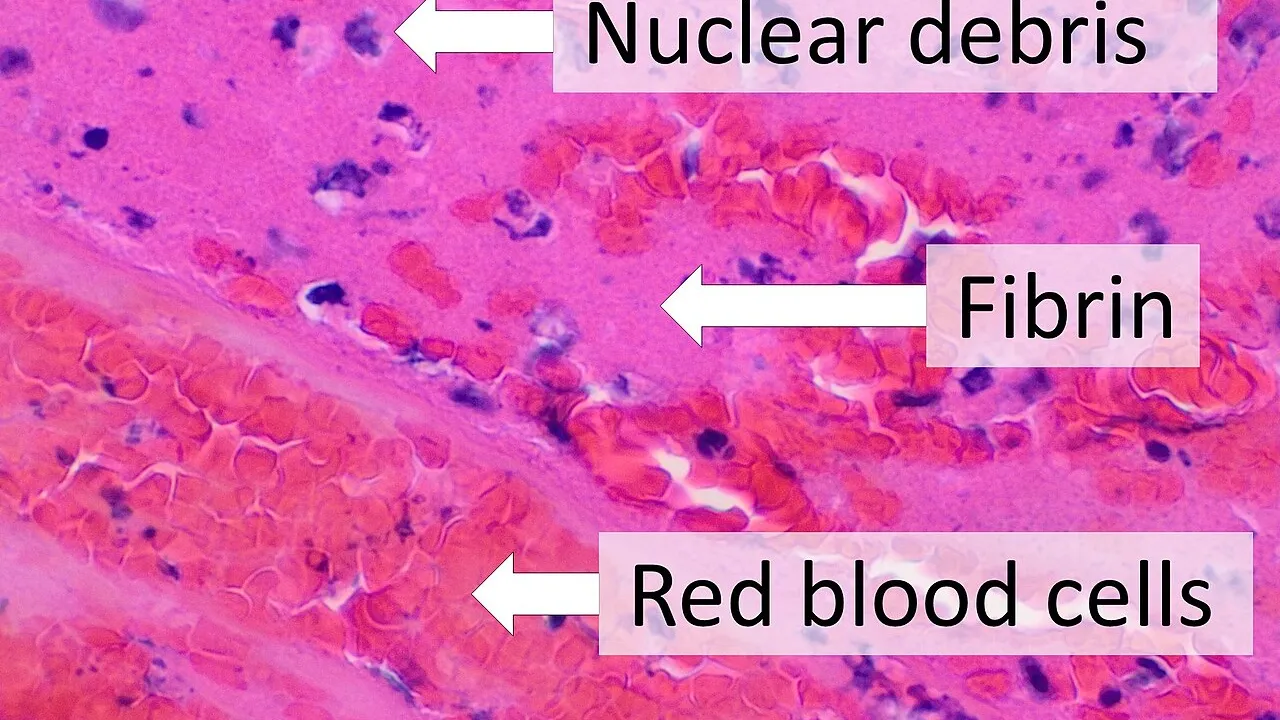
Next, special blood proteins link up into strong crisscross threads called . Fibrin weaves tightly over the platelets like a safety net, drying on the outside into a protective scab that blocks dirt and germs.
3
Rebuilding Smooth Skin
Beneath that shield, white blood cells tidy the area while builder cells lay down stretchy fibers and fresh pink skin. Once the new layer is ready, the old scab pops right off!
1. What are the strong, web-like protein threads that hold a healing patch together called?
2. Which cells clean up stray dust or microbes underneath a new scab?
🤯 Mind-Blowing Fact • Grade 3
Platelets are not even full cells—they are tiny pinched-off fragments from giant bone-marrow cells called megakaryocytes!
✨ Word Sparks (Grade 3 Glossary)
Tap 🔊 to hear
Collagen
Strong stretchy protein giving skin its firmness
Fibroblast
Builder cell weaving fresh collagen repair fibers
Megakaryocyte
Giant bone-marrow cell making thousands of platelets
🪝
Why does a healing scrape sometimes feel slightly warm and tickly a few days before the scab falls off?
1
Stage One: Instant Sealing
Imagine an emergency road crew fixing a pothole in minutes! Right after a skin scrape, tiny platelets touch exposed fibers along the vessel wall. Instantly, those smooth platelets sprout spiky arms so they can grip one another, while a chain reaction spins dissolved fibrinogen into tough fibrin mesh.
2
Stage Two: The Cleanup Crew
Once the fibrin patch dries into a protective scab on the surface, nearby blood vessels widen slightly to deliver extra oxygen, nutrients, and macrophages. That extra delivery explains why healing skin feels gently warm!
3
Stage Three: Fibroblast Builders
Next arrive master builder cells called . They weave fresh scaffolding across the gap while outer epidermal cells march inward from the edges like tiles sliding across a floor.
4
Why Healing Skin Tickles
As new skin stretches into place and tiny nerve endings reconnect under the drying scab, they send mild tickly signals to your brain—a sign that repair is nearly finished!
1. What makes smooth floating platelets suddenly sprout sticky arms at a scrape?
2. Which builder cells weave fresh collagen scaffolding underneath a scab?
🤯 Mind-Blowing Fact • Grade 4
A single giant megakaryocyte in your bone marrow can pinch off two thousand to three thousand fresh platelets before retiring!
✨ Word Sparks (Grade 4 Glossary)
Tap 🔊 to hear
Hemostasis
Rapid process sealing leaks in blood vessels
Thrombin
Enzyme turning liquid fibrinogen into fibrin threads
Angiogenesis
Sprouting of brand-new tiny blood vessels
🪝
How do thirteen numbered clotting proteins work like falling dominoes so blood patches scrapes outside vessels without clogging inside them?
1
Hemostasis and the Domino Cascade
Keeping blood flowing smoothly inside sixty thousand miles of vessels—yet solidifying within minutes at a scrape—requires remarkable precision called . First, smooth muscles narrow the nicked capillary. Second, platelets adhere via von Willebrand factor and release chemical flares. Third, more than a dozen numbered plasma proteins—known as clotting factors—activate one another like falling dominoes until an enzyme called snips soluble fibrinogen into insoluble fibrin strands.
2
Inflammation and Growth Signals
Once cross-linked fibrin and trapped cells dry at the air interface to form a protective scab, platelets release platelet-derived growth factor. Neutrophils and macrophages clear stray bacteria and cellular debris, then transition into repair directors that summon neighboring tissue builders.
3
Proliferation and Angiogenesis
During the proliferative phase, tiny new capillary loops sprout into the repair zone—a process called —bringing fresh oxygen. Fibroblasts deposit soft Type III collagen, while basal keratinocytes along the wound rim loosen their anchors and migrate beneath the scab until opposing edges meet.
4
Remodeling for Lasting Strength
Once keratinocytes touch across the middle, contact inhibition tells them to stop marching sideways and stack upward into layered epidermis. Soon the protective scab detaches naturally on its own, and over the following weeks remodeling enzymes weave temporary fibers into tougher Type I collagen bundles.
1. Why does clotting use a multi-step domino cascade of numbered proteins instead of staying switched on everywhere?
2. What tells migrating skin keratinocytes to stop crawling sideways underneath a scab?
🤯 Mind-Blowing Fact • Grade 5
In 1962, biologist George Winter discovered that clean, gently hydrated bandages let skin cells glide into place up to twice as fast as drying out completely!
✨ Word Sparks (Grade 5 Glossary)
Tap 🔊 to hear
Fibrinogen
Dissolved blood protein converted into solid fibrin
Why did doctors once think airing out a scrape was best—until a 1962 discovery revealed how skin cells actually race across healing wounds?
1
Four Overlapping Phases of Tissue Repair
Cutaneous wound healing is one of human biology's most choreographed symphonies, progressing through four overlapping stages: hemostasis, inflammation, proliferation, and remodeling. Within seconds of an epidermal breach, subendothelial collagen triggers primary hemostasis as two-micrometer anucleate platelets—shed from bone-marrow megakaryocytes—bind via glycoprotein receptors and aggregate into a reversible plug.
2
The Coagulation Cascade and Vitamin K
Secondary hemostasis reinforces that plug through intrinsic and extrinsic enzymatic pathways that converge on Factor X. Activated Factor X generates thrombin, which cleaves soluble plasma into fibrin monomers while Factor XIII cross-links those strands into a resilient polymer lattice. Several hepatic clotting factors require Vitamin K to bind calcium ions properly, linking everyday leafy-green nutrition directly to wound sealing!
3
Granulation Tissue and Myofibroblast Contraction
Beneath the desiccated fibrin-and-cell eschar—familiar to everyone as a scab—macrophages shift from antimicrobial defense to secreting vascular endothelial growth factor (VEGF) and transforming growth factor-beta. Sprouting capillaries and fibroblasts construct pink, nutrient-rich , while specialized myofibroblasts use actin-myosin cables to gently draw wound margins closer together.
4
George Winter's Moisture Breakthrough
For centuries, people assumed drying a scrape in open air sped recovery. In 1962, British biologist George D. Winter proved that epidermal cannot burrow through dry crust; under a dry scab they must expend energy tunneling underneath through deeper moist dermis, whereas clean, lightly hydrated dressings let keratinocytes glide across the surface up to twice as fast!
5
Maturation and Matrix Remodeling
Even after the scab sheds and fresh stratified epithelium looks completely smooth from outside, matrix metalloproteinases spend months replacing disorganized Type III collagen with tightly cross-linked Type I collagen aligned along natural skin tension lines, gradually restoring roughly eighty percent of the dermis's original tensile strength and elasticity.