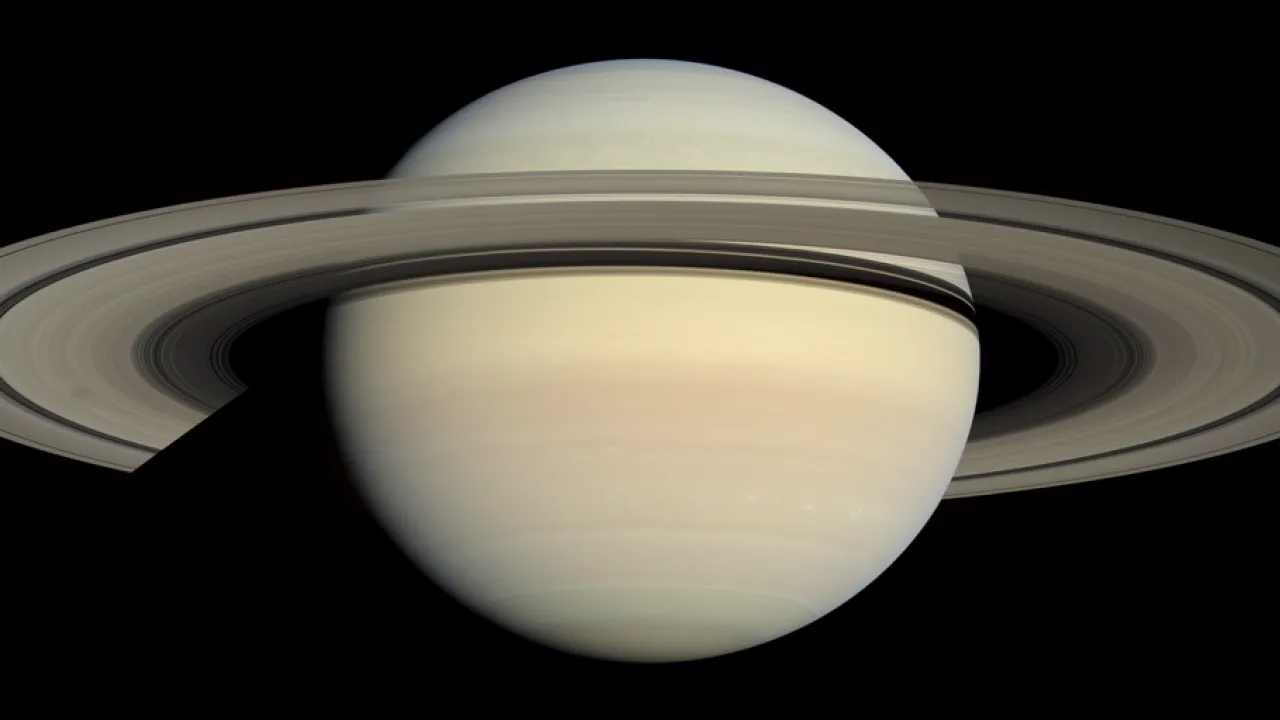
Winds near Saturn's equator roar at 1,100 miles per hour—more than four times faster than Earth's strongest tornadoes!
✨ Word Sparks (Grade 2 Glossary)
Tap 🔊 to hear
Equator
An imaginary line wrapping around a planet's widest middle.
Shepherd moon
A small moon whose gravity keeps ring edges tidy.
Boulder
A very large chunk of rock or frozen ice.
🪝
How can rings wider than twenty Earths be thinner than a three-story building?
1
A Spinning Golden Giant
Peer into the night sky and imagine a golden world spinning so fast that a full day lasts just ten and a half hours! That speedy spin squishes Saturn's poles flat and bulges its middle.
2
Billions of Icy Snowballs
Saturn's famous rings stretch 175,000 miles from side to side, yet in many places they are only 30 feet thick! Some ring pieces are tiny dust specks, while others are icy as big as houses.
3
King of the Moon Crowd
More than 140 moons orbit around Saturn! Tiny even cruise near the rings and keep their edges neat and sharp.
1. About how long is one single day on fast-spinning Saturn?
2. What job do Saturn's 'shepherd moons' perform?
🤯 Mind-Blowing Fact • Grade 3
Saturn's north polar Hexagon is a six-sided jet stream storm so huge that two whole Earths could sit side by side inside it!
✨ Word Sparks (Grade 3 Glossary)
Tap 🔊 to hear
Atmosphere
The thick blanket of gases surrounding a planet.
Hexagon
A geometric shape with six straight sides and corners.
Jet stream
A fast-flowing river of wind high in the sky.
🪝
Why is there a giant six-sided storm spinning right at Saturn's north pole?
1
A World of Hydrogen and Helium
Nearly 900 million miles from the Sun, Saturn takes almost thirty Earth years to finish a single solar trip! Like Jupiter, Saturn is built mostly of lightweight hydrogen and helium gases. Pale yellow ammonia crystals paint soft butterscotch bands across its chilly upper .
2
Inside the Ring Highways
Astronomers label Saturn's seven main ring groups with letters A through G in the order they were discovered. Between the bright A and B rings yawns the Cassini Division, a 3,000-mile-wide gap cleared out by the gravitational tug of the moon Mimas.
3
The Mysterious Polar Hexagon
High at Saturn's north pole whirls one of space's strangest weather wonders: a six-sided called the ! Each straight side stretches wider than Earth's diameter, framing a central hurricane.
4
Cassini's Grand Finale
NASA's Cassini spacecraft orbited Saturn for thirteen thrilling years, discovering icy geysers, new moons, and 'ring rain' slowly drizzling from the rings down into Saturn's clouds.
1. What unusual geometric shape forms the giant wind pattern at Saturn's north pole?
2. How long does Saturn take to orbit the Sun once?
🤯 Mind-Blowing Fact • Grade 4
Thousands of pounds of icy 'ring rain' fall into Saturn's atmosphere every single second—enough to fill an Olympic swimming pool every half hour!
✨ Word Sparks (Grade 4 Glossary)
Tap 🔊 to hear
Roche limit
Distance where planet gravity tears an approaching moon apart.
Metallic hydrogen
Compressed deep hydrogen that conducts electricity like liquid metal.
Condense
To turn from gas or vapor into liquid droplets.
🪝
Where did Saturn's dazzling rings come from, and why might they vanish one day?
1
Crushed Inside the Roche Limit
Why didn't Saturn's billions of icy ring chunks clump together into a single moon? They orbit inside Saturn's —the danger zone where the giant planet's tidal gravity pulls harder on an icy body than the body's own gravity can hold it together. Scientists discovered via Cassini data that the rings may be surprisingly young, forged just 100 to 400 million years ago when a stray comet or icy moon wandered too close and shattered!
2
Diving Deep Into Metallic Hydrogen
Plunging beneath Saturn's golden ammonia cloud decks, pressure skyrockets until hydrogen gas squeezes into a hot liquid ocean. Deeper still, electrons break free from atoms to create liquid , generating Saturn's remarkably symmetrical magnetic field around a fuzzy core of rock, ice, and heavy elements.
3
Helium Rain and Internal Heat
Saturn radiates more than twice as much heat energy into space as it absorbs from the distant Sun! Inside its deep interior, liquid helium into droplets like mist and sinks downward through liquid hydrogen, releasing frictional heat as it falls.
4
Losing Its Crown to Ring Rain
Micrometeoroids and sunlight electrically charge tiny water-ice grains in the rings, sending thousands of pounds of water streaming along magnetic field lines into Saturn every second. At this rate, Saturn's iconic rings could fade away in roughly 100 to 300 million years!
1. Why does Saturn give off more than twice the heat it receives from the Sun?
2. What happens inside a planet's Roche limit?
🤯 Mind-Blowing Fact • Grade 5
Ripples in Saturn's C ring act like a giant seismograph, revealing that Saturn's sloshing 'fuzzy' core stretches across 60 percent of the planet's width!
✨ Word Sparks (Grade 5 Glossary)
Tap 🔊 to hear
Kronoseismology
Studying Saturn's deep interior using ripples in its rings.
Centrifugal
Outward pull felt on a rapidly spinning giant planet.
Rossby wave
A giant meandering wave in planetary jet-stream winds.
🪝
How do seismic ripples in Saturn's rings work like a cosmic seismometer to reveal the planet's fuzzy core?
1
From Galileo's 'Ears' to Huygens's Ring
When Galileo Galilei first viewed Saturn through a low-power telescope in 1610, its rings looked like two mysterious companion lobes—or 'ears'—flanking the disk. Not until 1655 did Dutch physicist Christiaan Huygens deduce that a thin, flat ring encircled the globe without touching it. Today we know Saturn spans 120,536 kilometers at its equator—flattened nearly ten percent at its poles by force—with a mean bulk density of just 0.687 grams per cubic centimeter.
2
Kronoseismology: Reading Ring Ripples
During its 2017 'Grand Finale' orbits between Saturn's cloud tops and innermost D ring, NASA's Cassini spacecraft unlocked a revolutionary technique called . Internal oscillations deep inside Saturn tug rhythmically on nearby C-ring particles, carving spiral density waves. Measuring those waves revealed that Saturn lacks a sharp rocky core boundary; instead, a diffuse 'fuzzy' core of rock, ice, and metallic fluid extends across sixty percent of the planet's radius!
3
Resonance Sculpting and Propeller Moonlets
Comprising over 99 percent pure crystalline water ice, Saturn's main rings weigh roughly forty percent as much as the moon Mimas. Orbital resonances with external moons sculpt crisp spiral waves and divisions—such as Mimas's 2:1 resonance clearing the 4,800-kilometer Cassini Division, while tiny moons Pan and Daphnis carve narrow Encke and Keeler gaps ruffled by towering vertical edge waves.
4
Super-Storms and Rossby Wave Geometry
Every Saturnian year (29.45 Earth years), seasonal sunlight triggers colossal convective 'Great White Spots' that wrap lightning-laced ammonia plumes clear around the temperate latitudes. Meanwhile, at 78 degrees north latitude, steep wind-shear gradients sustain the 30,000-kilometer polar Hexagon—a standing planetary circling a central eyewall hurricane.
5
Shepherding Over 146 Moons
Hosting more confirmed natural satellites than any other planet—over 146 worlds ranging from haze-shrouded Titan and geyser-spouting Enceladus to captured irregular moonlets—Saturn functions as an entire miniature solar system showcasing disk physics in real time.