🏢 WorkplaceMaterials recovery facilities, compost yards, public works hubs, and design labs
⚡ Everyday Impact SparkKeeps entire cities sparkling clean and healthy while rescuing paper, metal, glass, and food scraps for new life
🤯 Mind-Blowing Fact • Grade 1
Recycling just one aluminum soda can saves enough electricity to run a television or computer for three hours!
✨ Word Sparks (Grade 1 Glossary)
Tap 🔊 to hear
recycle
turning old used materials into brand-new items
compost
rotted food scraps and leaves that feed soil
sanitation
keeping towns clean to protect everyone's health
🪝
What happens after the big recycling truck lifts your blue bin?
1
Up Goes the Blue Bin!
Whir, clank, whoosh! A strong robot arm on a clean truck lifts your bin and tips it inside. Keeping streets neat and healthy is the job of a and recycling engineer!
2
Sorting Cans and Paper
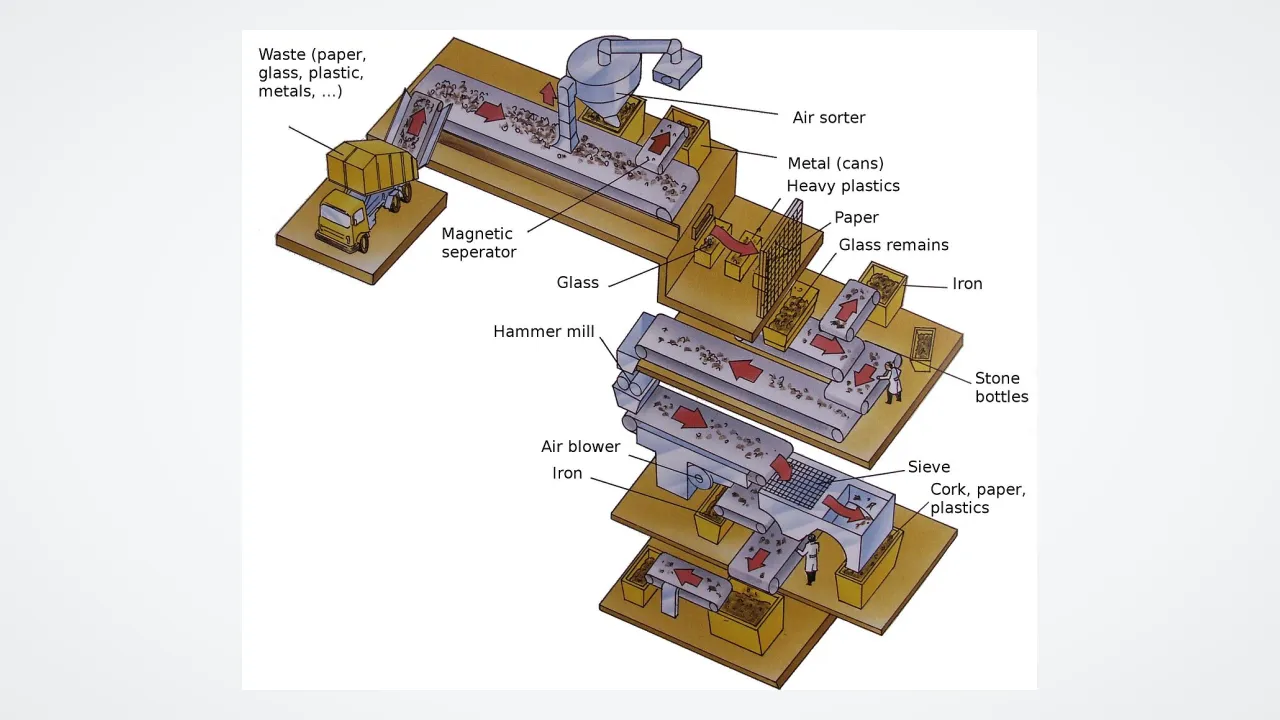
At a giant sorting center, magnets grab steel soup cans. Air puffs blow light plastic bottles into another chute!
3
Making New Things
Old cans melt into shiny new bikes, and banana peels turn into rich garden soil!
1. How do sorting machines quickly pull steel soup cans out of mixed recycling?
2. What can old banana peels and dry leaves turn into when composted?
🤯 Mind-Blowing Fact • Grade 2
Aluminum cans can be melted and recycled over and over forever without ever losing their strength—and can return to store shelves in just 60 days!
✨ Word Sparks (Grade 2 Glossary)
Tap 🔊 to hear
landfill
a carefully lined site built to hold trash safely
chute
a sloped slide guiding sorted items into bins
bale
a giant cube of tightly squished paper or cans
🪝
How can a giant machine sort 500 jumbled cans, bottles, and cardboard boxes every single minute?
1
Inside the Super Sorting Plant
Imagine dumping a giant mountain of cardboard, juice jugs, and tin cans onto a speeding conveyor belt! Designing clever machines to unscramble that jumble is what a sanitation and recycling engineer does every day.
2
Spinning Disks and Light Beams
First, spinning rubber stars bounce flat cardboard up to the top while heavier bottles drop underneath. Next, magnets snatch steel cans, and special camera beams spot clear plastic jugs and blast them into bins with tiny puffs of air!
3
Protecting Clean Air and Soil
For leftover trash that cannot be recycled yet, engineers design thick protective liners underground so rainwater and soil stay clean and safe.
1. Why do engineers put thick protective liners underneath modern landfills?
2. How fast can a recycled aluminum can come back to the store as a brand-new can?
🤯 Mind-Blowing Fact • Grade 3
Modern recycling plants use robotic arms guided by artificial-intelligence cameras that can pick 80 plastic cartons per minute—twice as fast as human hands!
✨ Word Sparks (Grade 3 Glossary)
Tap 🔊 to hear
MRF
a plant that sorts mixed recyclables into bales
eddy current
a spinning magnetic field that pushes aluminum cans
contamination
wrong trash mixed in that spoils clean recycling
🪝
Wait—magnets don't stick to aluminum cans, so how do engineers make aluminum cans jump off a belt like magic?
1
The Flying Aluminum Trick
Hold a kitchen magnet against an aluminum soda can and nothing happens! Yet inside a Materials Recovery Facility (), aluminum cans literally leap through the air over a splitter wall! That clever physics trick was built by a sanitation and recycling engineer.
2
Eddy Currents and Infrared Eyes
Spinning magnets inside a roller create invisible "" that push non-magnetic aluminum away like a spring! Nearby, infrared light sensors read the exact chemical fingerprint of different plastics in milliseconds, sorting milk jugs from detergent bottles.
3
Stopping "Wish-Cycling"
Engineers also educate communities not to toss garden hoses or greasy pizza boxes into blue bins—because tangled hoses jam spinning gears and spoil clean paper bales.
4
Public Health Champions
Historically, organized sanitation systems saved millions of lives by preventing disease outbreaks across growing cities.
1. Why shouldn't tangled garden hoses or holiday string lights go into curbside recycling bins?
2. What pushes non-magnetic aluminum cans off the end of a sorting belt?
🤯 Mind-Blowing Fact • Grade 4
In the 1890s, Colonel George E. Waring Jr. transformed filthy New York City streets by organizing uniformed sanitation crews called the "White Wings"—dramatically cutting childhood illness across whole neighborhoods!
✨ Word Sparks (Grade 4 Glossary)
Tap 🔊 to hear
leachate
liquid that seeps through waste and needs treatment
methane
a fuel gas made when microbes break down waste
watershed
land area draining rainwater into shared rivers
🪝
How can yesterday's apple cores and buried trash actually generate clean electricity to power thousands of homes?
1
Harvesting Energy From Waste
Deep beneath a grassy hill that used to be a city landfill, networks of perforated pipes quietly capture invisible gas produced by microscopic bacteria digesting old organic waste. Instead of letting that potent greenhouse gas escape into the atmosphere, a sanitation and recycling engineer routes it into turbines or fuel lines—powering garbage trucks and lighting neighborhood homes!
2
Engineering the Sanitary Landfill
Modern solid-waste sites are nothing like open dumps of the past. Engineers layer compacted clay with thick high-density polyethylene geomembranes, gravel drainage blankets, and collection pipes that pump any rainwater seeping through trash directly to wastewater treatment plants, safeguarding local like the Chesapeake Bay.
3
Industrial Composting and Anaerobic Digestion
Because food scraps and yard trimmings make up nearly a third of household waste, cities increasingly partner with engineers to build industrial composting windrows and sealed anaerobic digesters. Inside oxygen-free tanks, microbes convert cafeteria peels into clean biogas and nutrient-rich farm fertilizer.
4
The Waste Hierarchy: Reduce First!
Engineers design municipal systems around a clear priority pyramid: Reduce waste first, Reuse durable items second, Recycle and Compost third, and safely entomb or recover energy from the tiny remainder.
1. What comes at the very top of the waste-management hierarchy?
2. How do engineers turn buried organic waste into clean community energy?
🤯 Mind-Blowing Fact • Grade 5
Every gold, silver, and bronze medal awarded at the Tokyo Olympic Games was smelted 100 percent from precious metals recovered by recycling engineers from 6.2 million donated old cell phones and electronics!
✨ Word Sparks (Grade 5 Glossary)
Tap 🔊 to hear
near-infrared
invisible light waves used to identify plastic types
urban mining
recovering valuable metals like gold from old electronics
non-ferrous
metals like aluminum or copper containing no iron
🪝
How do near-infrared spectroscopy, urban e-waste mining, and civil engineering converge to build a zero-waste city?
1
Public Health's Unsung Foundation
Ask medical historians which breakthrough added the most years to human life expectancy since 1850, and right alongside vaccines and clean drinking water stands municipal sanitation. Today, Americans generate roughly 290 million tons of municipal solid waste annually—about 4.9 pounds per person every day! Transforming that linear river of discards into a safe, circular resource loop is the scientific mission of the sanitation and recycling engineer.
2
Hyperspectral Optics and Automated MRF Physics
Inside a state-of-the-art Materials Recovery Facility processing 50 tons per hour, engineers choreograph pure physics. Ballistic separators sort two-dimensional paper fibers from three-dimensional containers; rare-earth neodymium rotors induce Lorentz-force eddy currents to eject aluminum; and (NIR) hyperspectral scanners identify polymer bonds—distinguishing polyethylene terephthalate (PET #1) from high-density polyethylene (HDPE #2)—triggering microsecond pneumatic air jets.
3
Urban Mining for Critical Minerals
Discarded smartphones, laptops, and electric-vehicle batteries represent one of Earth's richest mineral veins! One metric ton of recycled circuit boards contains 40 to 800 times more gold—plus vital copper, cobalt, and lithium—than a ton of raw mined rock ore. Recycling engineers design hydrometallurgical recovery lines that reclaim these strategic metals safely without toxic fumes.
4
Geotechnical Containment and Bioreactor Design
Where residual disposal remains necessary, geotechnical and environmental engineers model groundwater hydrology, composite clay-and-HDPE barrier liners, gas-extraction wells, and post-closure capping systems that eventually convert retired landfills into solar farms and public wildlife parks.
5
Designing Out Waste Before It Starts
Partnering with packaging chemists and city policymakers, sanitation and recycling engineers champion Extended Producer Responsibility—proving that in nature and smart cities alike, nothing is truly "away."